

If your trip includes the Sahara, you'll be on a tour, planned or not: foreigners in the south are expected to travel with an approved Algerian agency, and only trips booked that way qualify for the southern visa on arrival. That's why most visitors see Algeria on some form of organized trip. The north you can do independently, though a guide makes the Casbah of Algiers, Timgad and Constantine much easier to understand.
Below: the three tour formats, the regions most tours visit, then safety, money and timing.
If you want an active trip, the options are real. There are multi-day walks on the Tassili n'Ajjer plateau above Djanet, sunrise on the Assekrem plateau in the Hoggar at about 2,726 m, and hikes in the Djurdjura range of Kabylie, whose highest point, Lalla Khedidja, reaches 2,308 m.
WildyNess is a local operator, so the advice below follows how we plan our own trips. Where there's a downside (cash only, slow trains, long transfers in the south), we say so.
Three ways to tour Algeria
The right format depends more on where you're going than on taste. For the south, you need an agency anyway. For the north, it comes down to budget, how much French or Arabic you speak, and how much you mind booking trains and hotels yourself.
Solo travelers can hire a guide for a day or two instead of booking a full tour. That works well in the Casbah of Algiers, where the UK Foreign Office (FCDO) itself recommends going with a good local guide. What you can book with us is listed under Algeria experiences.
If you'd rather fix the route first and choose the tour format afterwards, our day-by-day plan in 10-Day Algeria Itinerary: Full Route Plan shows how much fits into ten days.
Private tours
A private tour gives you your own guide, driver and vehicle, and you set the route and the pace. It costs more per person than a group trip, especially for one or two people, but it's the easiest way to combine, say, Algiers, Constantine and a week in the Sahara on your own dates.
If you need an English-speaking guide, ask for one when you book. French is widely used in Algeria and English much less, so don't count on finding an English speaker once you arrive.

A guide earns the fee at sites with little signage. At Timgad, the ruins make more sense once someone points out the forum, the theater and the Arch of Trajan. The Casbah is the other case: plenty of its houses are crumbling, and it takes local knowledge to know which lanes are open and safe to walk.
Small group tours
Small group tours share the cost of the guide, the 4x4s and the camp crew, which makes them the cheaper way to see the deep south. The trade-off is a fixed date, a fixed route and other people's pace.
Group tours in the south also handle the paperwork: the Sahara visa on arrival has to be requested by an approved agency before you fly. If you are organizing one yourself, group trips in Algeria come with their own visa and camping logistics, which we break down separately.
Before booking, ask the maximum group size, whether nights are in camps or guesthouses, and which language the guide speaks.
Activity-based trips
Expert-planned trips are built around one activity, such as trekking, photography, sea kayaking or a yoga week. The route is chosen for that activity, and so is the guide.
On the water, the best-known area is the Jijel coast in the north-east, where sea kayaking runs along the cliffs and coves of the corniche, mostly in the warmer months.

In the Sahara, the equivalent is a 4x4 day across the dunes or out to the dry salt lakes (chotts) of the northern desert. Activities like these also work well for companies, and kayaking on the Jijel coast or a Sahara 4x4 day are among the ideas we suggest for team building trips in Algeria.
Yoga and wellness trips are a small niche in Algeria, so ask how the days are split between practice and sightseeing before you book. For a desert version, our Algeria yoga retreat guide looks at options from Timimoun guesthouses to bivouac camps.
Which tour fits your time
| Trip | Length | Main stops | Best for |
|---|---|---|---|
| North classic | About 7 days | Algiers, Tipaza, Constantine, Djemila, Timgad | First visits, Roman sites and cities; spring or autumn |
| Djanet and the Tassili | 7 to 8 days with flights | Djanet, the Tassili plateau, Erg Admer, the Tadrart | Walkers and rock art; October to April |
| Hoggar | 7 to 8 days with flights | Tamanrasset, the Atakor, Assekrem | Mountain landscapes and sunrise at 2,726 m; October to April |
| West | 7 to 10 days | Oran, Tlemcen, Taghit, Timimoun | Islamic monuments, dunes and red ksour |
| North and Sahara combined | 10 to 14 days | Algiers, the east, then a flight to Djanet | A first long trip that covers both sides of the country |
The short version: the north you can see on your own, but in the Sahara foreigners travel with an approved agency, which also requests the visa on arrival (fee commonly about EUR 110, paid on landing); otherwise it's a consulate visa, GBP 85 in London (2026) with about 10 working days' processing. Allow about a week for one region, or 10 to 14 days for the north plus the Sahara with a domestic flight in between.
Go south between October and April (November to March if you're walking), and north from April to June or in September and October. Every guide speaks French and Arabic, you should ask for an English-speaking guide when you book, and on the ground you'll pay cash in dinars almost everywhere.
Top tours and experiences
Sahara Desert adventures: where tours go
The Algerian Sahara covers over four-fifths of the country, and most tours head for the far south-east: Djanet, the Tassili n'Ajjer plateau and the Hoggar around Tamanrasset. Distances are huge, so you fly from Algiers. Flights to the southern towns are with Air Algérie or its subsidiary Domestic Airlines (formerly Tassili Airlines), and in recent winters Air Algérie has added seasonal direct flights between Paris CDG and Djanet. Check the current schedule before you plan around it.
Djanet
Djanet is an oasis town in the far south-east and now a wilaya in its own right (it used to be part of Illizi). Almost every Tassili n'Ajjer trip starts here.
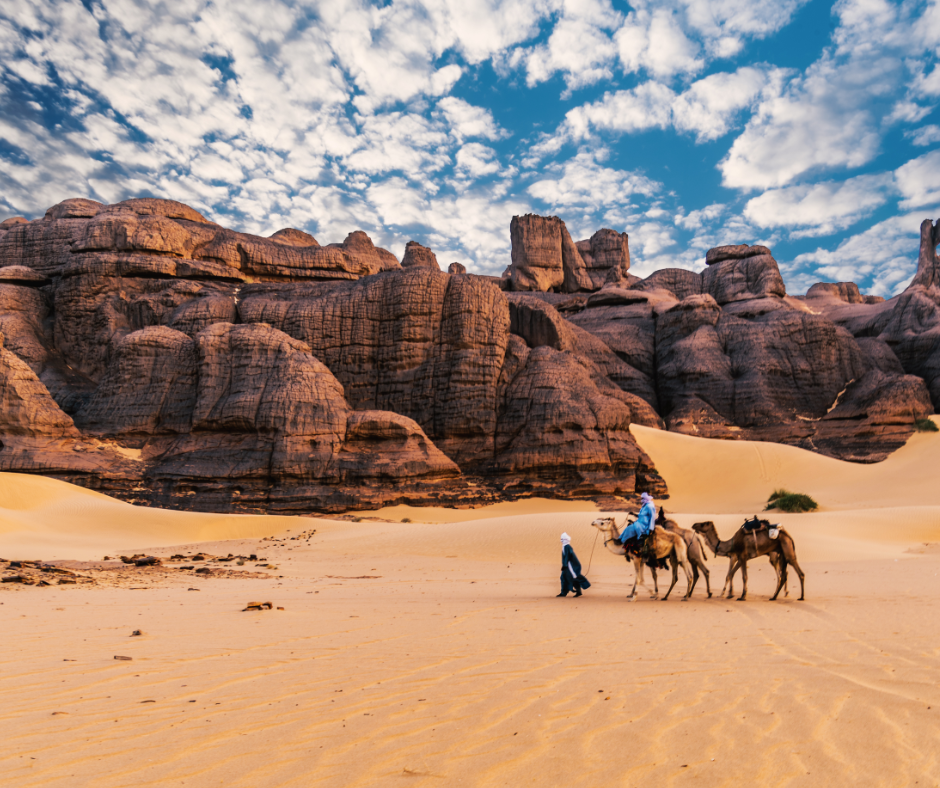
The main draws are the rock art, the dunes of the Erg Admer and the red Tadrart around Tin Merzouga, and Tuareg culture. Sebeïba, the Tuareg ritual held at Ashura and on UNESCO's intangible heritage list since 2014, next falls around 15 June 2027. That's hot season, so only plan around it if you can handle the heat.
In town, the old mud-brick ksour (the original fortified quarters) are worth a slow walk in the late afternoon, once the heat drops.
Our Djanet guide goes through the town and the trips from it in more detail.
Tassili n'Ajjer National Park
The plateau above Djanet is Tassili n'Ajjer National Park, on the UNESCO list since 1982, and by UNESCO's count its rock shelters and canyons hold more than 15,000 drawings and engravings.

They were made over a very long stretch, from roughly 10,000 BC to the first centuries AD: the oldest images show wild animals, later ones herds of cattle, and the latest horses and camels, as the Sahara dried out. Reaching the main sites means walking up onto the plateau and camping for several nights.
Don't touch the paintings or pick up flints and potsherds: exporting antiquities can mean prison. The rock art, the sandstone forests at sunrise and the Milky Way at night make it one of the top stops on any Algeria photography tour.
The Hoggar Mountains
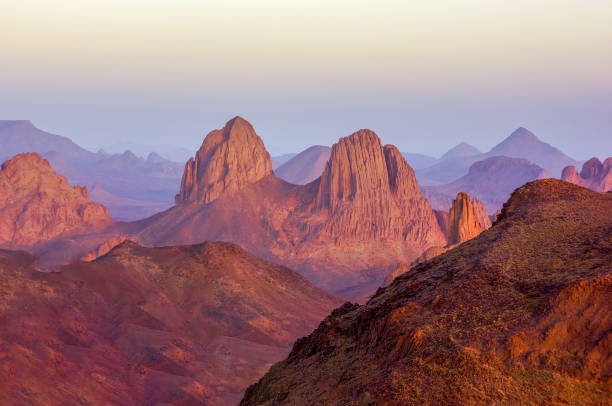
The Hoggar (or Ahaggar) Mountains rise around Tamanrasset in the central Sahara, and the dark volcanic rock turns red at sunrise and dusk. The classic outing is the drive up to the Assekrem plateau (about 2,726 m) for sunrise and for the hermitage Charles de Foucauld built there in 1911. Mount Tahat, Algeria's highest peak, is usually given as 2,908 m. Trekking here, or in the Tassili and the Djurdjura range further north, is best done on one of the guided Algeria hiking tours, since local guides and permits are mandatory in the south.
Camel treks
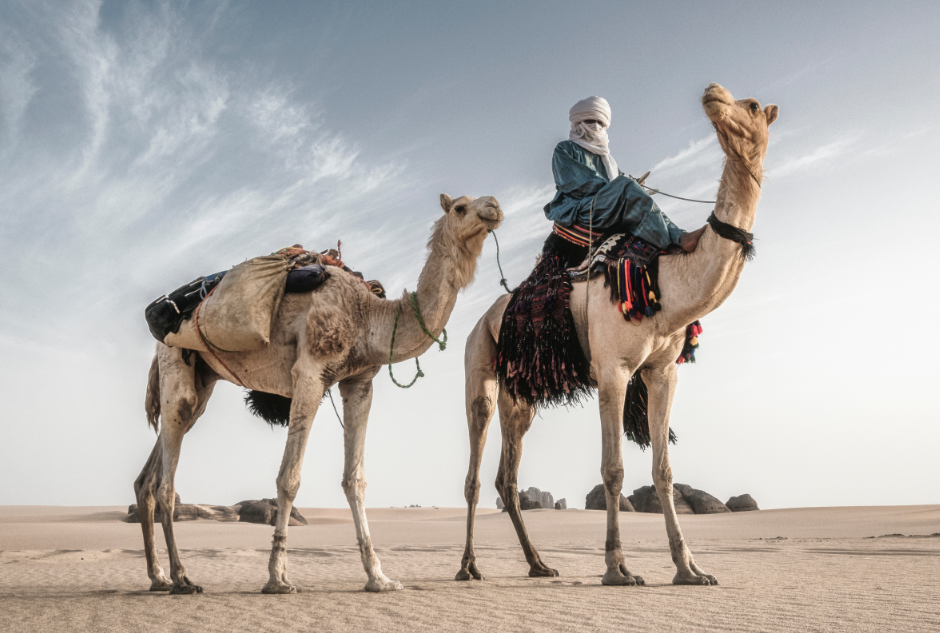
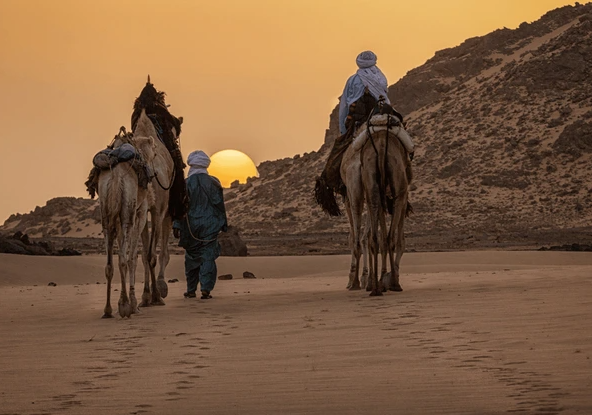
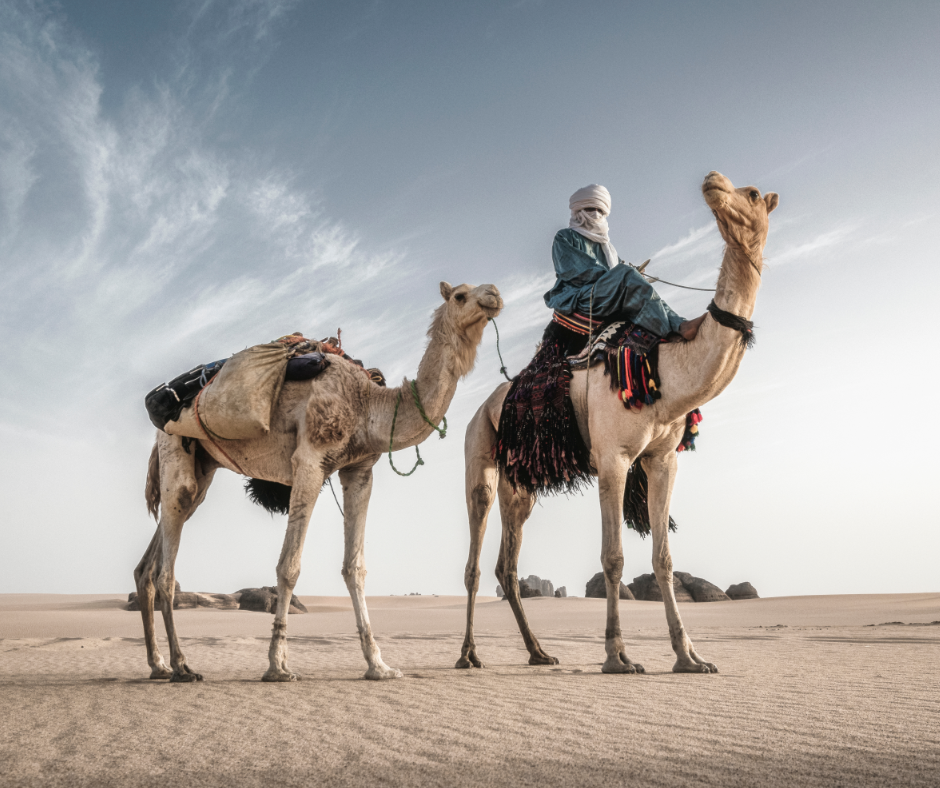
Camel treks across the dunes run from a few hours to several days, led by Tuareg cameleers from the Djanet or Tamanrasset area. Many people walk part of each day, since hours in the saddle are tiring.
Most Tuareg in Algeria now live in towns, but desert crews are often Tuareg, and evenings in camp usually come with their strong, sweet tea poured in three rounds.

The downsides: June to August is too hot for walking, winter nights in camp get close to freezing, and outside town there are no ATMs or card payments. Hoggar trips go out with a licensed Algerian agency and Tuareg guides from around Tamanrasset; that's how ours run.
Algeria's cultural and historical sites
Two of North Africa's best-preserved Roman towns, Timgad and Djemila, are in the north-east, and both work as day trips from Constantine, Batna or Sétif.
Timgad
Timgad was founded in AD 100 by the emperor Trajan, 35 km east of Batna, and UNESCO listed it in 1982. Its streets follow an almost perfect grid. The main sights are the Arch of Trajan, the forum, the 2nd-century theater and the public baths.

The site is big and has almost no shade, so go early, bring water and allow two to three hours. Entry costs a few hundred dinars.
Djemila
Roman Cuicul, now Djemila, was built on a ridge at about 900 m in the hills north-east of Sétif, and it joined the UNESCO list the same year as Timgad. The Romans adapted their usual town plan to the slope, so the streets climb in terraces.
Look for the theater (built in AD 161 and able to seat about 3,000), the Severan forum with the Arch of Caracalla (AD 216) and the temple of the Septimian family. Leave time for the site museum, which holds the mosaics found there.
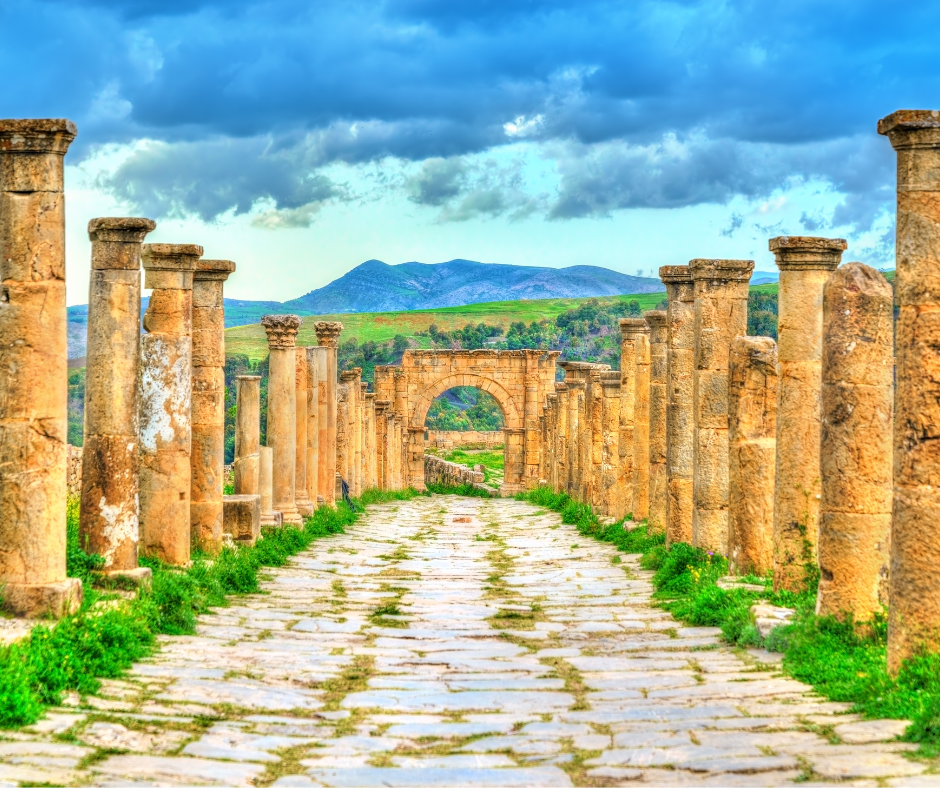
Djemila sits in green, hilly farmland, a contrast with Timgad's open high plain. An east Algeria loop can combine the two with Constantine in three or four days.
Algeria's cities, coast and oases
Algiers, Oran and Constantine are different enough that a longer tour can easily take in two of them. All three are linked by train and by domestic flights.
Algiers
Algiers is the capital, nicknamed "Alger la Blanche", the White City, for the whitewashed buildings that climb up from the bay.
Above the port is the Casbah, the old Ottoman citadel and medina, inscribed by UNESCO in 1992. The citadel was built between 1516 and 1592, and the lanes below it are steep, narrow and easy to get lost in.

Some houses have been restored, others are crumbling, and the FCDO advises going with a good local guide. Start at the lower edge, by the Ketchaoua Mosque.
City tours usually add two modern landmarks: Djamaa El Djazaïr, the Great Mosque of Algiers, with the world's tallest minaret at 265 m, and the Maqam Echahid, the Martyrs' Memorial above the bay.
For the rest of the city, from the Jardin d'Essai to Notre-Dame d'Afrique, see our Algiers guide.
Oran
Oran, on the west coast, is Algeria's second-largest city and goes by El Bahia, "the radiant". Raï music comes from here, and UNESCO put it on its intangible heritage list in 2022.
Most visitors come for the seafront and the beaches west of the city, which fill up with Algerian holidaymakers in July and August.

Above the city, the Spanish fort of Santa Cruz (built 1577 to 1604) on Mount Murdjadjo has the best view over the bay and the port. Down in the center, the Front de Mer promenade is where Oran goes for an evening walk. Our Oran guide has the rest.
Constantine
Constantine, ancient Cirta and the capital of Massinissa's Numidian kingdom, is built on a rock plateau cut off on several sides by the deep gorge of the Rhumel River.
The bridges across that gorge give it the name City of Bridges. Sidi M'Cid, a suspension bridge from 1912, hangs about 175 m above the river, while the Salah Bey viaduct has carried traffic across the valley since 2014.

Beyond the bridges, tours stop at the Palace of Ahmed Bey (built 1825 to 1835) and the twin-minaret Emir Abdelkader Mosque.
For more on the city, see our Constantine guide.
The M'Zab Valley
The M'Zab Valley, around Ghardaïa about 600 km south of Algiers by road, is a valley cut into a rocky desert plateau. Its appeal is the five fortified towns (ksour) the Mozabites built there between about 1012 and 1350.
UNESCO listed the valley in 1982. Its five towns, El Atteuf (the oldest), Bounoura, Melika, Ghardaïa and Beni Isguen, each grew around a hilltop mosque, with the houses stepping down the slope below it.
Rules are stricter here than anywhere else in Algeria. At Beni Isguen you take a local guide at the main gate or you don't go in; non-residents must be out by sunset, and photographing people, women especially, is forbidden. Staying with a family is the best way to see it up close, and the valley is one of the best regions in the country for an Algeria homestay.
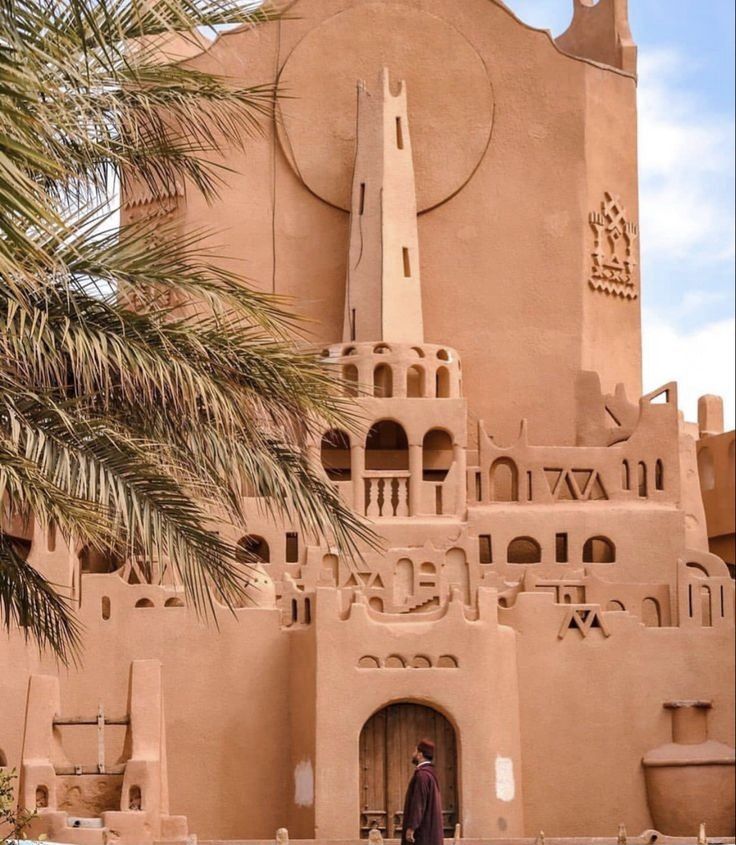
The water system is worth asking about: dams on the wadi catch the rare floods, and channels and old wells share the water between the gardens. For places even fewer visitors reach, like the Assekrem plateau or the red oases of the Gourara, see how to travel Algeria off the beaten path.
For destinations beyond these, see our Algeria travel guide.
West Algeria: Tlemcen, Taghit and Timimoun
Tours of the west usually start in Oran and head to Tlemcen, near the Moroccan border. Its Great Mosque was founded in 1082 by the Almoravids, and the 38 m minaret of Mansourah stands over the ruins of a Marinid siege city of about 1300.
From there, desert trips go south. Taghit, with big dunes and Neolithic rock engravings on the edge of the Grand Erg Occidental, has a date festival in late October. Timimoun, in the Gourara, is a red-ochre oasis town watered by foggaras, underground channels that carry groundwater to the gardens. Both are in wilayas covered by the Sahara visa on arrival.
Safety and cultural tips for visitors
Safety tips
Something our travelers often mention after a trip is how calm and friendly Algeria felt compared with what they'd read beforehand. People stop to help with directions, ask where you're from and often invite you for a coffee. We stick to itineraries we've run many times, with licensed local agencies and guides, and haven't had a single incident on our trips.
You'll see a visible police presence: checkpoints on main roads and, on some desert routes, a police or gendarmerie escort that the authorities assign to tour groups. Your agency arranges it, and it is a normal part of travel in the south. At checkpoints, slow down and have photo ID ready.
Official travel advice differs by region, so look up your own government's current advice for each place on your route, and confirm your insurance covers them, before you pay a deposit.
In cities, keep valuables out of sight, don't carry large sums of cash, and at night use a registered taxi or a ride-hailing app such as Yassir (Uber doesn't operate in Algeria). Bring prescription medicines with a copy of the prescription.
Get travel insurance that covers medical evacuation. Hospitals in the big cities handle most problems, but care is limited in remote areas, and in the deep south a well-equipped hospital can be a flight away. Most consulates also ask for insurance with the visa application (British and Irish citizens applying in London are exempt).
For more detail, see our safety guide.
Local laws
Customs are more conservative in rural areas, the south and the M'Zab than in Algiers or Oran. Holding hands is fine; anything more in public can bring police attention. Same-sex sexual acts are illegal under the penal code. Alcohol is sold at licensed shops and some hotels, but drinking in public is illegal.
Dress modestly away from the beach: cover shoulders and knees, more so in the south and the M'Zab. In Ramadan, which should start around 8 February 2027, eating, drinking and smoking in public stop during daylight, and visitors should follow suit.
Carry your passport on long journeys: you need it to check into hotels and for domestic flights, and checkpoints may ask for photo ID. Keep a photocopy of your passport and visa somewhere separate in case you lose them.
Photos: ask people first, women especially, and keep your camera away from police, military and gendarmerie sites, checkpoints, ports, airports and government buildings. Leave the drone at home: bringing one in without authorization is illegal, and customs usually confiscates them.
Currency exchange and payment tips
Plan on cash for almost everything on a tour. A foreign Visa or Mastercard is accepted in large international hotels, airline offices and some upscale shops and restaurants in the big cities, and that's about it; in the south, it's dinars nearly everywhere.
Cards and ATMs give the official rate of about 150 dinars to the euro (autumn 2026), against roughly 275 on the informal market, which is, on paper, against the exchange-control rules but used openly by nearly everyone; on a tour, your guide can introduce you to a money changer they know. If you declared more than 1,000 euros in cash on arrival, change some at a bank and keep the receipt for customs on the way out, and spend your dinars before you leave, as visitors can't take them out.

Carry small notes for taxis, markets and rural areas. For visas and safety, see our visa guide.
The best time to visit Algeria
For the Sahara, go between October and April; November to March is the most comfortable stretch for walking. Days are warm and dry, but nights in camp can drop close to freezing in December and January, so pack a warm layer for the evenings.
The same season applies to the Grand Erg Occidental around Taghit and Timimoun, and Taghit holds a date festival in late October. For the Mediterranean coast and the Roman sites of the north, spring (April to June) and autumn (September and October) are best.
Summer (June to August) is beach season on the coast and the wrong time for the south. Winter is mild but wet on the coast, with snow in the Djurdjura and the Aurès. During Ramadan (from about 8 February 2027) many restaurants close by day.
What an Algeria tour costs
Where you go and how many of you share the costs matter more than the number of days. These items move the price most:
- Domestic flights. Any Sahara trip from the north needs at least a return flight to Djanet or Tamanrasset.
- Vehicles and crew in the desert. 4x4s with drivers, a cook, camels or pack donkeys, and the guide. A group of six shares these; a couple pays them alone.
- Hotels versus camps. Northern tours use hotels and guesthouses; desert nights are in camp, with food and gear included.
- Visa. GBP 85 at the London consulate (2026), or about EUR 110 on arrival for the Sahara visa, depending on nationality.
- Extras on the ground. Museum and site tickets are cheap, about 200 to 300 DZD in 2026. In the Sahara, plan on tipping the crew about 1,500 to 2,000 DZD per traveler per day, pooled.
When you compare quotes, check whether domestic flights, the visa request, park fees and tips are included.
Choosing your tour
The travelers who enjoy Algeria most come for Roman sites, desert and old cities with few other tourists, and accept some paperwork to get there. It's harder going if you want nightlife, easy card payments or English everywhere.
With one week, pick one region: the north (Algiers, Constantine, Timgad and Djemila) or the Sahara around Djanet. With two weeks, you can combine them using a domestic flight.
A sample 10-day tour
| Day | Where | What you do |
|---|---|---|
| 1 | Algiers | Arrive; afternoon walk in the Casbah with a local guide |
| 2 | Algiers and Tipaza | Day trip to the Roman ruins of Tipaza and the Royal Mausoleum of Mauretania |
| 3 | Constantine | Domestic flight east; the bridges over the Rhumel gorge at sunset |
| 4 | Constantine | Palace of Ahmed Bey, the old town and the Sidi M'Cid bridge |
| 5 | Djemila | Day trip to Roman Cuicul and its mosaic museum |
| 6 | Timgad | Trajan's grid town, then the night in Batna or back in Constantine |
| 7 | Djanet | Fly south, usually via Algiers; evening in the old ksour |
| 8 | Tassili and Erg Admer | Rock art panels and the dunes by 4x4; first night in camp |
| 9 | Tadrart | Red dunes and canyons around Tin Merzouga; camp |
| 10 | Djanet | Return to town and fly home via Algiers |
Book through an operator licensed in Algeria, especially for the south, where only approved agencies can request the visa on arrival. Ask whether the guides and camp crew are hired locally. We arrange custom itineraries in both regions, from a driver waiting at arrivals to desert trips with local guides, cooks and drivers, and the visa-on-arrival request for Sahara trips goes through our licensed Algerian partner agencies.
On the ground, carry your rubbish out of the desert, don't climb on the ruins at Timgad and Djemila, and leave rock art, flints and potsherds where they are.
Before you book an Algeria tour
Can I do Algeria without a tour?
In the north, yes: Algiers, Oran, Constantine and the Roman sites are easy with trains, flights and taxis. The deep south is the opposite. Around Djanet and Tamanrasset, foreigners are expected to travel with an approved agency and local guides, and only those organized trips get the visa on arrival. The northern edge of the desert, around Biskra or Ghardaïa, sits in between: you can get there on your own by flight or road, though a few places such as Beni Isguen still require a local guide.
Is one week enough for an Algeria tour?
For one region, yes (the north, or the Sahara around Djanet, where the flights from Algiers leave you about five days in the desert), while combining both takes 10 to 14 days.
Which trip would you suggest for a first visit?
A combined trip of 10 to 14 days: Algiers and the Roman sites of the east, then a few nights around Djanet. That gets you the cities, the history and the desert in one go. With only a week, choose one side and come back for the other.
What languages do guides speak on Algeria tours?
Arabic and French, all of them, and in the Sahara many crew members also speak Tamahaq, the Tuareg language. English-speaking guides exist but are fewer, so request one when you book.
If you're traveling on a tight budget or want more independence, see our backpacking guide.
If you want the east and the south-east in one trip, start with The Journey Through East & South‑East Algeria (12 days).


