


An Algeria nomad experience usually means a desert trek of several days out of Djanet or Tamanrasset, walking or driving with a Tuareg guide and team and sleeping in a bivouac each night. You book it through an approved Algerian agency: the authorities expect foreigners in the deep south to travel that way, and the same booking is what gets you the Saharan visa on arrival.
Below is what time with Tuareg guides and hosts actually involves (tea, food, a day on the move), how to choose between Djanet and Tamanrasset, what to pack, the visa, how trips in the south are organized and the best months to go.
Count on at least a week including the flights from Algiers; the classic walking treks on the Tassili run 7 to 9 days, with about 4 to 5 hours on foot a day and one or two big climbs. Your team is a Tuareg guide, a cook and camels, donkeys or 4x4s, and you sleep in a tent or on a mat under the sky, out of Djanet (Tassili n'Ajjer, Erg Admer, Tadrart) or Tamanrasset (Hoggar, Assekrem). Go between October and April: December to February is the coolest time for walking, though winter nights drop to near freezing.
The Nomadic Experience: Traveling with the Tuareg
Nomad trips in southern Algeria are built around the Tuareg, an Amazigh (Berber) people of the central Sahara. They are sometimes called the "Blue People" because the indigo dye of the men's veil, the tagelmust, rubs off on the skin. Among the Tuareg it is the men, not the women, who traditionally cover their faces. For us, learning a little about how they live is the main reason to do this trip, more than the scenery.
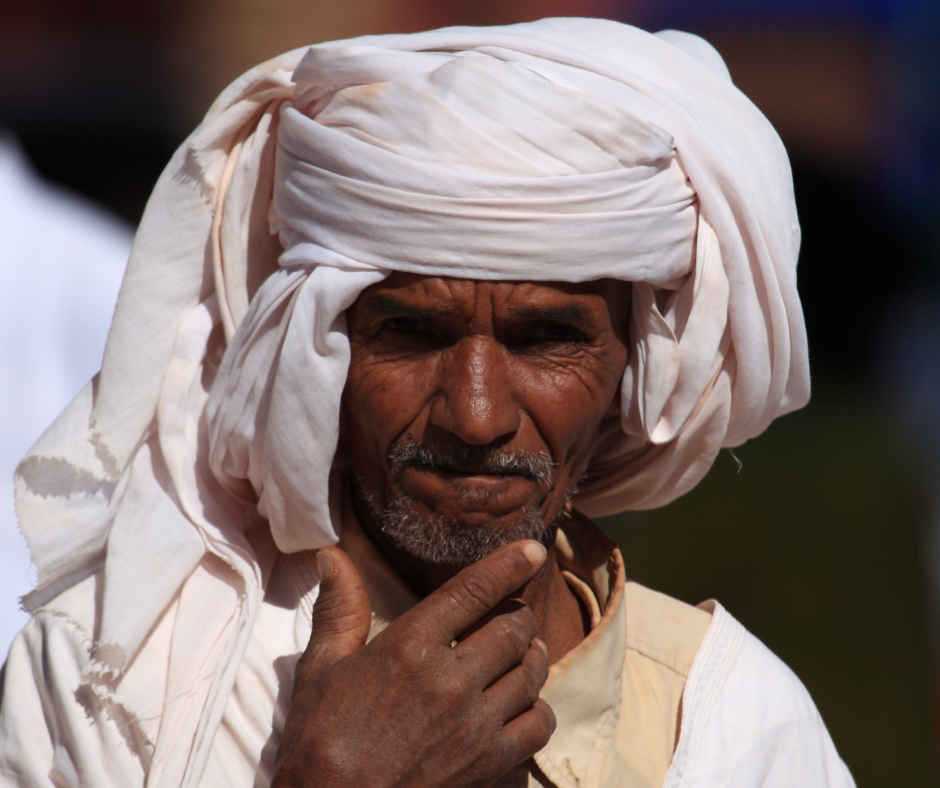
Be clear about what you are joining. Most Tuareg in Algeria now live settled lives in towns such as Djanet and Tamanrasset, and camel herding and caravan trade declined sharply over the 20th century.
A tourist trek is run by an agency, usually with a Tuareg guide, a cook and a driver or cameleers, often from families that once herded and traded across this desert. The day follows the sun. People walk and work in the cool hours, rest through the midday heat and talk late around the fire, and nobody hurries the tea.
The Three Glasses of Tea
Tea comes first, and several times a day. It's green tea, usually Chinese gunpowder, brewed with plenty of sugar in a small metal teapot over embers, poured from a height to raise a froth, and served in three rounds from the same leaves.
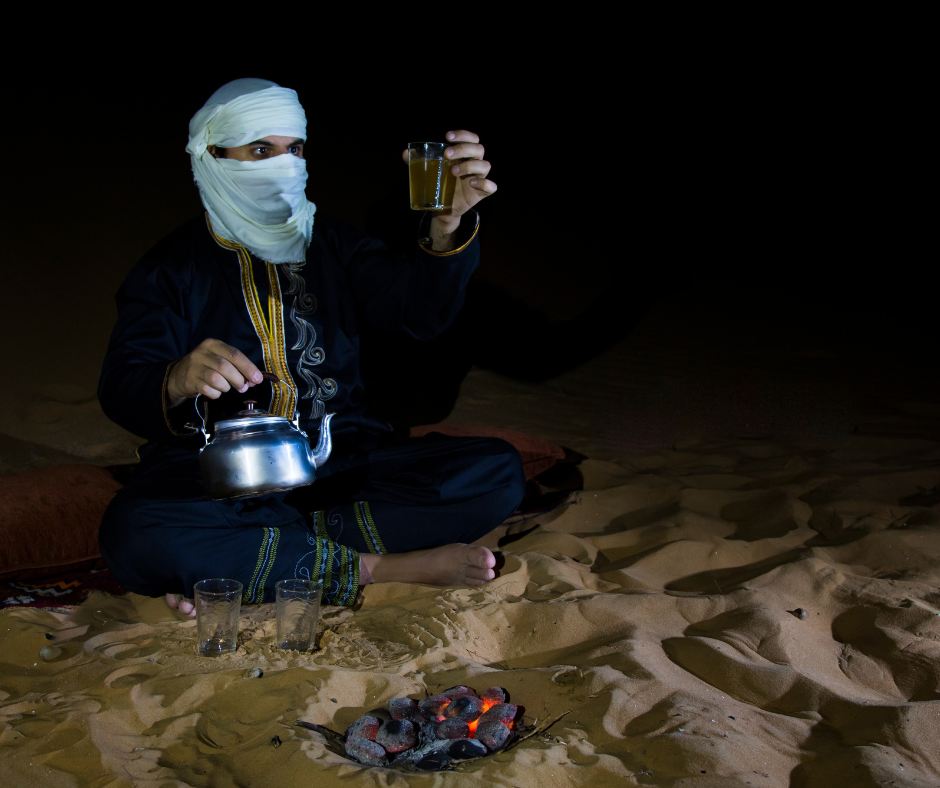
Across the Sahara people say the first glass is bitter like life, the second sweet like love and the third gentle like death. In practice the first glass is the strongest and the later ones are milder, because the leaves are reused.
Accept all three glasses; it's the polite thing to do, and each round takes time to prepare. That wait is a good moment to ask your guide about the region, or about the Tifinagh letters you'll see cut into rocks. Tifinagh is the Tuareg alphabet, and older Libyco-Berber inscriptions in a related script turn up at rock art sites in the Tassili and the Hoggar.
Food in the Deep Desert: Taguella
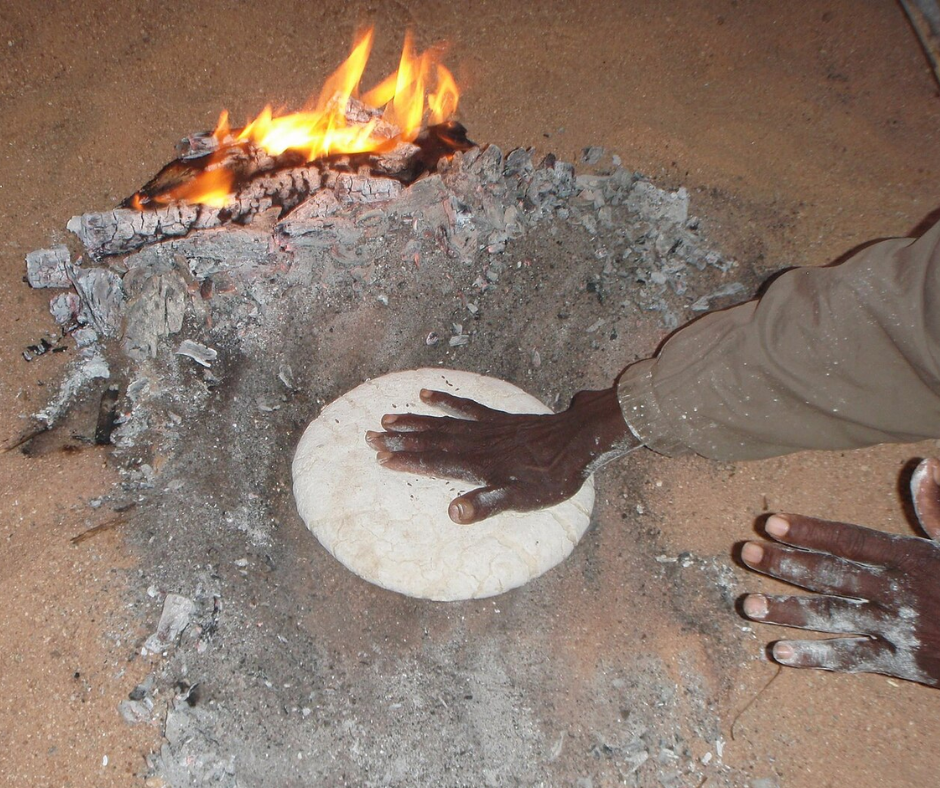
The dish to watch for is taguella, a thick unleavened flatbread baked straight in hot sand under the embers. When it's done, the cook brushes off the sand, breaks it into pieces and pours a stew of meat or vegetables over it. Other meals on a trek are simple and depend on what the team carries in.
Eat with your right hand, as people do here, and from your own side of the shared dish. Dinner is eaten around the fire after dark, and it's the easiest time to ask questions about the places you walked through that day.
How Tuareg society works
A few facts help you understand your hosts. The Tuareg of Algeria speak Tamahaq, one of the Tuareg languages, and write it in Tifinagh. Descent has traditionally counted through the female line: a chief was often succeeded by his sister's son, and the family tent belongs to the married woman.
The women play the imzad, a one-string fiddle whose music UNESCO listed as intangible heritage in 2013. Silver jewelry is a craft of its own, often handed down from mother to daughter.
Choosing Your Gateway: Djanet vs. Tamanrasset
Southern Algeria has two main bases for nomad trips: Djanet and Tamanrasset. Both have airports with flights from Algiers. Choose by landscape: Djanet for sandstone, rock art and dunes, Tamanrasset for volcanic mountains.
We'd pick Djanet if the Tassili n'Ajjer plateau is the draw. UNESCO listed it in 1982 for two things: its prehistoric rock art, which UNESCO puts at more than 15,000 paintings and engravings, and its "forests" of eroded sandstone pillars that look like a ruined city from a distance.
| Djanet | Tamanrasset | |
|---|---|---|
| Town altitude | About 1,035 m | About 1,320 m |
| Landscape | Sandstone plateau, canyons and dunes | Volcanic peaks, needles and high plateaus |
| Highlights | Tassili rock art, Sefar, the Tamrit cypresses, Erg Admer, the Tadrart | The Atakor, Assekrem plateau (about 2,726 m), Charles de Foucauld's hermitage |
| Walking | Plateau treks with pack donkeys after a steep climb up | Higher altitude and steeper ground |
| Airport | Djanet Inedbirene, about 30 km south of town | Tamanrasset airport |
| Best months | October to April | October to April |
Djanet: Trekking the Tassili n'Ajjer
The Tassili mixes narrow canyons and open sandstone plateau, with dune fields such as the Erg Admer below it near Djanet. The oldest paintings and engravings go back to roughly 10,000 BC, when much of the Sahara was savanna with lakes (hence the elephants, giraffes and herds of cattle), and the latest to the first centuries AD.
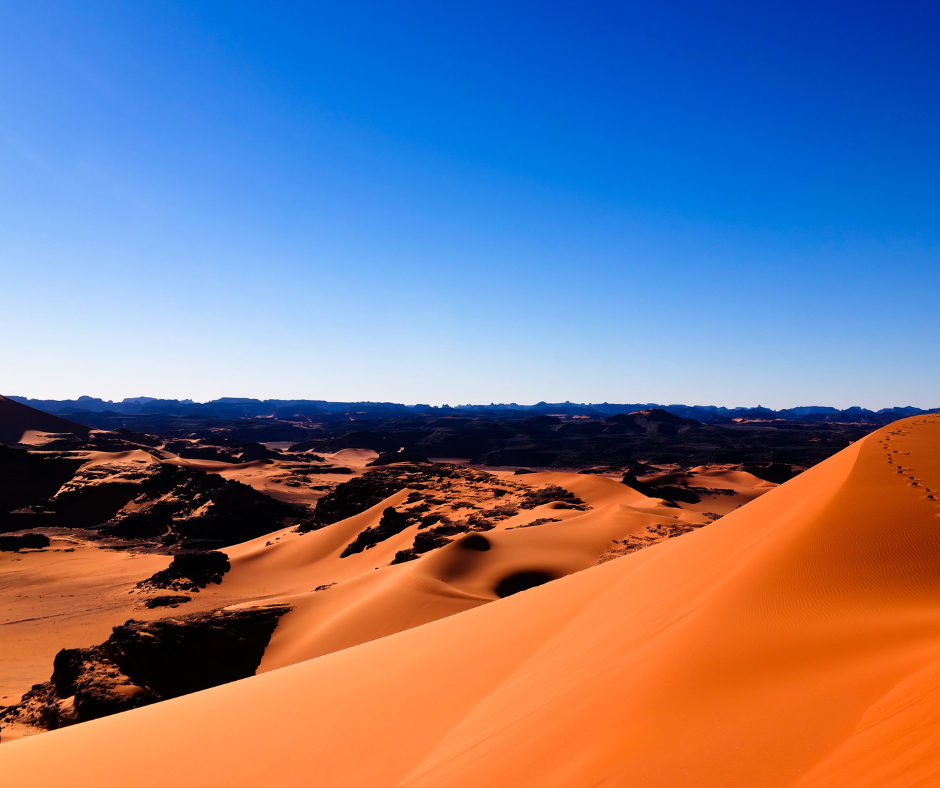
Your guide will know where the panels are and which period they belong to, from the early wild-animal art to the cattle scenes of the pastoral period. The plateau is walking country. From Djanet you climb a pass such as the Akba Tafilalet (about 600 m of ascent, most of a day) while donkeys carry the bags, then spend several days on top. Our guide to the Tassili n'Ajjer explains the rock art periods in more detail.
A sample 7-day trek from Djanet
Every agency and guide shapes the route a little differently, depending on the group's pace. This is the usual pattern on the Tassili plateau.
| Day | Route | Walking | Night |
|---|---|---|---|
| 1 | Arrive in Djanet; the old quarters and the palm grove | Short stroll | Camp or guesthouse near town |
| 2 | Climb the Akba Tafilalet onto the plateau, bags on pack donkeys | Most of the day, about 600 m up | Camp on the plateau |
| 3 | Tamrit and its ancient cypress trees, canyon viewpoint | 4 to 5 hours | Rock-shelter camp |
| 4 | Tin Tazarift: sandstone arches, towers and painted shelters | 4 to 5 hours | Camp |
| 5 | Sefar, one of the richest rock art sites, with the "Great God" painting | 4 to 5 hours | Camp near Sefar |
| 6 | Back down from the plateau, then by 4x4 to the Erg Admer dunes | Morning descent | Camp in the dunes |
| 7 | The Tegharghart "crying cows" engraving, Djanet market, flight out | Short walks | Flight |
Before and after the trek: a day in Djanet
Plan a rest day in Djanet at one end of the trek. The town grew from old quarters such as El Mihan, Azelouaz and Adjahil, built along the palm grove of the valley. Walk them in the late afternoon, then visit the market for tea, dates and Tuareg silver.
Places to stay are simple guesthouses and small hotels; your agency books them with the trek. If you can travel in the hot season, Sebeïba, the Tuareg ritual held at Ashura and listed by UNESCO in 2014, next falls around 15 June 2027.
Tamanrasset: The Hoggar Mountains and Assekrem
Tamanrasset is the base for the Hoggar (Ahaggar) Mountains, which lie inside the Ahaggar Cultural Park. Most trips head for the Atakor, a high volcanic massif, and the Assekrem plateau at about 2,726 m.

Trips usually time the visit to Assekrem for sunrise or sunset, and to see the hermitage Charles de Foucauld built there in 1911. The rock is dark and volcanic: old lava plugs and needles, basalt columns and steep valleys. Around Tamanrasset you'll still see zeribas, huts of reed or palm thatch. When de Foucauld settled in Tamanrasset in 1905 it was a small village of such huts; today it is a city of more than 100,000 people.
The Hoggar asks more of your legs, with higher altitude and steeper walking than most Tassili routes. In return you get the Atakor peaks at dawn, the quiet of the Assekrem refuge and evenings with guides who know these mountains well. People who walk here with us often say the south felt nothing like the place they had read about before coming.
As everywhere in the far south, you go with an approved agency, which also sorts out the police or gendarmerie escort the authorities assign on some routes. Look up your government's current advice for the Hoggar and check that your insurance covers it before you pay for the trip.
A Day on a Desert Caravan Trek
Days on a nomad trek follow the light. You get up just before sunrise, when the air is cold and the sand still cool. After breakfast and the first tea, the team loads the camels or donkeys, or packs the 4x4s.
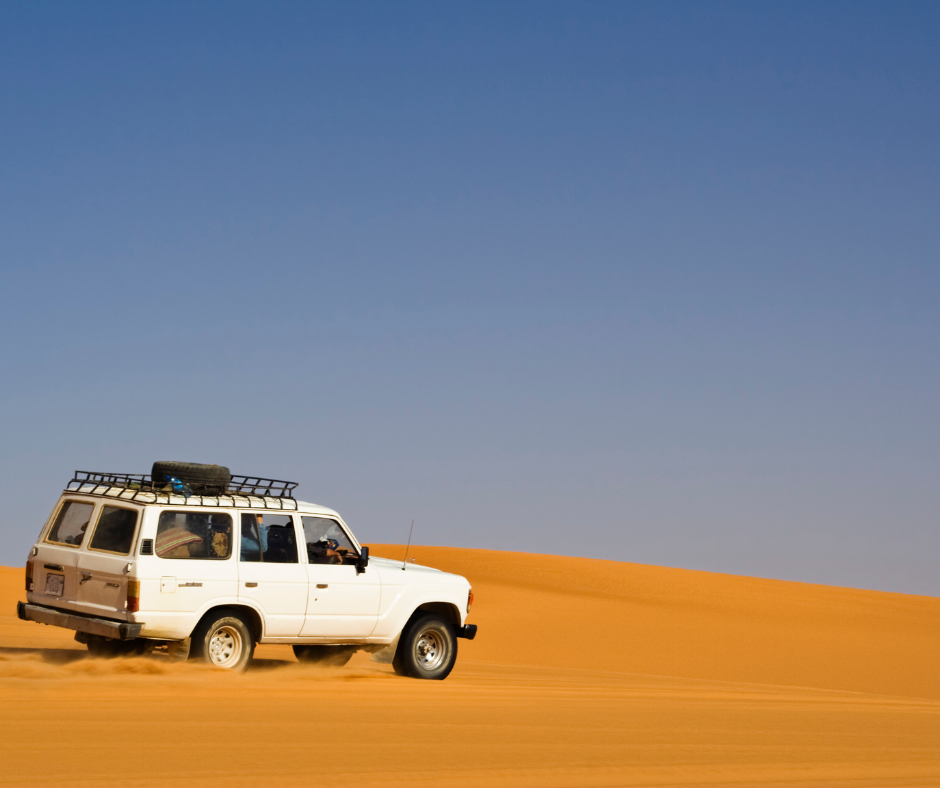
Walk in the morning while it's cool. Around midday the group stops in the shade of an acacia or a rock overhang for a long lunch and a rest until the worst of the heat has passed. Drink steadily through the day; the team carries the water.
Late Afternoon and the Golden Hour
You set off again in the late afternoon as the shadows lengthen and the sand turns from pale yellow to orange. The last hour or two before sunset is the best light for photography: it's soft, and it picks out the ripples on the dunes.

Camp, the bivouac, goes up before dark. Everyone helps. While the guides light the fire and start dinner, there's usually time to walk up the nearest dune for the sunset.
Sleeping Under the Stars in a Bivouac
Most agencies bring tents, but try at least one night in the open on a mat. Far from any town, the sky is very dark and the Milky Way is easy to see. If the stars matter to you, plan your dates around the new moon.
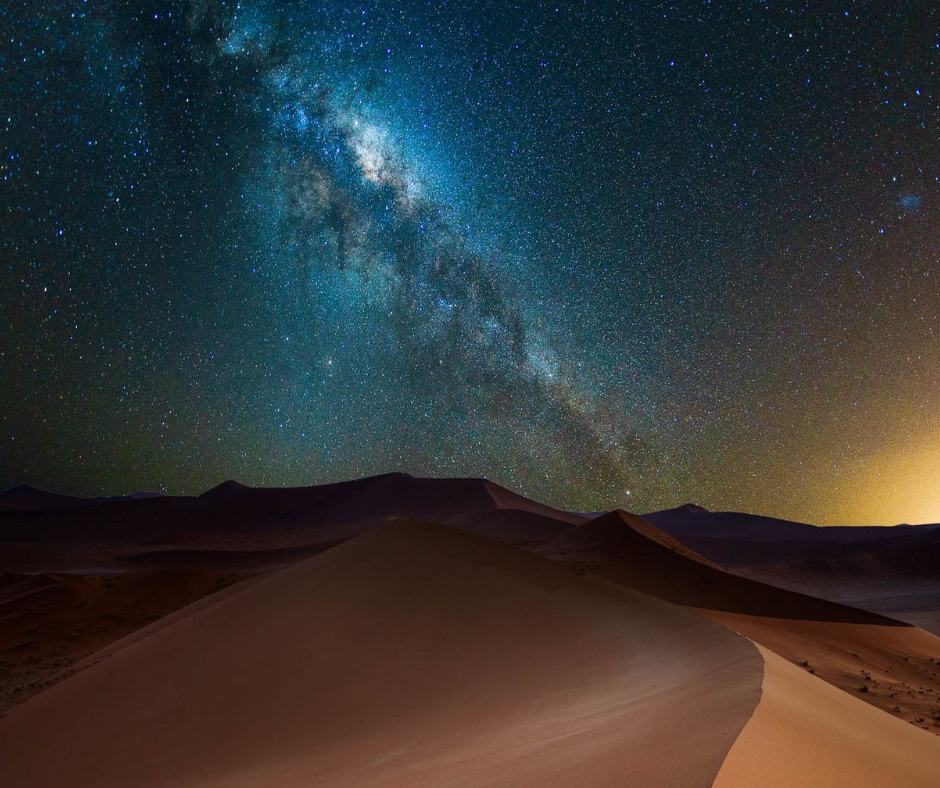
From December to February, bring a sleeping bag rated to around 0 °C: Djanet's average January low is about 3.5 °C, and the plateau and the Hoggar get colder. A chèche, the long cotton scarf Tuareg men wind into a turban, keeps your head warm at night and the sand out of your face when the wind gets up.
Transport Logistics: Camels or 4x4 Vehicles?
Camel or 4x4 comes down to distance versus pace. On a camel trek you walk beside the animals for much of the day, ride for stretches and cover about 20 to 25 km. At that speed you notice beetle tracks in the sand and the different shrubs, and you hear how quiet the desert is.
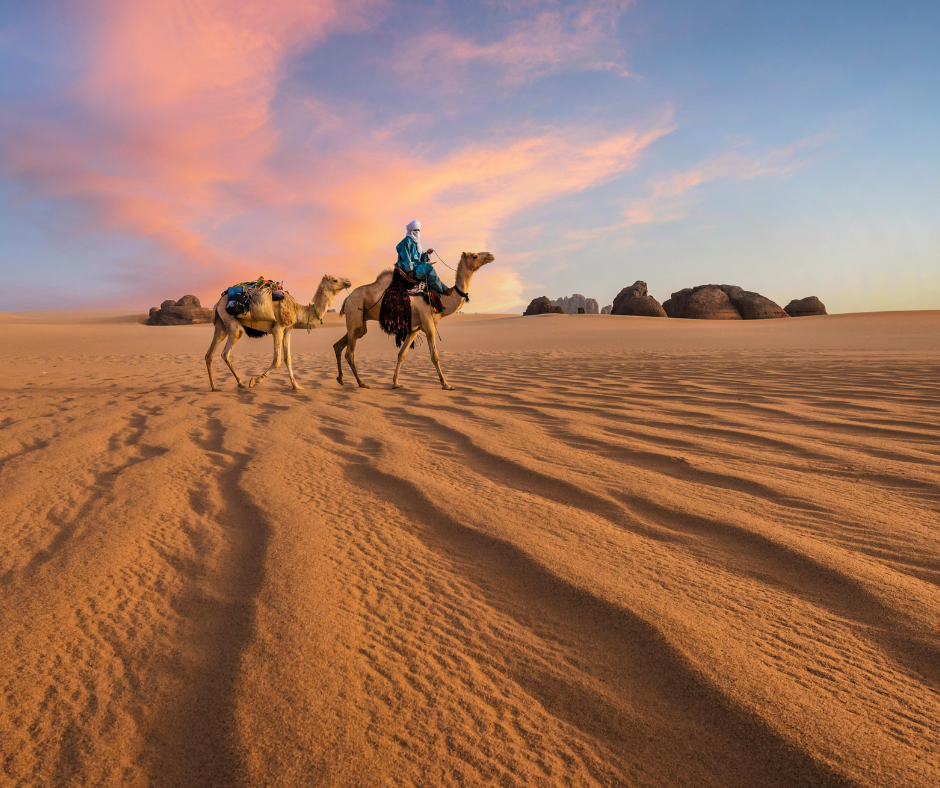
For the deep interior, or rock art sites far apart, you need a 4x4. The vehicles carry more water and fuel, so you can get well away from the wells, but you spend hours a day on rough tracks. We usually suggest a mix: drive the long stretches and add a few days of walking with camels. Our wider Algerian Sahara guide compares the desert regions.
Practical Preparation for the Sahara Climate
Pack for sun by day and cold by night. In the daytime, wear loose, long-sleeved cotton or linen: it lets air through and keeps the sun off your skin.
Add a wide-brimmed hat and good sunglasses, because the glare off pale sand is hard on the eyes. Sturdy, broken-in boots that cover the ankle keep sand out on rocky ground, and light sandals give your feet a break in camp.
Layering for Extreme Temperature Shifts
The temperature drops fast after sunset. From November to March, bring a fleece, a windproof shell and thermal base layers.
There's no electricity on a trek, often for several days, so bring a power bank, and expect mobile coverage to be patchy or absent away from towns (the UK FCDO says the same). A headlamp with a red-light mode lets you move around camp at night without dazzling everyone. Biodegradable wipes and high-SPF lip balm are worth the space: the air is very dry.
What a Tuareg trek includes
Prices depend on the length, the group size and how much driving is involved, so ask for a per-person quote for your dates. What the price covers is fairly standard on Tassili treks:
- Usually included: the Tuareg guide and cook, pack donkeys or camels, 4x4 transfers to and from the trailhead, all meals and water in camp, tea, tents, mattresses and blankets, park entrance fees, and the visa-on-arrival request.
- Usually not included: international and domestic flights, travel insurance, the visa fee paid on arrival (commonly about EUR 110), drinks in town and tips.
- Tips: the crew's tip usually comes from a pooled kitty; budget about 1,500 to 2,000 DZD per traveler per day, which works out at 10,000 to 14,000 DZD each for a week.
- Group size: walking groups on the plateau are usually small, often capped at about 10.
Visas, Permits and Local Rules
The visa is easier for desert trips than it used to be. Since late 2022, a visa on arrival has been open to tourists whose organized trip, booked through an approved Algerian travel agency, includes the southern wilayas, among them Djanet, Tamanrasset, Illizi, Timimoun and Adrar. Your agency applies to the Tourism Ministry, a QR-code authorization lets you board, and the fee (commonly reported at about EUR 110, varying by nationality) is paid when you land.
The visa runs for the length of the trip, up to 30 days. It isn't limited to southern airports: it can be issued at Algiers and other international entry points, as long as the south is on the itinerary.
If most of your trip is in the north, you need a standard visa from an Algerian consulate instead. Either way, send your passport details to the agency well ahead, and carry printed copies of the authorization, passport and insurance. Download offline maps before leaving town; our Algeria travel guide lists the apps we use.
On the trek itself, a few rules matter. Drones need an authorization tourists can't realistically get and are usually confiscated at customs, so leave yours at home. Don't pick up flint tools or pottery shards in the Tassili or the Hoggar: taking antiquities out of Algeria can mean prison. And ask before photographing people, especially women.
The full rules, for both consulate visas and the visa on arrival, are in Algeria Visa: Requirements and Visa on Arrival.
Why you trek with a local guide
Going without one isn't an option in the deep south, where the authorities expect foreigners to travel with an approved agency. We work the same way, with licensed local agencies, Tuareg guides and routes we know. Rules aside, the terrain is easy to get lost in, and wind can wipe out vehicle tracks quickly.
A Tuareg guide reads the ground, knows where the wells and rock pools (gueltas) are and runs the logistics. They also explain you to the people you meet, and them to you, at a well or a herders' camp where few people speak English. We'd say the days with your guide and team are the best part of the trip.
Timing Your Visit to the Southern Desert
Go between October and April. December to February is the most comfortable for walking, with average highs of about 20 to 23 °C in Djanet and Tamanrasset; October and April are warmer, with highs of about 30 to 33 °C. Winter nights are cold: average lows in both towns are about 3 to 7 °C, and on the Assekrem plateau, above 2,700 m, they can drop below freezing.
Skip June to August. Average highs in Djanet and Tamanrasset are 36 to 38 °C, with peaks above 40 °C, and trekking in that heat is dangerous; May and September are not much cooler. If you have less time, the western Sahara around Timimoun and Taghit is easier to reach from the north and works well for shorter trips.
Before You Sign Up: Planning a Nomad Trek
Expect to walk several hours a day, sleep on the ground and go days without a shower or a phone signal. If that sounds like a holiday to you, you'll love it. It suits people less well if they need a fixed schedule. Plans shift with the wind, the vehicles and the checkpoints, and some of the best moments are unplanned: an extra hour at a rock art panel because the light is right, or a stop to talk with herders at a well.
Our trips in the south are run with local guides, cooks and drivers, so most of what you spend stays in the region. Ask any operator, us included, to camp leave-no-trace and carry all rubbish out.
Before you trek out of Djanet or Tamanrasset
How fit do you need to be for a Tassili trek? Reasonably fit. Expect 4 to 5 hours of walking most days on sand and rock, and one or two long climbs, such as the Akba Tafilalet onto the plateau. You carry only a daypack. If you can hike a full day in the hills at home, you will manage.
Can you ride camels the whole way? Not usually. On camel treks most people walk beside the animals for much of the day and ride for stretches, because hours in the saddle are tiring. On the Tassili plateau donkeys carry the bags and everyone walks. If walking is hard for you, choose a 4x4 trip with short walks.
How long should I give Djanet? A week at the least, flights from Algiers included: one day to arrive, five or six in the desert and a rest day in town. A walking trek across the Tassili plateau usually takes 7 to 9 days. With less time, a 4x4 trip to the Erg Admer and the Tadrart still works.
Is it cold at night in the Sahara? Yes, in winter. Djanet's average January low is about 3.5 °C, the plateau is colder, and on the Assekrem above 2,700 m it can freeze. From December to February bring a sleeping bag rated to about 0 °C, a fleece and a hat. Days stay warm and sunny.
Where do you sleep on a Tuareg trek? In camp, every night, in light tents or often under rock shelters on the Tassili, with simple guesthouses and hotels in Djanet before and after.
We'd allow at least a week for Djanet or Tamanrasset including the flights from Algiers, and book a couple of months ahead so there is time for the visa-on-arrival request, which we file through a licensed Algerian partner agency. Tell us your dates, your fitness level and what you most want to see, and we'll suggest a route. You can contact us here to start planning your Sahara trip.
For visas, transport, safety and places across the rest of Algeria, see Backpacking Through Algeria: A Practical Travel Guide.
If you'd rather start from a ready-made route, see our itineraries page.


