

Algeria's best-known landmarks are its Roman towns (Timgad, Djémila, Tipasa), its Islamic architecture (the Great Mosque of Tlemcen, the M'Zab Valley), the monuments of Algiers and the Saharan ranges of the Hoggar and Tassili n'Ajjer. All seven of Algeria's UNESCO World Heritage sites are on this list, and the two Saharan entries (the Hoggar and the Tassili) can only be visited with an approved Algerian agency.
Each entry gives a short history, then a "Visiting" note on cost, access and timing. Prices are in dinars (DZD), autumn 2026; opening hours change often, so confirm them locally.
Algeria's landmark regions compared
| Region | Landmarks to aim for | When to go and how |
|---|---|---|
| Algiers and Tipasa | The Kasbah of Algiers (UNESCO, 1992), the Martyrs' Memorial, the Grande Poste, the Hamma garden and Djamaa El Djazaïr, whose 265 m minaret is the tallest in the world; Tipasa (UNESCO, 1982) is a day trip | March to May or October to November; Algiers is the easiest base |
| The east | Timgad and Djémila (both 1982), Al Qal'a of Beni Hammad (1980) and the bridges of Constantine | The same spring and autumn months; a car and driver from Constantine, Sétif or Batna |
| The west and the M'Zab | The Great Mosque of Tlemcen, Oran's Ahmed Zabana Museum and the M'Zab Valley (1982) | Spring or autumn; Tlemcen and Ghardaïa each need a night |
| The deep south | The Tassili n'Ajjer (1982, a mixed cultural and natural site) and the Hoggar | October to April, only with an approved Algerian agency and local guides; several days |
A week covers Algiers plus one of the other three. Entry fees run from nothing to about 200 to 300 DZD, under EUR 2 at either the official or the informal rate (autumn 2026), and ticket offices want cash. The second table goes landmark by landmark with the fee and how long to allow; where we couldn't confirm a price, check on the spot.
| Landmark | Where | UNESCO | Entry | Time to allow |
|---|---|---|---|---|
| Casbah of Algiers | Algiers | Yes, 1992 | Free (guide extra) | Half a day |
| Makam Echahid | Algiers | No | Esplanade free | 1 to 2 hours |
| Grande Poste | Algiers | No | Outside only | 15 minutes |
| Sidi M'Cid Bridge | Constantine | No | Free | Half a day with the other bridges |
| Jardin d'Essai du Hamma | Algiers | No | About 200 DZD | 2.5 to 3 hours |
| Timgad | Near Batna | Yes, 1982 | About 200 DZD | Half a day |
| Djémila | Near Sétif | Yes, 1982 | About 200 DZD, museum included | Half a day |
| Al Qal'a of Beni Hammad | Near M'Sila | Yes, 1980 | Check locally | 2 to 3 hours |
| Tipasa | 70 km west of Algiers | Yes, 1982 | Check locally | A day trip |
| Great Mosque of Tlemcen | Tlemcen | No | Free (active mosque) | 1 hour; 2 days for Tlemcen |
| Djamaa El Djazaïr | Algiers (Mohammadia) | No | Grounds free | 1 to 2 hours |
| Notre-Dame d'Afrique | Algiers (Bologhine) | No | Check hours | 1 hour |
| Ahmed Zabana Museum | Oran | No | About 200 DZD | 2 hours |
| M'Zab Valley | Ghardaïa | Yes, 1982 | Guide fee at Beni Isguen | At least one night |
| Kabylie | Tizi Ouzou, Béjaïa | No | Free | A day or more |
| Hoggar Mountains | Tamanrasset | No (cultural park) | Agency trip | Several days |
| Tassili n'Ajjer | Djanet | Yes, 1982 | Agency trip | Several days |
Historic landmarks in northern Algeria
Numidian kings, Rome, Byzantium, Arab and Berber dynasties, the Ottomans and, from 1830 to 1962, France all left buildings in the north. Five of the nine sites in this section are in or near Algiers.

Algiers is the easiest starting point: the Casbah, the Martyrs' Memorial, the Grande Poste and the Hamma garden are a short metro, cable car or taxi ride apart.
This list sticks to landmarks and historic sites. For activities beyond the landmarks, from hiking to festivals, see our list of things to do in Algeria.
The Casbah of Algiers
The Casbah is the old walled city of Algiers, climbing the hillside above the port. It grew from a Zirid town founded in 944, but most of what you see is Ottoman, including the citadel at the top (1516 to 1592). UNESCO listed it in 1992.
Near its foot stands the Ketchaoua Mosque, first recorded in 1612 and rebuilt in 1794. The French turned it into a cathedral in 1832 and rebuilt it between 1845 and 1860. It has been a mosque again since 1962 and reopened in April 2018 after a long restoration. Visitors are welcome outside prayer times if dressed modestly.

Visiting: Walking the lanes costs nothing, but go with a local guide. The alleys twist back on themselves and plenty of houses are crumbling; someone who knows the quarter can tell which lanes are passable and get you into courtyards and up onto rooftops.
Makam Echahid
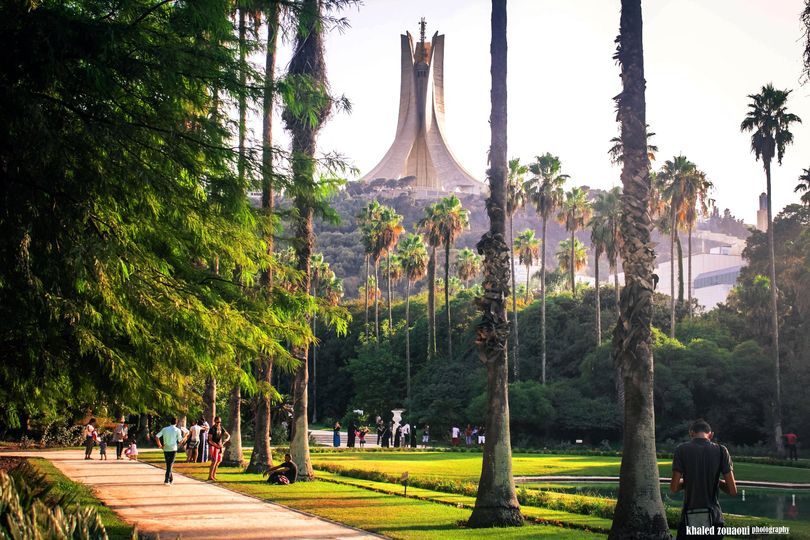
The Martyrs' Memorial (Maqam Echahid) is the concrete monument you can see from almost everywhere in Algiers. It was inaugurated on 5 July 1982, the 20th anniversary of independence, and was built by the Canadian firm Lavalin from a design developed under the Algerian artist Bachir Yellès.
It honors those who died in the War of Independence (1954 to 1962). Three stylized palm fronds join at mid-height above the eternal flame, and a bronze soldier stands at the base of each one, representing the popular resistance after 1830, the National Liberation Army and today's People's National Army.

Above the fronds sits an Islamic-style turret about 10 meters across, capped by a 6-meter dome. Under the esplanade are a crypt, an amphitheater and the National Museum of the Mujahid, covering armed resistance from 1830 to 1962.
The monument is 92 meters tall and stands on the heights of El Madania, beside the Riadh El Feth complex, above the Hamma district and the bay.
The seaward edge of the esplanade has the widest view over the bay. At night the monument is floodlit and visible from far across the water.
Visiting: The esplanade is free; the museum keeps its own hours and fees. Spring and autumn are the most comfortable seasons, while in July and August the open esplanade is very hot by midday. A taxi from central Algiers takes 10 to 15 minutes. From the Hamma garden, take the cable car up (it was running in the latest reports) or walk about 20 minutes uphill.
The Grande Poste of Algiers
The Grande Poste is the white, arched building on the square of the same name in central Algiers, a few minutes' walk up from the port.
The French architects Jules Voinot and Marius Toudoire designed it in the neo-Moorish style, completed in 1910: horseshoe arches, carved stucco and tilework borrowed from North African Islamic buildings and applied to a modern post office.

The main hall, with its stucco, carved wood and tiles, looks more like a palace than a public office.
Visiting: You can see the façade and the square for free at any hour, but you probably won't get inside. Postal services moved out in 2015 for a planned museum of postal history; the building has been closed to the public since 2019, restoration began in March 2025 and no reopening date had been announced by autumn 2026. Tafourah-Grande Poste metro station is next door.
Sidi M'Cid Bridge
Constantine sits on a rock cut off by the Rhumel gorge. The Sidi M'Cid suspension bridge, designed by Ferdinand Arnodin and opened in 1912, spans 164 meters and hangs about 175 meters above the river, linking the old town to the Sidi M'Cid hill and the university hospital.

Walk across rather than drive: from the middle you look straight down into the gorge and back at houses lining the cliff edge. Skip it if you have a strong fear of heights.
The city has several other bridges, including the Salah Bey viaduct (2014), so allow half a day. Add the Emir Abdelkader Mosque, completed in 1994 beside the Islamic university of the same name, whose two minarets rise about 107 meters over the city.
Visiting: Free. Go early, before the traffic builds up, since the bridge carries cars too. Constantine is conservative, so dress modestly, and keep your belongings close on the narrow walkway.
Botanical Garden of Hamma
The Jardin d'Essai du Hamma, in the Belouizdad district of Algiers, was created by the French in 1832 as a trial garden for plants from around the world.
It started on 5 hectares, grew to 18 by 1837 and covers about 32 today: a formal French garden to the west, an English-style garden with a lake to the east, and a small zoo opened in 1900.

It still holds more than 1,200 plant species, including huge fig trees and avenues of palms and dragon trees. Since 1966 Algeria's National Institute for Agronomic Research (INRAA) has used part of it as a research station.
Visiting: Entry is about 200 DZD for adults (autumn 2026). It opens daily at 10am and closes at 5pm in winter, 6pm in spring and autumn and 7pm from May to August. The Jardin d'Essai metro station is at the entrance. Allow two and a half to three hours, take water in summer, and go on a weekday morning to avoid the crowds.
The ruins of Timgad
Timgad (ancient Thamugadi) is a Roman town founded by Emperor Trajan in AD 100, about 35 km east of Batna, with its street grid still almost complete. UNESCO listed it in 1982, and guidebooks like to call it the "Pompeii of Africa". It sits at the foot of the Aurès Mountains, where the Ghoufi canyon and the Chaoui villages make a good add-on.

Visiting: Base yourself in Batna and arrive early. The site is an exposed plain with almost no shade, and from June to September midday is hard going. Entry is a few hundred dinars (about 200 DZD in recent reports). Our guide to visiting Timgad covers the road from Batna and the main structures to see.
Djémila (Cuicul)
Djémila, the Roman town of Cuicul, sits on a narrow ridge about 900 meters up in the mountains northeast of Sétif. It began in the 1st century AD as a colony for veterans, and its builders bent the usual Roman grid to fit the slope. UNESCO listed it in 1982 for that mountain adaptation.
The core is the old forum with its market and Capitol. In the early 3rd century the town spread south: a second forum, the Arch of Caracalla and the Temple of the Gens Septimia went up there. The theater was built outside the walls because the ridge was too narrow. A Christian quarter with basilicas and a baptistery came later.
Visiting: Djémila is about 50 km from Sétif, so stay there or in Constantine. Entry is about 200 DZD in recent reports and includes the site museum, whose walls are covered in Roman floor mosaics; don't skip it. Come in the morning, when the light is soft and the ridge is cooler, and bring water: there is little shade.
Al Qal'a of Beni Hammad
Al Qal'a of Beni Hammad was the first capital of the Hammadid dynasty, founded in 1007 by Hammad ibn Buluggin on the slopes of Djebel Maadid, more than 1,000 meters up in the Hodna mountains. The court moved to Béjaïa in 1090 and the Almohads destroyed the city in 1152. In 1980 it became Algeria's first World Heritage site.
Inside a ruined wall about 7 km long lie the foundations of palaces, pools and the Great Mosque. Its 25-meter minaret still stands, one of the oldest in Algeria, and the site museum holds pottery and carved stone from the digs.
Visiting: The site is about 36 km northeast of M'Sila. You need a car or driver, from M'Sila or Bordj Bou Arreridj, and it fits as a detour between Algiers and Sétif. Facilities are basic, so bring water, and confirm opening hours locally before you set out.
Tipasa ruins
Tipasa, about 70 km west of Algiers, began as a Punic trading post and became a Roman colony; its seafront ruins include Roman, early Christian and Byzantine buildings. The UNESCO site (1982) also covers the Royal Mausoleum of Mauretania, a huge round tomb on a hill toward Algiers, usually linked to Juba II and Cleopatra Selene, though its date is debated.

Visiting: An easy day trip from Algiers along the coast road. Go early on a weekday; Fridays and summer weekends are crowded. The small port has fish restaurants for lunch. If you want more time by the sea, our pick of Algeria's best beaches runs from Ain Temouchent to El Kala.
Religious heritage and iconic sites
The Great Mosque of Tlemcen
The Great Mosque of Tlemcen was founded in 1082 by the Almoravid ruler Yusuf ibn Tashfin and rebuilt under his son Ali ibn Yusuf; an inscription under the mihrab dome dates that work to 1136. With the Great Mosques of Algiers and Nedroma, it is one of the main surviving Almoravid buildings.
Rows of horseshoe arches divide the prayer hall into 13 aisles, opening onto a courtyard. The 29-meter minaret, covered in interlaced sebka panels, was added in 1236 by the Zayyanid sultan Yaghmurasan.

The highlight is the ribbed dome in front of the mihrab, where intersecting arches form a twelve-pointed star with openwork stucco between them. It dates from the 1136 rebuilding.
Two later sites are worth adding: the ruins of Mansourah, a Marinid siege city of about 1299 to 1307 whose 38-meter minaret still stands, and the shrine of Sidi Boumediene (Abu Madyan, died 1198), with a mosque and madrasa built in the 1330s.
Visiting: The mosque is in the old center and is an active place of worship, so come outside prayer times (avoid Friday midday) and cover legs and shoulders; women should bring a headscarf. Sidi Boumediene is a short taxi ride up the hill in El Eubbad. Tlemcen is more than 500 km from Algiers by road, about an hour and a quarter by Air Algérie, and about 140 km from Oran, so pair it with Oran.
The Great Mosque of Algiers (Djamaa El Djazaïr)
East of the center, at Mohammadia, the Great Mosque takes up a long stretch of the bayfront. Its 265-meter minaret is the tallest building in Algeria and the tallest minaret in the world. Up to 37,000 people can pray in the hall and 120,000 in the whole compound, which makes it the third-largest mosque in the world.
Construction finished around 2019 and the mosque was officially inaugurated on 25 February 2024. The minaret's floors house a museum of Islamic art and a research center on the history of Algeria, with an observation deck at the top looking over the bay.
Visiting: The grounds are free and open to visitors outside prayer times. Visits to the minaret and museum are guided and sometimes need booking, so ask at the entrance or your hotel for current times. Dress as for any mosque: legs and shoulders covered, a headscarf for women, shoes off in the prayer hall. Avoid Friday midday.
Notre Dame d'Afrique
Notre-Dame d'Afrique is a Catholic basilica on a headland 124 meters above the sea at Bologhine, on the north side of Algiers.
Work began in 1858 and it was consecrated in 1872, after fourteen years of construction. The architects, Jean-Eugène Fromageau and Joseph Pougnet, chose a neo-Byzantine style.

It is a basilica, not a cathedral. Above the apse an inscription in French, Arabic and Kabyle reads "Notre Dame d'Afrique, priez pour nous et pour les musulmans" (Our Lady of Africa, pray for us and for the Muslims).
It is often called the sister of Notre-Dame de la Garde in Marseille, which faces it across the Mediterranean.
Inside are a bronze Virgin cast in 1838 and walls of ex-votos. Damaged in the 2003 earthquake, the building was restored between 2007 and 2010.
The terrace in front looks straight out to sea.
Visiting: It is an active church, so dress respectfully. Hours are limited and change with services, so check before you go. Late afternoon has the best light. The walk up is steep and the Bologhine cable car hasn't run for years (ask whether it has reopened), so a taxi is the simple option.
Cultural sites: Oran, the M'Zab and Kabylie
The Ahmed Zabana National Museum in Oran
The Ahmed Zabana National Museum, at 19 Avenue Ahmed Zabana in central Oran, is the city's main museum.
It began in 1879 as a learned society's collection. The present building opened in 1935 as the Musée Demaeght, after the officer and archaeologist who started the collection, and was renamed in 1986 for Ahmed Zabana, the first independence fighter executed by guillotine (1956).

Sections cover prehistory, Roman antiquities and mosaics, Islamic art, ethnography, coins, natural history and old Oran.
The fine-arts rooms hold paintings, sculpture and engravings, including French Orientalist and 20th-century Algerian work.
Visiting: Entry is not free, whatever older guides say: one 2026 listing gives 200 DZD, the usual national-museum price. Opening days vary, so check ahead. For more on the city, see our post on Oran's unmissable experiences. And if you are there in summer, our Oran beach guide covers Les Andalouses and Madagh.
The M'Zab Valley
The Ibadi Mozabites built the valley's five fortified hilltop towns (ksour) between about 1012 and 1350. El Atteuf is the oldest; the others are Bounoura, Melika, Ghardaïa and Beni Isguen. UNESCO listed the valley in 1982, and daily life still follows Ibadi religious rules.

Visiting: You don't get into Beni Isguen without a guide, whom you hire at the main gate, and the town shuts to visitors at sunset. We'd take a guide in the other ksour too. Cover shoulders and legs, don't smoke in the streets, and don't photograph people, especially women.
The Kabylie region
Kabylie is the mountainous, Berber-speaking region east of Algiers, stretching roughly to Skikda. Its language, Taqbaylit, is a form of Tamazight, an official language of Algeria since 2016.
It is usually divided into Greater Kabylie (Tizi Ouzou and the Djurdjura), Lesser Kabylie (around Béjaïa) and the Collo Kabylie near Skikda: steep ridges, crest-top villages, olive groves and oak forest.
Tizi Ouzou, the main city of Greater Kabylie, is the usual base.
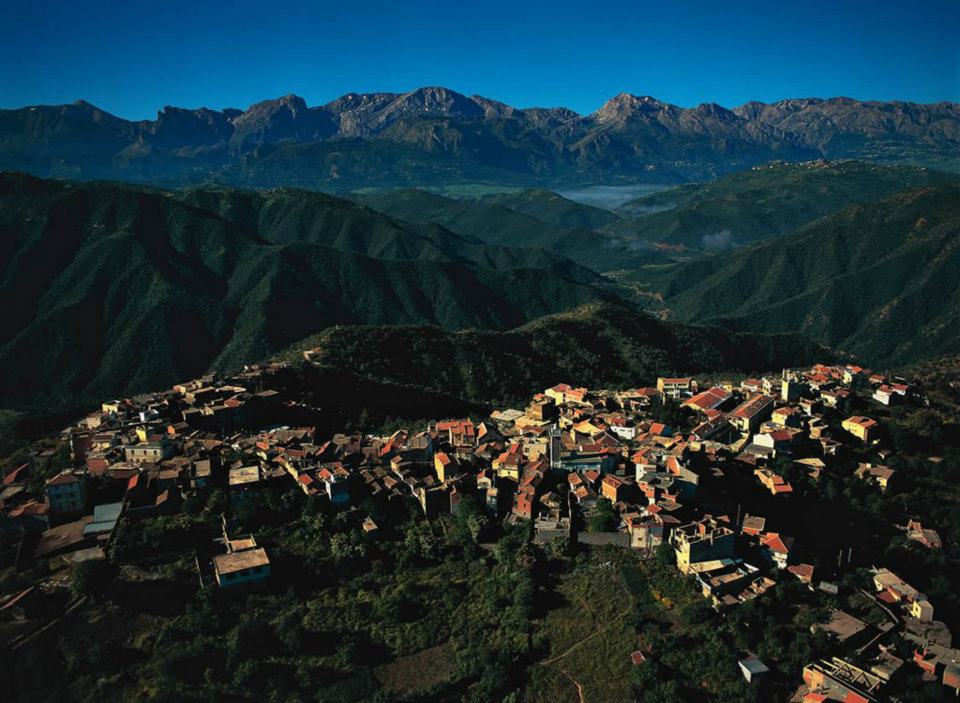
The reason to go is the villages around it, where Kabyle is the everyday language and the silver jewelry of Ath Yenni is still made.
For hiking, Djurdjura National Park has Lalla Khedidja (2,308 m), the Tikjda resort and Lake Agoulmime. On the coast, Béjaïa has Gouraya National Park (a UNESCO biosphere reserve since 2004) and the Cap Carbon lighthouse, about 220 m above the sea.
Visiting: Tizi Ouzou is about 100 km east of Algiers, under two hours by road. The villages are easiest with a local guide or driver who knows the mountain roads. Expect a few routine police checkpoints on the way, and keep your passport handy.
Natural landscapes in the Sahara
Hoggar Mountains
The Hoggar (Ahaggar) Mountains rise north of Tamanrasset in Algeria's far south. Their best-known part, the Atakor, is a cluster of volcanic peaks that turn red and orange at sunrise and sunset.
The upland covers about 550,000 square kilometers of the central Sahara, mostly bare rock, which is why it gets compared to Mars.

Much of it is in the Ahaggar Cultural Park, a national park from 1987, reclassified in 2011.
Mount Tahat, Algeria's highest peak, is usually given as 2,908 meters (some sources say 2,918).
The base is ancient metamorphic and granite rock; the sharpest peaks are volcanic plugs worn into needles and columns.
Visiting: Fly to Tamanrasset from Algiers (Air Algérie or its subsidiary Domestic Airlines) and travel with an approved Algerian agency; the authorities expect it, and the Sahara visa on arrival only applies to agency trips. Most trips include sunrise on the Assekrem plateau (about 2,726 m), where Charles de Foucauld built his hermitage in 1911. We run Hoggar trips only on routes our team knows well, with licensed local agencies and Tuareg guides.
As with any trip this far south, read your government's latest travel advice for the route and confirm that your insurance covers it. Go between about October and April, and give it several days.
Tassili n'Ajjer National Park
Tassili n'Ajjer is a sandstone plateau above Djanet, a UNESCO site since 1982. Its rock art is among the most important prehistoric collections anywhere: over 15,000 drawings and engravings by UNESCO's count, made between roughly 10,000 BC and the first centuries AD, showing wild animals, cattle herds, horses and camels.
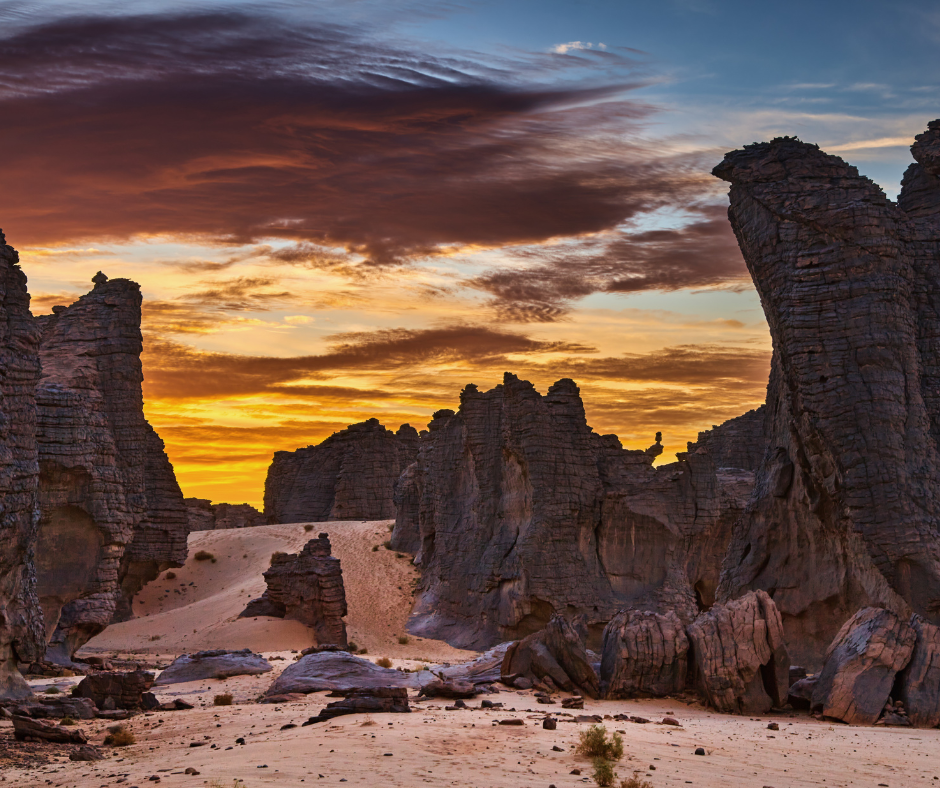
Visiting: Djanet is the gateway, with Air Algérie flights from Algiers and, in recent seasons, from Paris. Independent travel isn't possible: an approved local agency handles permits, guides and transport, and plateau treks start with a steep climb and involve nights camping. Don't pick up flints or potsherds; taking antiquities out of Algeria can mean prison.
Landmarks, UNESCO sites and mosque visits
If you only see one, which landmark is Algeria's most famous?
Inside Algeria, the Martyrs' Memorial (Maqam Echahid) is the national symbol, seen from almost everywhere in Algiers. Abroad, the best-known landmarks are the Casbah of Algiers and the Roman town of Timgad, both UNESCO sites. The newest icon is the 265-meter minaret of Djamaa El Djazaïr, finished in 2019.
Is every one of Algeria's UNESCO sites in this guide?
Yes, all seven: Al Qal'a of Beni Hammad (1980); Djémila, the M'Zab Valley, Tassili n'Ajjer, Timgad and Tipasa (all 1982); and the Kasbah of Algiers (1992). The Tassili is the one mixed cultural and natural site; the other six are cultural.
Is the Great Mosque's minaret really the tallest building in Algeria?
Yes. At 265 meters it is also the tallest minaret in the world.
Can I fit Djémila and Timgad into one trip?
Yes. Both are in eastern Algeria, with Constantine between them. Djémila is about 50 km from Sétif and Timgad about 35 km from Batna, so with a car and driver you can see one each day, spending a night in Constantine or Batna. Add the Sidi M'Cid bridge and you have a full eastern loop.
Can visitors go inside the Great Mosque of Algiers?
Yes, outside prayer times, and weekday mornings are quietest. The grounds are free; guided visits cover the minaret's observation deck and the museum and may need booking at busy times. Cover legs and shoulders, bring a headscarf if you're a woman, and avoid Friday midday prayers.
Apart from the landmarks, what is Algeria known for?
The Sahara, which covers over four-fifths of the country, with the Tassili rock art and the Hoggar peaks. Roman ruins such as Timgad and Djémila, the Casbah of Algiers, dates (Algeria is the world's third-largest producer), raï music from Oran and couscous, all have a strong claim too.
Tips for visiting Algeria's landmarks
You won't see every place on this list in one trip. Algeria is Africa's largest country, and the Saharan sites are a long domestic flight from Algiers.
With a week, we'd combine Algiers and Tipasa with either the east (Constantine, Djémila and Timgad) or the west (Oran and Tlemcen). The other option is a whole week in the Sahara: Djanet and the Tassili, or the red ksar of Timimoun and the Gourara dunes. Tell us which and we'll put the route together: someone waiting for you at arrivals in Algiers, a driver between cities and local guides at the main sites.
Day trips from Algiers work well for Tipasa and Kabylie. Timgad is best done from Batna, and Tlemcen and the M'Zab Valley each need at least one night.

Our Algeria travel guide has more tips on choosing which places to visit and planning your route.
A few rules apply almost everywhere. Carry cash in dinars, since ticket offices don't take foreign cards.
Don't photograph police, soldiers, checkpoints or government buildings. Leave drones at home: customs confiscates them. For a region-by-region picture of traveling here, see our guide to traveling safely in Algeria.


