
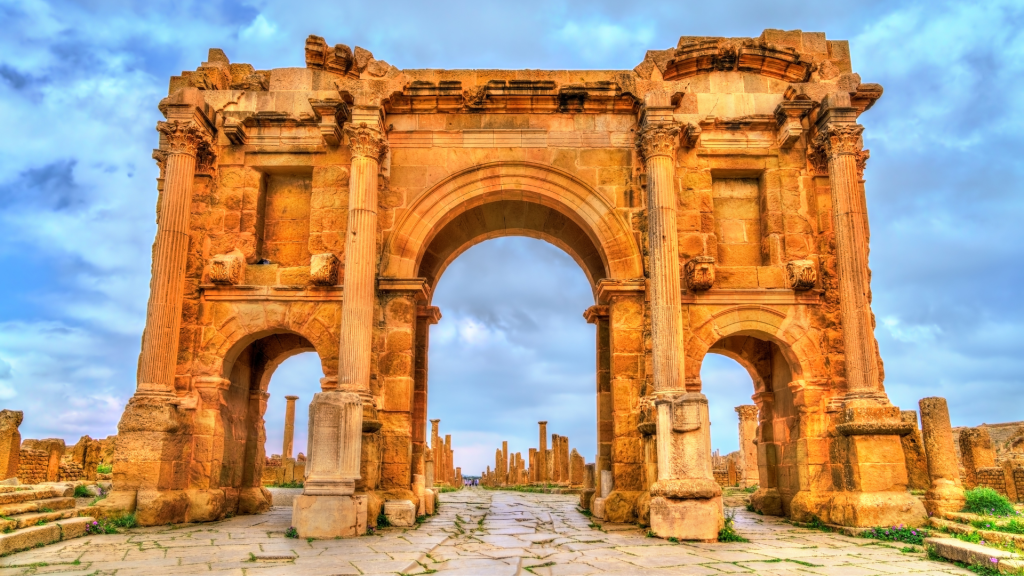

Timgad is worth a full day. It's a Roman town founded by the emperor Trajan around AD 100, on the UNESCO World Heritage list since 1982, and so much of its street grid survives that you can walk from Trajan's Arch to the Forum and the theater on the original paving. The ruins are 35 km east of Batna, so most visitors sleep in Batna and drive over in the morning.
Below: what to see, how to get there, when to go and a one-day plan. Give it most of the day (three to four hours in the ruins, 30 to 45 minutes in the museum), come in spring or autumn if you can, and carry cash, because that is all the ticket office takes. If you'd rather wake up next to the ruins, the four-star Trajan Hotel in Timgad village is about 80 m from the site, and it's the hotel our Algeria guide names for Timgad.
The History of Timgad
To the Romans it was Thamugadi, and few planned Roman towns anywhere have come down to us in such good shape. It is also one of the highlights in our roundup of things to do in Algeria.
A City Built on a Grid
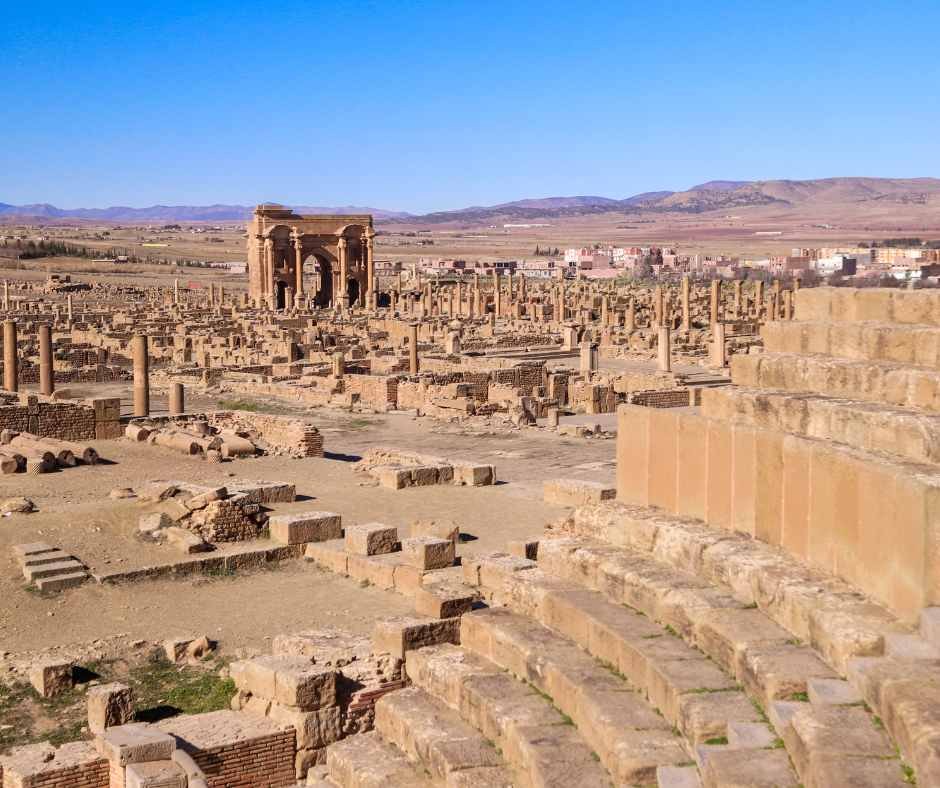
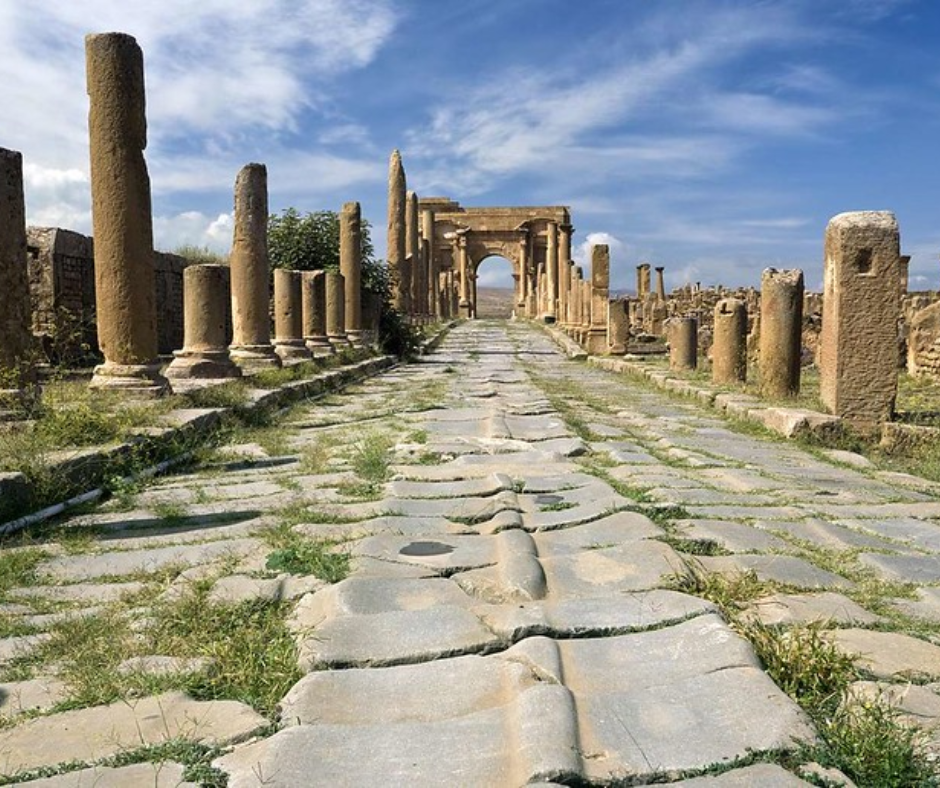
Trajan founded the town around AD 100 as a colony for veterans of the Third Augustan Legion (Legio III Augusta), soldiers who were given land here after their years of service. Because it was built from scratch on open ground, the engineers could lay it out as a square grid of near-identical blocks, crossed by the Decumanus Maximus running east to west and the Cardo running from the north gate to the Forum.
Walk in and the streets still meet at right angles. The town later spread beyond its original square, which is why some large buildings, such as the Great North Baths, stand outside the line of the first walls.
The Pompeii of Africa
Timgad is often called the "Pompeii of Africa." No volcano was involved. The comparison is about how much of an ordinary Roman town survives here: paved streets, colonnades, houses, markets and baths.
Timgad was abandoned in the 7th and 8th centuries, and nobody built a new town on top of it. The ruins lay partly buried under about a meter of sand and soil until French archaeologists began excavating in 1881. The dry climate of this high plateau (the site is at about 1,000 m) helped too.
Look for the ruts in the paving stones. Cart wheels wore them in over centuries of traffic.
Timgad after Rome
The town did not end with the Roman Empire. In the 4th century it was a stronghold of the Donatists, a breakaway North African church, and its bishop Optatus led the movement from about 388 until his arrest in 398.
5th century: the Vandals take North Africa, and Timgad is sacked.
Late 5th or early 6th century: Berber tribes from the Aurès wreck the town.
539 to 540: the Byzantine general Solomon builds a fort on the southern edge, reusing stone from the ruins.
645: the date of a chapel dedication, one of the last signs of life.
By the 8th century: the town is empty.
1881: French archaeologists begin systematic excavation.
Getting to Timgad: The Road from Batna
Timgad is about 35 kilometers east of Batna, the main city of the Aurès, or roughly 40 minutes by road. You can drive yourself, hire a driver in Batna, or take a bus or shared taxi.
Renting a Car
A rental car gives you the most freedom. There are agencies in Batna and in bigger cities such as Algiers and Constantine. If you pick the car up in Constantine, the round trip plus the site makes a long day, so consider a night in Batna or Timgad.
With your own car you can stop where you like on the way and stay until the site closes. The road from Batna is paved and generally in good condition. Expect police checkpoints on Algerian roads: slow down as you approach and have your passport and rental papers ready.
Book the car in advance if you are traveling during Algerian school holidays or around the Timgad festival in July.
Taxis and Collective Transport to Timgad
The cheaper way is a bus or a shared taxi (taxi collectif) from Batna. They drop you near the entrance to the ruins. Shared taxis leave when every seat is taken, so you may wait a little. Ask your hotel which Batna station the Timgad departures use.
For the return trip you may wait longer for a taxi to fill up, so don't leave it until dusk.
The Main Structures to See in Timgad
The site is large: allow three to four hours for the ruins alone. These are the structures worth walking to.
Trajan’s Arch in Timgad
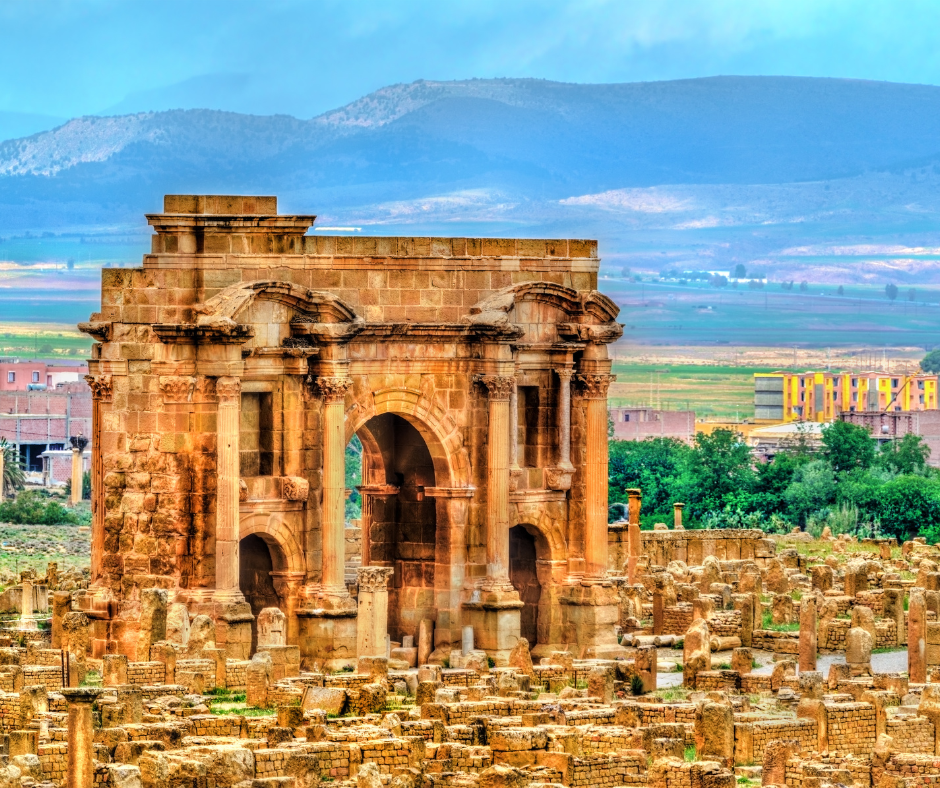
Start with Trajan's Arch, the best-known monument in Timgad. It stands about 12 meters high at the western end of the Decumanus Maximus, where it marked the town's western entrance. It is built mainly of sandstone, which turns a warm ochre in the afternoon sun.
Approach it along the Decumanus Maximus from the center of town, so the arch grows in front of you as you walk. It earns its place on our list of the top landmarks in Algeria for good reason.
The Ancient Theater in Timgad
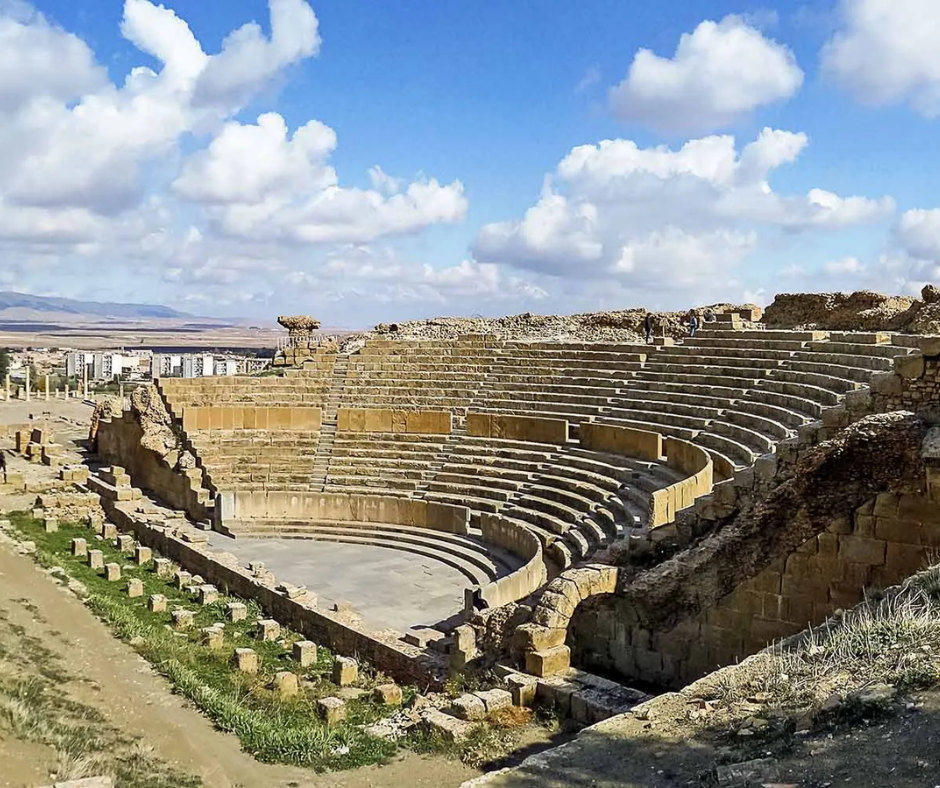
Next, climb to the Ancient Theater, built into the hillside south of the Forum. It held about 3,500 spectators and is still in good condition.
Climb to the top row for one of the best views over the town's grid. Timgad still hosts a well-known international music festival in summer, one of the festivals in Algeria worth timing a trip around. The concerts no longer take place in this Roman theater: since around 2010 they have been held in a modern open-air theater built next to the site to protect the ruins. The 43rd edition ran from 9 to 13 July 2026, after a three-year break.
The Public Library in Timgad
Timgad has one of the very few Roman public libraries ever identified. It stands on the Cardo, north of the Forum. A local notable, Julius Quintianus Flavius Rogatianus, paid 400,000 sesterces for it, and it dates from the late 3rd or 4th century.
In the semicircular main room, look for the rectangular niches in the walls. They held the wooden cupboards where the scrolls were kept.
Estimates put its capacity at about 3,000 scrolls, a sign that by then Timgad had become a comfortable civilian town with educated residents.
The Forum in Timgad
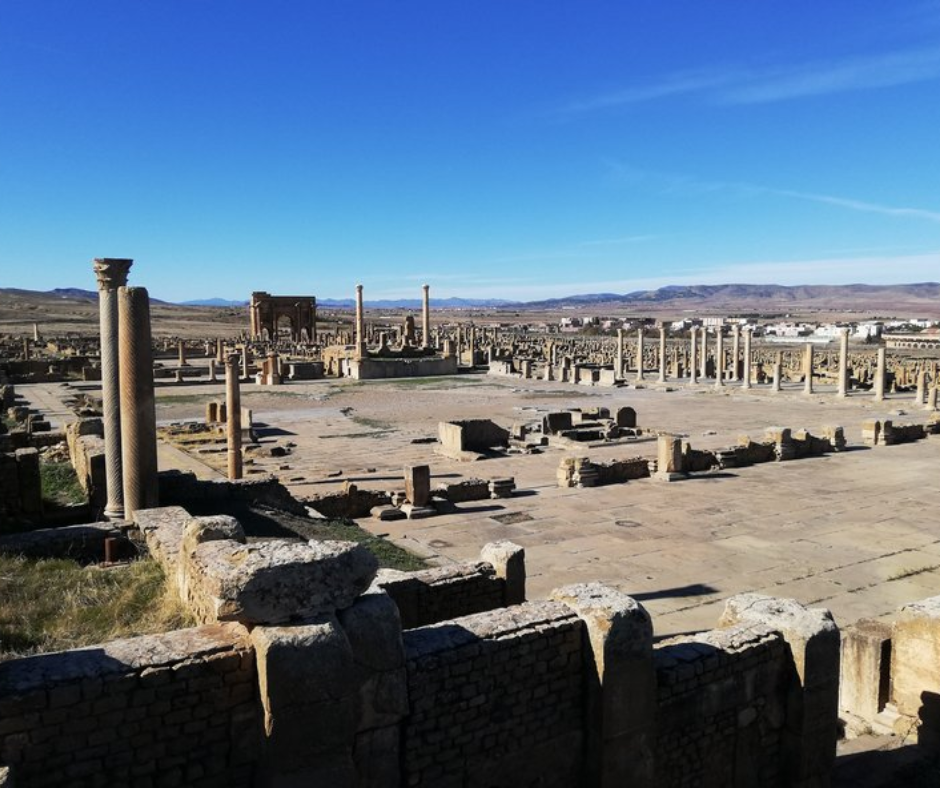
The Forum was the town's civic center, where people did business, met officials and argued politics. It is a paved square of about 50 by 43 meters, lined with colonnades, with the remains of the Curia (council house), a basilica and a small temple usually attributed to Victory.
Look for the inscription carved into the paving: "Venari, lavari, ludere, ridere, occest vivere" ("To hunt, to bathe, to play, to laugh: that is living").
The Great Baths in Timgad
Timgad had at least 14 bath complexes, a lot for a town planned for around 15,000 people.
The Great North Baths are huge, with some 40 rooms. You can still see parts of the hypocaust, the underfloor heating: the floors rested on small pillars so that hot air from the furnaces could circulate underneath and warm the rooms.
The Capitol
The Capitol was Timgad's main temple, dedicated to Jupiter, Juno and Minerva. It stands south of the Decumanus Maximus, not far from Trajan's Arch, outside the original grid. The temple measured about 53 by 23 m, and two of its columns, about 14 m tall, were put back up by the archaeologist Albert Ballu. Standing on the high podium, they are the tallest thing on the site.
The Market of Sertius
West of the old town, on the way to Trajan's Arch, is the market paid for around AD 200 by Marcus Plotius Faustus Sertius and his wife Cornelia Valentina Tucciana. It is a courtyard with porticoes and stone stalls, ending in an apse. Their house stands next door, and an inscription names the couple.
The Byzantine fort
At the southern edge of the site is the fort Solomon built in 539 and 540. It is about 111 by 67 m, with eight towers, and parts of its walls still stand 8 to 12 m high. Inside are the remains of a chapel, baths and a cistern. Look at the walls closely: many blocks were taken from Roman buildings.
The churches
Christian Timgad left several churches, including the Donatist cathedral and a small square church with a round apse near the Capitol. They are low ruins and easy to miss, so ask your guide to point them out on the way to the fort.
To fit all of this in, here is roughly where each monument sits on a walk from the entrance.
| Monument | Where on the site | Why go |
|---|---|---|
| Museum | At the entrance | The mosaics, before you walk the ruins |
| Cardo and library | North of the Forum | One of the few Roman public libraries ever found |
| Forum | Center of the grid | The paving inscription and the Curia |
| Theater | South of the Forum, on the hillside | The best view over the grid |
| Market of Sertius and Trajan's Arch | West end of the Decumanus | The arch at its best in afternoon light |
| Capitol | South of the Decumanus, near the arch | The two tall re-erected columns |
| Great North Baths | North, outside the first walls | Some 40 rooms and the hypocaust |
| Byzantine fort | Southern edge | Walls still 8 to 12 m high |
The Museum of Timgad and Its Mosaics
The site museum is right at the entrance. It reopened in the late 2010s after years of closure, and it is worth the time: the ruins give you the scale, the museum gives you the art.
Its four rooms hold mosaics lifted from the floors of Timgad's houses and baths. Look for Neptune in his chariot, Diana and Actaeon, and Venus riding a sea centaur. One small panel from the northwest baths shows an enslaved Black man carrying embers to heat the baths, a reminder of the forced labor behind Roman bathing culture.
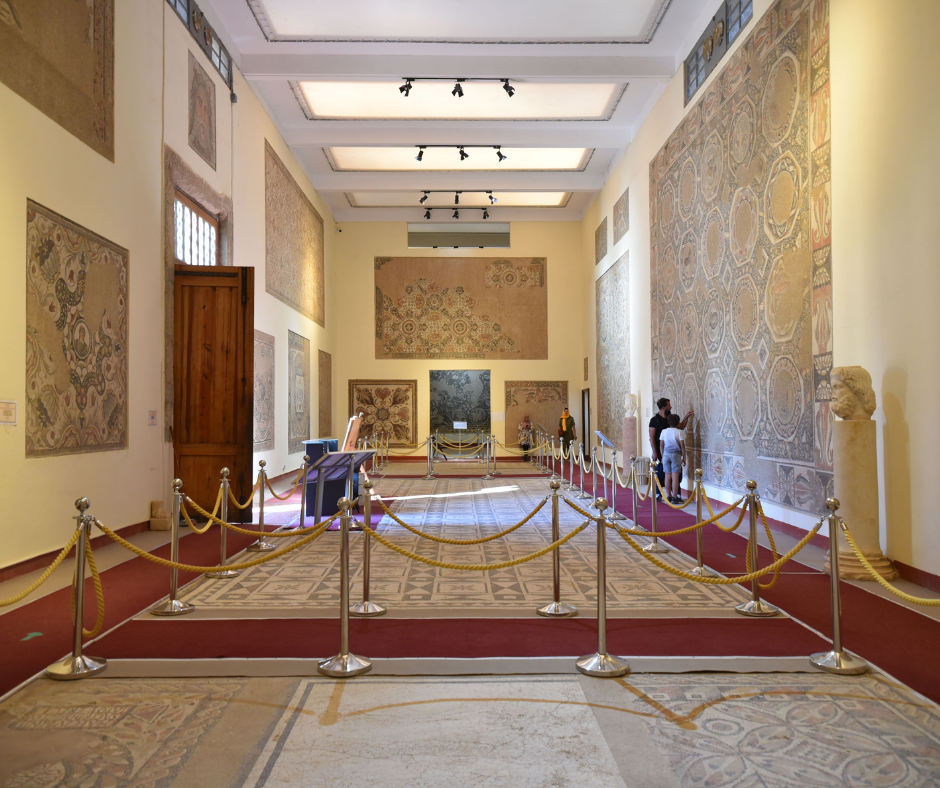
Give it 30 to 45 minutes, ideally before you walk the ruins, so you can picture what the bare floors outside once looked like.
Tickets and opening hours
We could not find an official 2026 tariff for Timgad. Recent visitor reports put it in the same 200 to 300 DZD band that Algeria's national museums and sites generally charge, so budget a few hundred dinars for the ruins and the museum together: under EUR 2 at the official rate of about 150 dinars to the euro (autumn 2026). It's cash only.
Opening hours are not published online either. The site opens in the morning and closes before dark, so arrive early and ask at the ticket office how late you can stay.
Timgad tours and guides
Most visitors see Timgad on a day trip by car. On a typical guided day from Batna, a driver collects you at your hotel, you spend the morning in the museum and the ruins with a site guide, and you are back in Batna by late afternoon. From Constantine, add about 4 hours of driving there and back, or sleep a night in Batna.
Site guides wait at the entrance, and some speak English. A good one makes sense of the low walls and takes you to the Capitol, the market and the fort, which most visitors skip. We can arrange a driver from Batna or Constantine, a guide at the site and a hotel night in Batna as part of a custom Aurès trip.
Planning the Day Trip
When to Visit Timgad
Go in spring (March to May) or autumn (September to November). Timgad sits at about 1,000 m, and those months are usually mild enough to walk the site for hours. There is almost no shade among the ruins, so start early whatever the season.
Summer (June to August) is hot and very exposed: arrive at opening time and save the middle of the day for the museum and lunch. July also brings the festival crowds. Winter (December to February) is cold at this altitude, with rain and occasional snow, so bring warm layers and waterproofs. The upside is that there are fewer visitors.
Where to Stay and Eat
Timgad itself is a small modern village next to the ruins, with only a few simple places to eat. Many visitors bring a picnic: buy bread, cheese, fruit and water in Batna before you leave.
For more choice, base yourself in Batna, which has hotels from basic to business class. If you want to be at the gate when it opens, the Trajan Hotel next to the site is the alternative.
Two days in the Aurès
With a second day, Batna makes a good base for more of the region. Lambaesis (Lambèse), at Tazoult about 11 km southeast of Batna, was the camp of the Third Augustan Legion, the same legion whose veterans settled Timgad, and its tall 3rd-century Praetorium still stands.
North of Batna, toward Constantine, the Medracen is a round Numidian royal tomb about 59 m across, older than anything Roman in the area. Further southeast, beyond Arris, the balconies of Ghoufi look down into a canyon of the Oued Abiod with an abandoned troglodyte village. You can read more about it in our guide to the Aurès Mountains.
What to Pack for Timgad
Pack for sun and uneven ground:
A wide-brimmed hat, sunglasses and loose, light clothes (linen or cotton) that cover your arms and legs. The pale stone throws back a lot of glare, and covered clothes also fit local dress norms.
Sturdy walking shoes with good grip, not sandals. The Roman paving is uneven and slippery where it is worn smooth or wet.
At least 1.5 to 2 liters of water per person in warm weather. You can’t refill out among the ruins.
A One Day Itinerary for Timgad
Here is how we would spend a day in Timgad, arriving by road from Batna. Check the closing time when you buy your ticket and adjust if needed.
-
10:00 AM: Arrive, buy your ticket (cash) and hire a guide at the entrance if you want one. Start at the museum.
-
11:00 AM: Enter the ruins and walk the Cardo north of the Forum to the library.
-
12:30 PM: Back at the Forum, find the inscription about hunting, bathing and laughing in the paving.
-
01:30 PM: Picnic near the entrance, out of the sun if you can find some shade.
-
02:30 PM: Head to the Theater and climb to the top for the panoramic view.
-
03:30 PM: Walk out to Trajan's Arch. By now the sun is in the west and lights the arch's outer face.
-
04:30 PM: Head back to the entrance, look at the souvenir stalls if they're open, and drive back to Batna (about 40 minutes).
Photography Tips for Timgad
-
Late afternoon: Low sun throws long shadows from the columns across the streets. The best light may come close to closing time, so ask at the ticket office how late you can stay.
-
Scale: Have your travel companion stand at the base of Trajan's Arch. Without a person in the frame, photos make the 12 m arch look smaller than it is.
-
Texture: Get close to the carvings and the wheel ruts in the paving. Wide shots miss them.
Practical Tips for Visiting Timgad
-
Hire a Local Guide: Many of the low walls are hard to make sense of on your own. Guides can usually be found at the entrance, some of them English-speaking. Agree on the price before you set off.
-
Bring Cash: The ticket office and the stalls take Algerian dinars in cash only, and cards are no use at the site or in the village. Get cash in Batna before you leave.
-
Restrooms: Use the toilets near the entrance before you start. The site is big, and walking back takes time.
-
Respect the Site: Don't climb on the walls or columns, and leave stones and pottery fragments where they are. Taking antiquities out of Algeria is a crime that can lead to prison.
Timgad tickets, transport and timing
What is the entrance fee for Timgad? A few hundred dinars, cash only, which is under EUR 2 at the official rate; bring small notes and hang on to your ticket.
Who destroyed Timgad? No single enemy. The Vandals sacked it in the 5th century, Berber tribes from the Aurès wrecked it in the late 5th or early 6th century, and the Byzantines built a fort there in 539. Life faded after the 7th century, and by the 8th the town was empty and slowly filled with sand.
How do you get to Timgad from Constantine? By road, about 2 hours each way via Batna. Hire a driver for the day, drive yourself, or take a train or bus to Batna and a shared taxi for the last 35 km. Many travelers sleep in Batna so they reach the site at opening time.
Can you visit Timgad as a day trip from Algiers? Not comfortably by road. Fly from Algiers to Batna with Air Algérie, then drive 35 km to the site, and plan to sleep at least one night in Batna. That also leaves time for Lambaesis or Ghoufi the next morning.
How long do you need at Timgad? Most of a day: 3 to 4 hours for the ruins, 30 to 45 minutes for the museum, plus lunch. Start at opening time if you also want the Capitol, the Market of Sertius and the Byzantine fort.
Is Timgad worth visiting? Yes, if you like Roman sites. Few places let you walk a complete planned Roman town on its original paving with so few other visitors. It suits travelers already in Constantine or the Aurès; on its own it is a long trip from Algiers.
If Timgad is one stop on a longer trip, read these two first:
Want Timgad on a custom Algeria route?
WildyNess is a local operator: we plan custom itineraries around Algeria, with the drivers, hotels and local guides, so you can spend your time at sites like Timgad. Tell us your dates and budget and we’ll send you a free, personalized plan.
Share Your Trip Idea With WildyNess
Curious what other travelers have to say? WildyNess reviews on Google


