


Timimoun is the main town of the Gourara, a chain of oases in Algeria's western Sahara, and it is called the Red Oasis for its ochre earth buildings. To go, fly from Algiers with Air Algérie to Timimoun airport (TMX), travel between October and April, and book through an approved Algerian agency, which the authorities expect of foreigners in the south.
Timimoun stands at about 288 m with its palm grove at its feet; past the gardens to the northwest lies a sebkha (a dry salt lake), and past that, the dunes of the Grand Erg Occidental. It is now a wilaya (province) in its own right, no longer part of Adrar. Visitors are usually struck by how quiet and friendly the town feels, and we run our Gourara trips with local Gourara guides. Police checkpoints on the roads will ask where you're going, so keep your passport handy.
By road, Timimoun is about 460 km from Taghit via Béni Abbès and Kerzaz (around 7 hours) and about 630 km from Ghardaïa via El Menia. Avoid summer: July highs average around 44°C. We'd allow three or four days for the old town, the palm grove, the sebkha circuit and a night in the dunes. For the rest of the country, from the coast to the big cities, there is our guide to Algeria.
Inside Timimoun's old ksar
Defense and heat shaped the old ksar, the fortified earth village at the heart of Timimoun. Its mud-brick walls are thick, there are few openings onto the street, and the lanes are narrow enough to stay in shade.
The neo-Sudanese style
The red ochre walls are what you notice first. The decorated town center, with its spiky crenellations, pilasters and pointed wall tops, is neo-Sudanese: a style borrowed from West African mud architecture and brought in during the French colonial period, then built by local masons who added Zenata Berber geometric motifs. The best example is the former Hôtel Oasis Rouge (1917), now a protected monument that houses CAPTERRE, Algeria's center for earthen architecture.
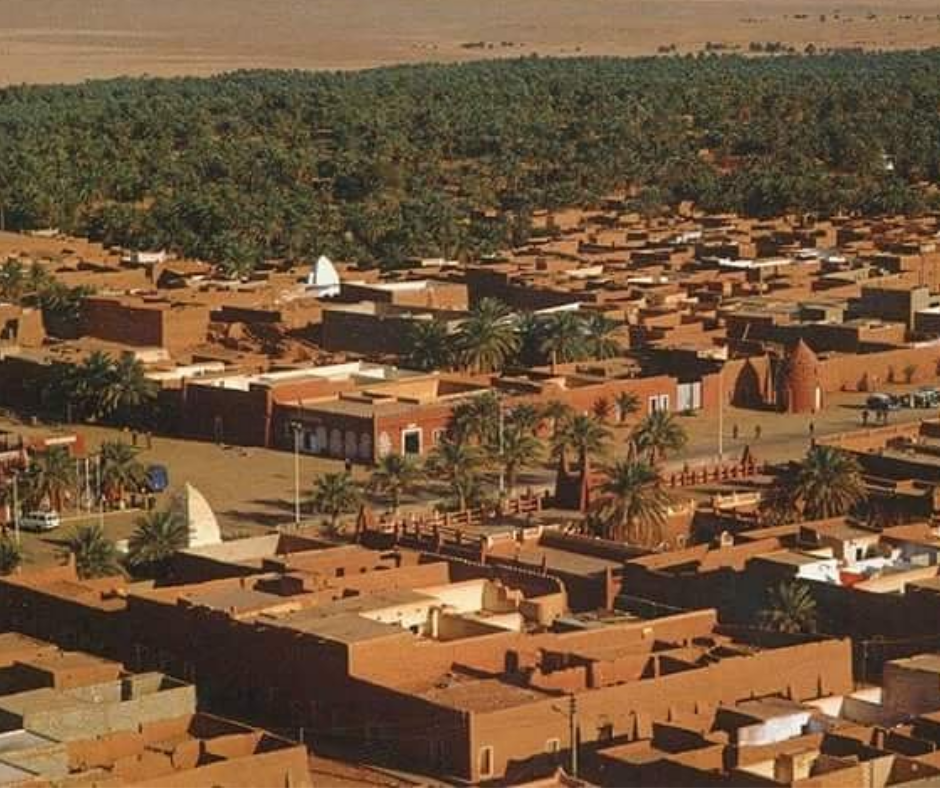
Along the rooflines and parapets you'll see rows of pointed clay spikes and raised geometric patterns worked into the plaster.
Here they are mainly decorative. The real upkeep is the plaster itself: earth walls wear away in the wind and the rare downpour, so they need fresh mud rendering regularly, and a house left empty decays quickly. That is why so many of the ksour around Timimoun are half ruined.
The covered alleys and the heat
The lanes of the old town are narrow, winding and partly roofed over.
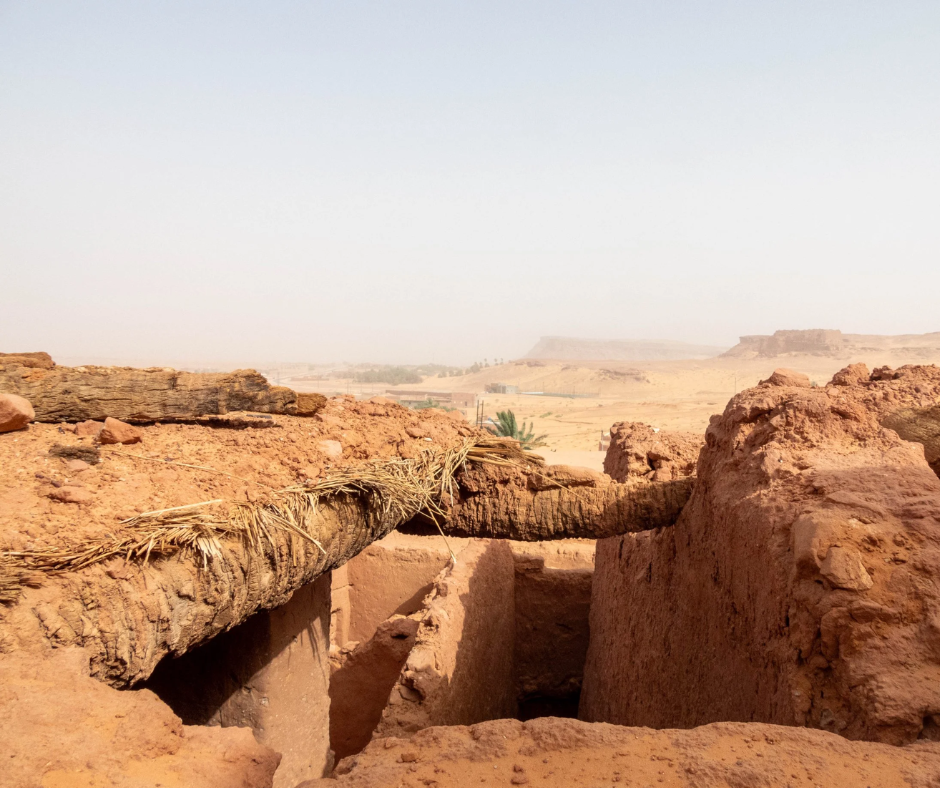
The sharp turns help break the wind and keep blown sand out of the center, and they also made the village easier to defend.
Because the walls are high and close together, the lanes stay in shade for most of the day. On a hot afternoon they are noticeably cooler than the open streets of the newer town.
Local etiquette in the ksar
Parts of the old ksar are still lived in, so treat the lanes as someone's street: keep your voice down, don't wander into courtyards, and dress modestly, with shoulders and knees covered.
Greet people with salam alaykum, and ask before you photograph anyone, especially women, or point a camera through an open doorway.
A guide from Timimoun is worth having here. You won't waste time in dead-end lanes, and a local can tell you which families lived where and how the old caravan trade with West Africa shaped the town. On an agency trip, one is usually included.
Seasons, the New Year rush and cash
| Planning point | What it means in Timimoun |
|---|---|
| Flights | Air Algérie from Algiers, about 1.5 hours, to an airport 4 km from town |
| Season | October to April; stay away from June to August |
| The busy week | Late December and New Year, when Algerian visitors fill the hotels |
| Length of stay | Three or four days |
| How you go | With an approved Algerian agency, a 4x4 and a local guide |
| Paying | Cash in dinars; cards are not something to count on |
How the palm groves are watered: the foggaras
Timimoun gets almost no rain, so its palm grove has always depended on groundwater brought to the surface by hand-dug channels.
How a foggara works
A foggara is a gently sloping tunnel dug back into the higher ground above the oasis until it reaches water-bearing rock. The water then runs down it by gravity to the gardens. From the surface you only see a line of access shafts, which the diggers used to haul out spoil and which are still used for cleaning. Lengths range from under a kilometer for small garden foggaras to about 20 km for the longest in the region, according to the hydrologist Boualem Remini.
Because the water stays underground until it reaches the gardens, little of it is lost to evaporation. The threat today is modern: pumped wells have lowered the water table, and many foggaras have dried up or carry far less than they used to. In a 2010 study, Remini counted about 820 still working across the Gourara, Touat and Tidikelt.
Sharing the water: the kesria and the kiel el ma
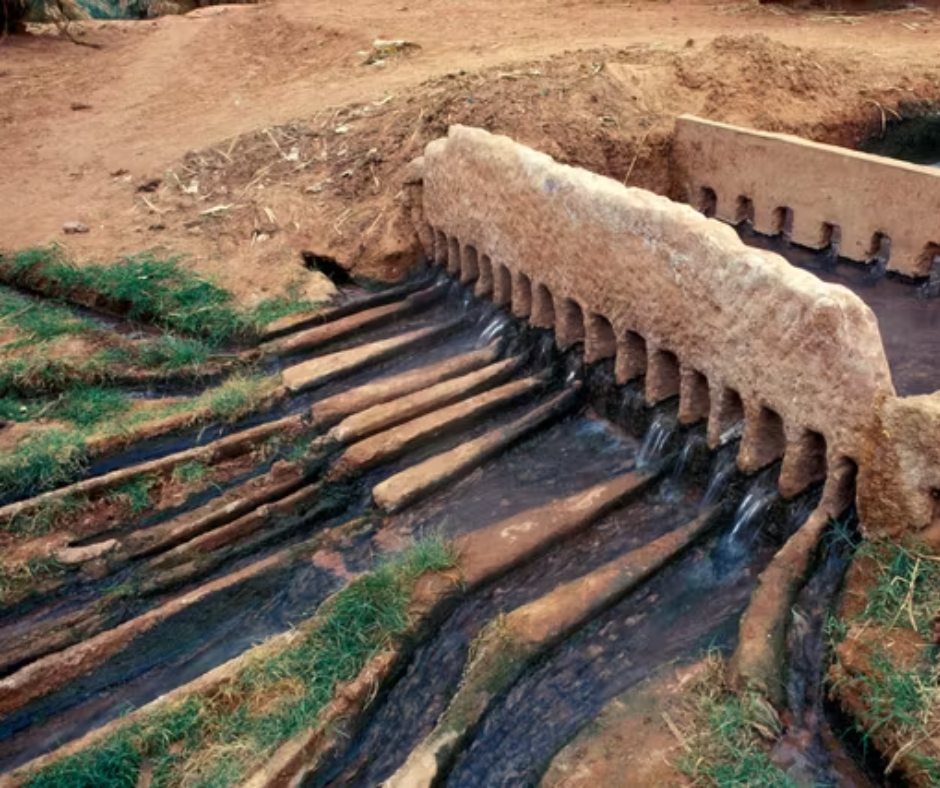
Where a foggara comes out at the edge of the palm grove, the water runs into a kesria, a comb-shaped distributor of stone and clay that splits the flow into one channel for each owner. Each share is gauged by the water measurer, the kiel el ma, with a copper plate pierced with holes of different sizes.
Shares are inherited and can be bought and sold, so the channels coming off a kesria are often very unequal in size. The water feeds the date palms, with fruit trees and vegetables grown in their shade. UNESCO added the foggara water measurers of neighboring Touat and Tidikelt to its Urgent Safeguarding list in 2018.
The paths through the palm grove follow the channels, so a walk there with your guide is the easiest way to see a kesria at work. The gardens are private, so ask before you go in.
Sunset on the sebkha
Beyond the palm grove to the northwest is the sebkha, backed on its far side by the dunes of the Grand Erg Occidental.
The sebkha and the Grand Erg Occidental
The sebkha is an old salt lake. For most of the year it is a dry, flat crust of clay and salt that shows white where the salt has dried on the surface. Small fortified ksour line its edge, many of them partly abandoned.
On the far side, the orange dunes of the Grand Erg Occidental rise above the flat floor of the basin. Timimoun is one of the three great desert regions we compare in our guide to the Algerian Sahara.
The usual 4x4 outing, the sebkha circuit, crosses the salt flat to the ksour on the far side. On the hard ground at the foot of the dunes you can find desert roses, rosette-shaped clusters of gypsum crystals and sand that form as salty groundwater evaporates.
Where to watch the sunset
Go out in the last hour before sunset, when the light is low and the heat has eased.
The salt floor picks up the color of the sky, and the dunes on the far side turn deep orange, then red.
The easiest viewpoint in town is the terraces of the Hôtel Gourara, a 1970s building by the French architect Fernand Pouillon on the edge of the palm grove, which look over the gardens and the sebkha to the erg. For the dunes themselves you need a 4x4 and a driver. Many visitors stay on for a night in the dunes, and our notes on Sahara camping in Algeria explain how to do it well.
Beyond town: the sebkha circuit and the caves of Ighzer
Outside town you need a 4x4 and a local driver, because the tracks off the paved roads cross soft sand; your agency will arrange both. For a longer trip with Tuareg hosts further south, see our Algeria nomad experience.
The ksar of Ighzer
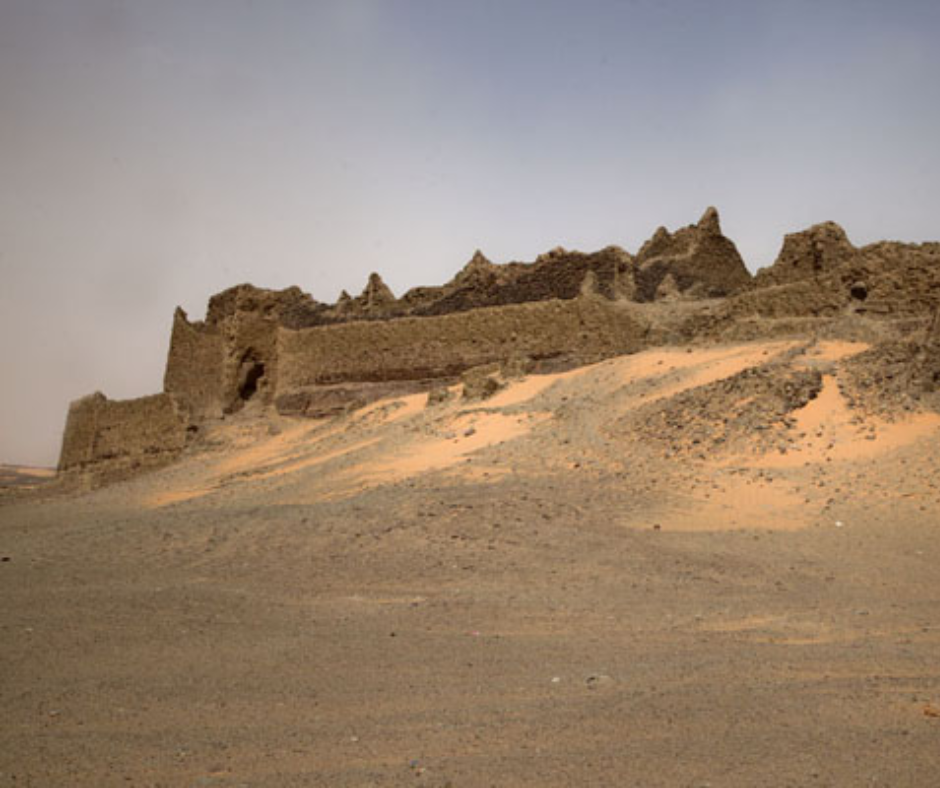
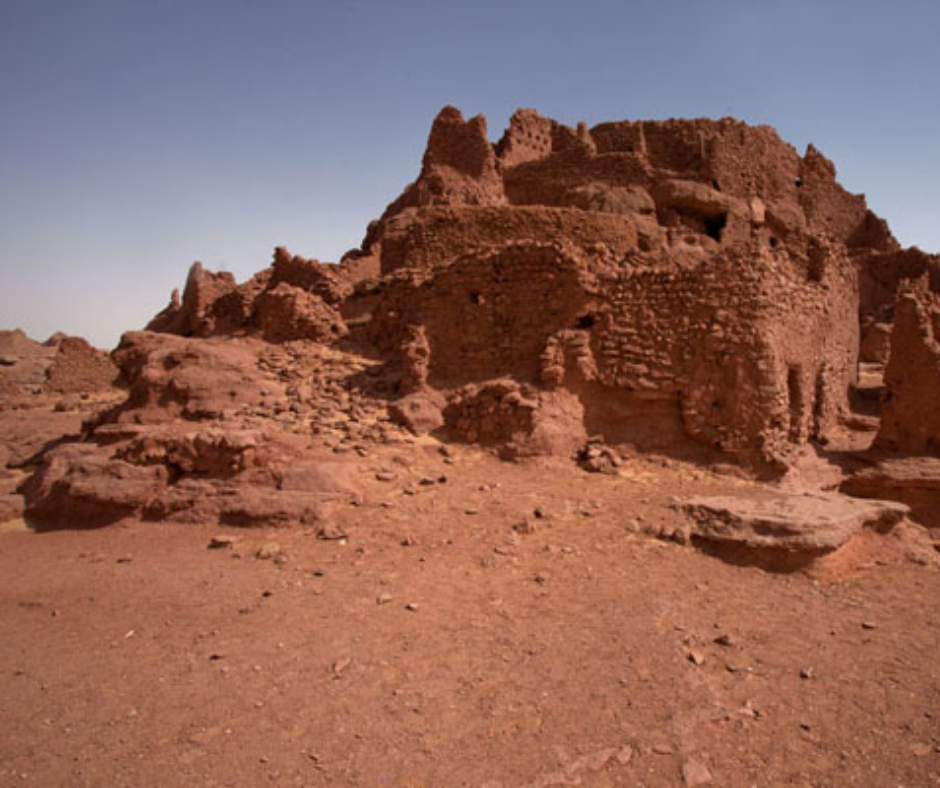
Ighzer is on a rocky rise northwest of Timimoun, across the sebkha, and is usually the first stop on the sebkha circuit.
Like most ksour in the Gourara, its stone and earth ksar was built on high ground so the villagers could see who was coming. It is mostly in ruins now, but from the top you look out over the salt flat, the old fields and the dunes beyond.
At the highest point stands a white, tower-like tomb of a marabout, a local holy man.
The caves below the ksar
Below the ksar, caves are cut into the soft sandstone, and the largest runs dozens of meters back into the hill.
The villagers used the smaller ones to store dates and other food, because the rock keeps them cool.
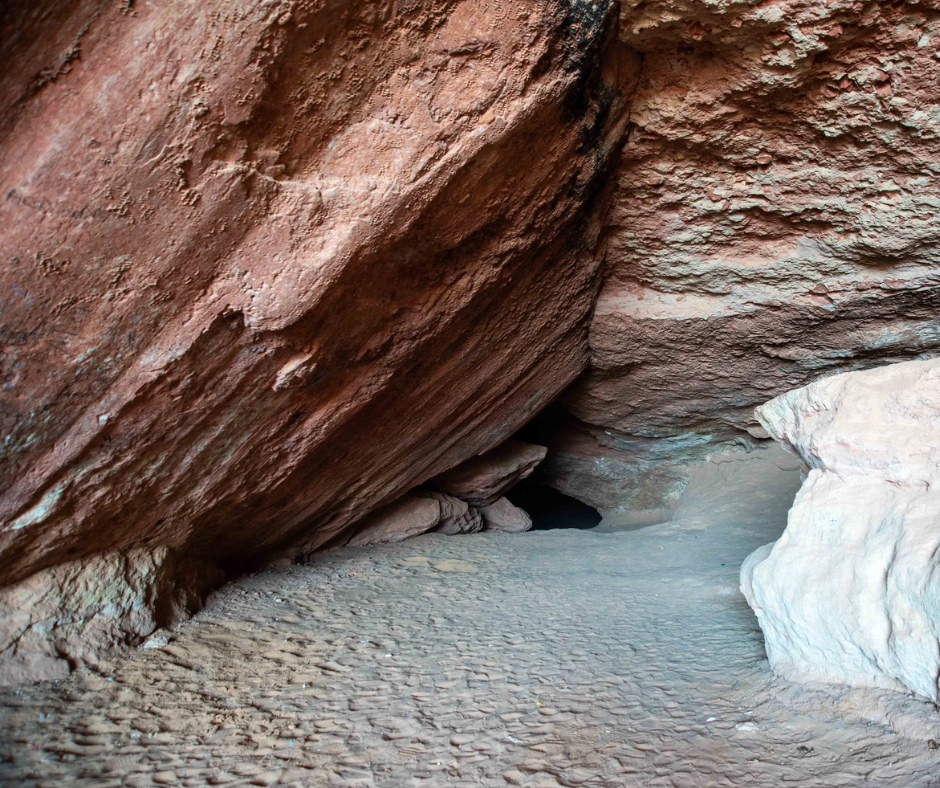
The big cave was also a refuge: people spent the hottest hours of summer days inside it. Bring a flashlight if you want to go in.
Timimoun tours and what they cost
Most visitors come on a short agency trip of three to five days. A typical one includes the airport pickup, a hotel or guesthouse, all meals, a French- or English-speaking local guide, a 4x4 day on the sebkha circuit with Ighzer and its caves, a walk through the palm grove and foggaras, and sunset tea in the dunes. Many add a night in a dune camp with a cook.
Prices vary with the season and the group size. As a benchmark, four-day Timimoun trips started from about EUR 450 per person in 2026, including the return flight from Algiers, meals and the guide, but not the visa, insurance or tips. New Year departures cost more and sell out first. Tips for the guide, driver and cook come on top: plan on about 1,500 to 2,000 DZD per traveler per day.
Where to stay in Timimoun
The Hôtel Gourara is the landmark: Fernand Pouillon's 1970s building on the edge of the palm grove, reopened in 2015 after a long rehabilitation, with 98 rooms and terraces over the sebkha. It is about 10 minutes from the airport, and it was still the usual base for groups in 2026.
The alternatives are small guesthouses in and around the old ksar, often family-run in restored earth houses, and dune camps beyond the sebkha for a night under the stars. Book early for late December and New Year, when Algerian families and agency groups take most of the rooms. Pay in cash.
Three days in Timimoun
Day 1, the town. Arrive, walk the old ksar with a local guide, see the neo-Sudanese facades around the former Hôtel Oasis Rouge, and watch the sunset from the Hôtel Gourara terraces.
Day 2, the palm grove. Follow the foggara channels to a kesria, visit a garden with permission, and spend the afternoon at the market and the craft shops.
Day 3, the sebkha circuit. A 4x4 takes you across the salt flat to Ighzer and its caves, then on to the Grand Erg Occidental, where you can stay for sunset tea or sleep in a dune camp.
Crafts and what to buy
Timimoun's crafts are textiles and leather: embroidered wall hangings, red and green carpets woven with Zenata symbols, and colorful leather slippers (babouches). Dates from the palm grove make an easy gift, but check your home country's rules on bringing food back. Bargain politely and pay cash.
The Ahellil of Gourara: Timimoun's UNESCO-listed music
Timimoun's other heritage is musical.
How the Ahellil is performed
The Ahellil of Gourara is a sung poetry of the Zenata oases around Timimoun, and it has been on UNESCO's intangible heritage list since 2008.
It is performed at night, at weddings, local fairs and religious festivals, mostly in Zenete, the local Berber language, with Arabic religious phrases mixed in.
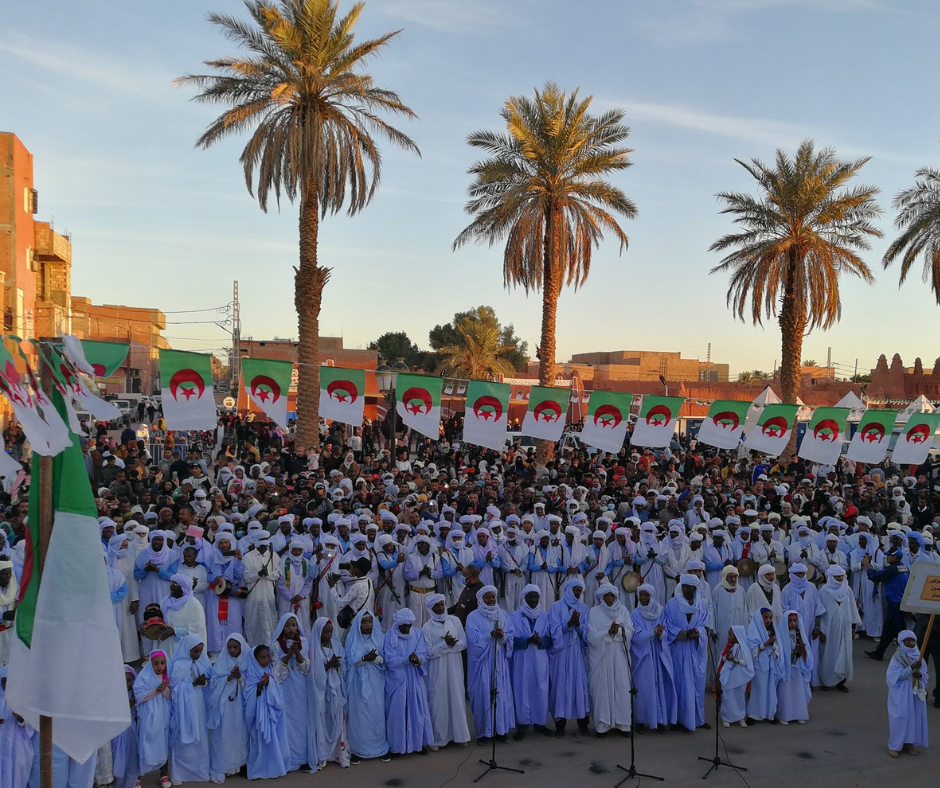
A soloist, the abechniw, stands at the center of a circle of singers, sometimes close to a hundred of them, who stand shoulder to shoulder, clap and answer the soloist's lines. A flute player and a drummer stand beside the soloist, and some groups add a two-stringed lute or two stones struck together to keep the beat.
What the songs say, and when to hear them
The poems mix love songs with religious verse, and some of the oldest Zenete lines are now hard even for the performers to understand. Fewer women take part than in the past, especially in the larger towns.
The biggest occasion to hear it is the S'boue (Sbuâ), the pilgrimage to the zawiya of Sidi El Hadj Belkacem in the week after Mawlid, itself on UNESCO's list since 2015. It follows the lunar calendar and moves about 11 days earlier each year: the next one should fall around 21 or 22 August 2027, in deep summer heat. Outside that, ask your agency whether a group is performing at a wedding or festival while you're there.
Getting there, guides, timing and tour prices
Should I fly or drive to Timimoun?
Fly if you can. Air Algérie gets you from Algiers to Timimoun airport (TMX), about 4 km from town, in roughly an hour and a half, and your agency picks you up there. The roads in, about 460 km from Taghit via Béni Abbès and about 630 km from Ghardaïa via El Menia, make for very long days.
Where does the "Red Oasis" name come from?
Its buildings: the old ksar and the colonial-era center, neo-Sudanese facades included, are built and rendered in red ochre earth.
Can I explore Timimoun and the sebkha without an agency?
Not realistically. Foreigners in the south are expected to go with an approved Algerian agency, the Sahara visa on arrival is only issued for agency trips, and the sebkha tracks call for a 4x4 and a driver who knows them. A local Gourara guide also makes the ksar and the foggaras far easier to understand.
Which months are most comfortable in Timimoun?
October to April, with October, November, February and March the most comfortable: warm days and cool nights. December and January nights can be cold, and late December brings the New Year crowds. From May the heat builds, and July highs average around 44°C.
What does a four-day Timimoun tour cost?
From about EUR 450 per person from Algiers in 2026, with the flight, accommodation, meals, a guide and a 4x4 day included; private trips, New Year dates and dune nights cost more, and visa, insurance and tips are usually extra.
Timimoun is also on our Algeria desert road trip, as part of the western loop with Taghit. If you would like help planning your own route through the Gourara, tell us what you would like to see and we will put it together, from the airport pickup in Timimoun to a 4x4 and driver for the sebkha and a night in the dunes with a local guide and cook.


