

For couples, the draw is Roman ruins, old medinas and a Sahara camp of your own without the crowds, because foreign tourists are still few. The trade-offs: a visa arranged in advance, low-key public affection, and hotel rules on who shares a room, which mostly affect Algerian couples (see the rules below).
We'd come in October and November or in March and April, when the coast and the Sahara are both comfortable, and allow 7 days for two regions or 10 for three. Below are the five places we'd pick (Algiers, Tipaza, Djanet, Oran and Constantine), plus Tlemcen and Taghit as add-ons, then where to stay, what it costs, two sample routes and honeymoon tips.
Rules for couples in Algeria
Affection stays private here. Holding hands is about the limit in public, and rural areas are more conservative than Algiers or Oran, as we mention in our guide to visiting Algeria. Kissing or embracing in the street is frowned upon and can draw police attention under public-indecency law. Dress modestly as well: shoulders and knees covered in towns, more so in the south.
Hotels. Every hotel and guesthouse records your passports at check-in, and Algerian couples are routinely asked for a marriage certificate or family booklet (livret de famille) to share a room. That also applies when one partner is Algerian, including dual nationals. Foreign couples on foreign passports are usually checked in without questions, but practice varies, and Belgium's foreign ministry notes that some hotels make unmarried couples take two rooms. If you're married, carry a copy of your marriage certificate just in case.
Alcohol. Licensed shops, hotels and a few restaurants sell it, though most restaurants don't, and the law forbids drinking or being drunk in a public place. A glass of wine with dinner usually means eating at a hotel.
Same-sex couples. The UK FCDO is blunt: "Sexual acts between people of the same sex are illegal in Algeria." The penal code (article 338) sets prison terms of up to two years. Discretion in public and at check-in is the realistic approach.
Algiers: historical highlights and the bay
Most international flights land in Algiers, so this is where nearly every trip starts.
The city climbs steeply from its bay: the Ottoman-era Casbah on the hill, the white, French-built boulevards of the lower town along the seafront, and Notre-Dame d'Afrique, a neo-Byzantine basilica inaugurated in 1872, on the cliffs to the north-west. Get up there by taxi, since the Bologhine cable car that used to climb to the basilica has been out of service for years. We'd give the city at least three days. Our 3 days in Algeria itinerary shows how to split that time between the Casbah, Tipaza and the gardens.
Walking the historic alleys of the Kasbah
The Kasbah has been on the UNESCO World Heritage list since 1992. It is a steep maze of Ottoman-era houses, mosques and small workshops running down the hill toward the sea. Start at Place des Martyrs at the bottom, next to the Ketchaoua Mosque (first documented in 1612 and reopened after restoration in 2018), and climb from there.
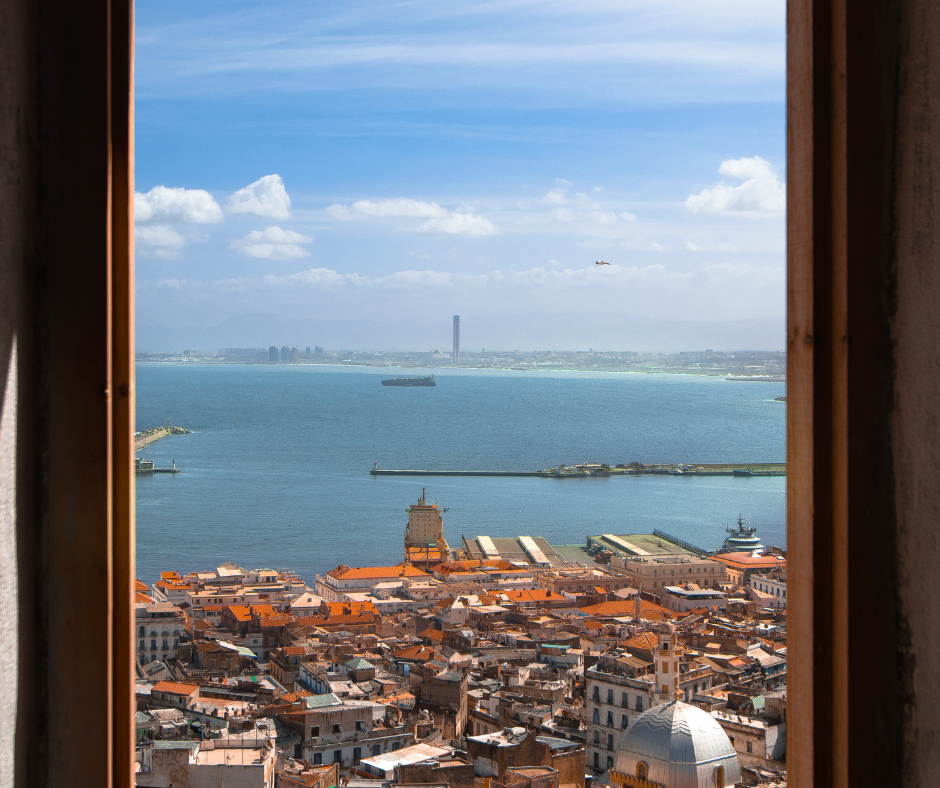
Take it slowly, and take a guide. The stepped lanes are uneven, plenty of houses are in poor repair, and getting lost is easy. We can put you in touch with a local guide for a half-day walk, which leaves you free to look up instead of at a map.
Traditional neighborhood cafés are mostly men's territory, so for mint tea or a strong coffee as a couple, a tea room or one of the larger cafés on the main boulevards is more comfortable.
Staying in a historic dar
For the most atmospheric stay, look for a restored traditional house, a dar, in or just outside the Casbah. Only a handful take guests, so book early.
The good ones keep the high ceilings, painted tiles and a central courtyard, and a top-floor room often comes with the roof terrace and a view of the bay. The downsides: cars can't reach most houses, so you'll carry your bags up stairs, and comfort varies a lot. If you'd rather have a lift and a pool, stay in a large hotel on the hills or near the seafront and visit the Casbah by day.
If you're not married, or one of you is Algerian, read the rules for couples above before you book.
Roman History and Coastal Views in Tipaza
Tipaza (Tipasa in its Latin form) is about 70 km west of Algiers, roughly an hour to an hour and a half by car depending on traffic. The town started as a Punic trading post before becoming a Roman colony, and UNESCO listed it in 1982. Its ruins run right down to the shore. Even on a short break it fits as a day trip, as our plan for a weekend in Algeria shows.
Walking the Ruins of the Ancient Port
The archaeological park holds the forum, a civil basilica, a theater and the remains of early Christian basilicas, spread out under pine trees along the cliffs. Paths are dirt and loose stone, some floor mosaics are still in place, and near the shore a stele remembers Albert Camus, who wrote about the site in his essay "Noces à Tipasa". Entry costs a couple of hundred dinars.
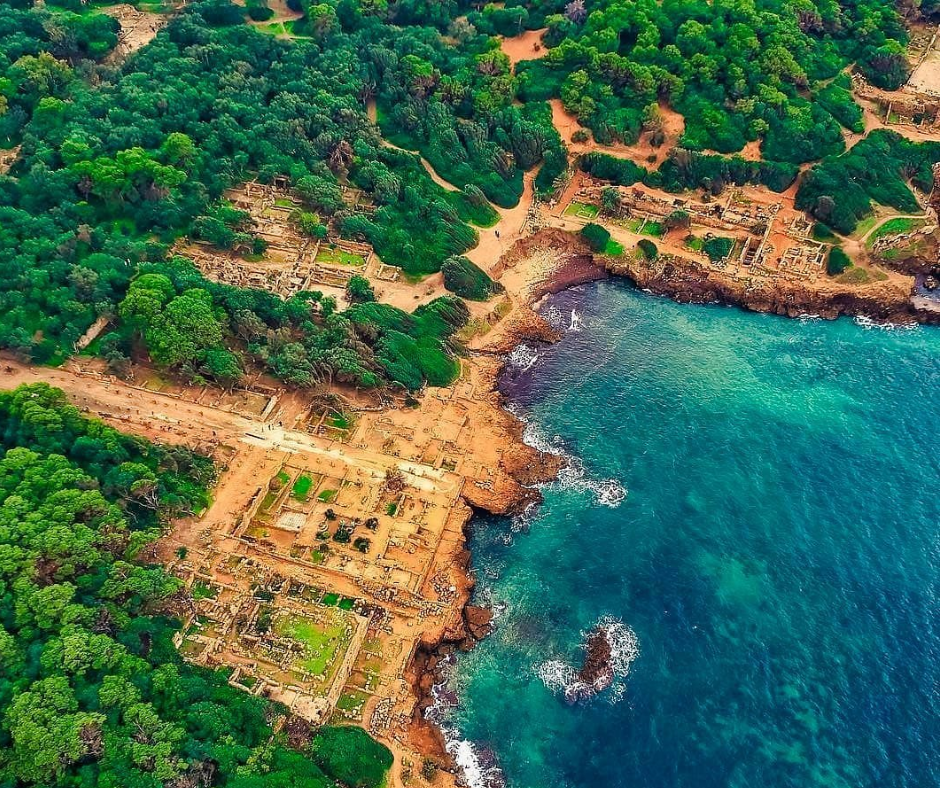
The path ends at the old harbor, where the stone foundations meet the waves.
Planning a Coastal Picnic
Pick up bread, fruit and a few pastries in Tipaza town and eat by the sea, or have grilled fish at one of the restaurants by the small fishing port.
Arrive early, especially from June to September: the morning is cooler and quieter. Wear proper shoes, because the old paving is uneven and slippery near the water. Before heading back to Algiers, pull over at the Royal Mausoleum of Mauretania, the huge round tomb above the coast road, which shares Tipaza's UNESCO listing.
Stargazing and desert camps in Djanet
Djanet, a Sahara oasis about 100 km from the Libyan border, is the base for the Tassili n'Ajjer (UNESCO 1982, with more than 15,000 rock paintings and engravings) and the dunes of the Tadrart. Air Algérie flies there from Algiers, and in the Saharan season (roughly October to April, when days are warm rather than scorching) there are also seasonal direct flights from Paris.
In the Sahara you travel with an approved Algerian agency. It can also arrange a visa on arrival for your organized tour, and where the authorities assign a police escort on a desert route, the agency handles that too.
Couples who camp with us usually come back saying the desert felt calmer than the internet had led them to expect, and the Tuareg crews are a big part of that. Since Djanet is in the deep south, read the official travel advice for the area before booking, and make sure your insurance policy covers the trip.
Arranging a Private Saharan Camp
The agency provides the 4x4, a driver-guide and the camp gear. Ask exactly what "camp" means before you pay: it can be a two-person tent on the sand or a set-up with mattresses and proper bedding, and the price changes with it.
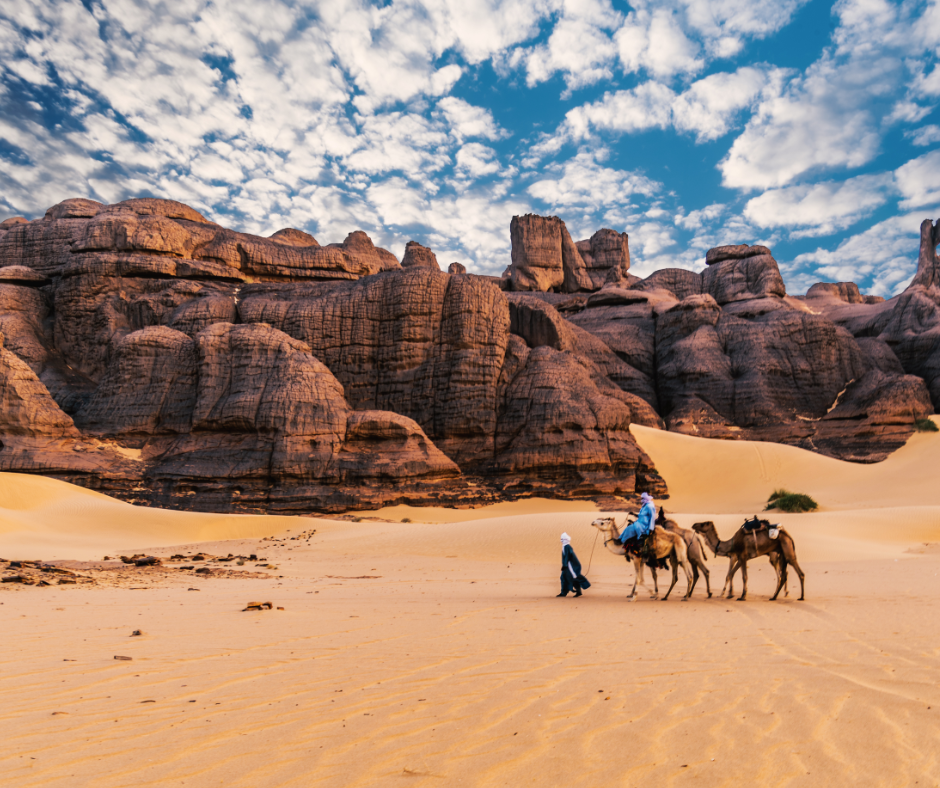
Confirm meals, water and the route before you leave town, because there are no shops once you're out. The drives pass sandstone arches and deep canyons, and in the Tadrart the sand is orange-red against dark rock.
Stargazing in the Sahara
Once the sun goes down the temperature drops fast, and from December to February nights in camp can get close to freezing, so pack warm layers and a headlamp. Dinner is usually cooked over the fire, followed by strong green tea served in three rounds, the Tuareg way.
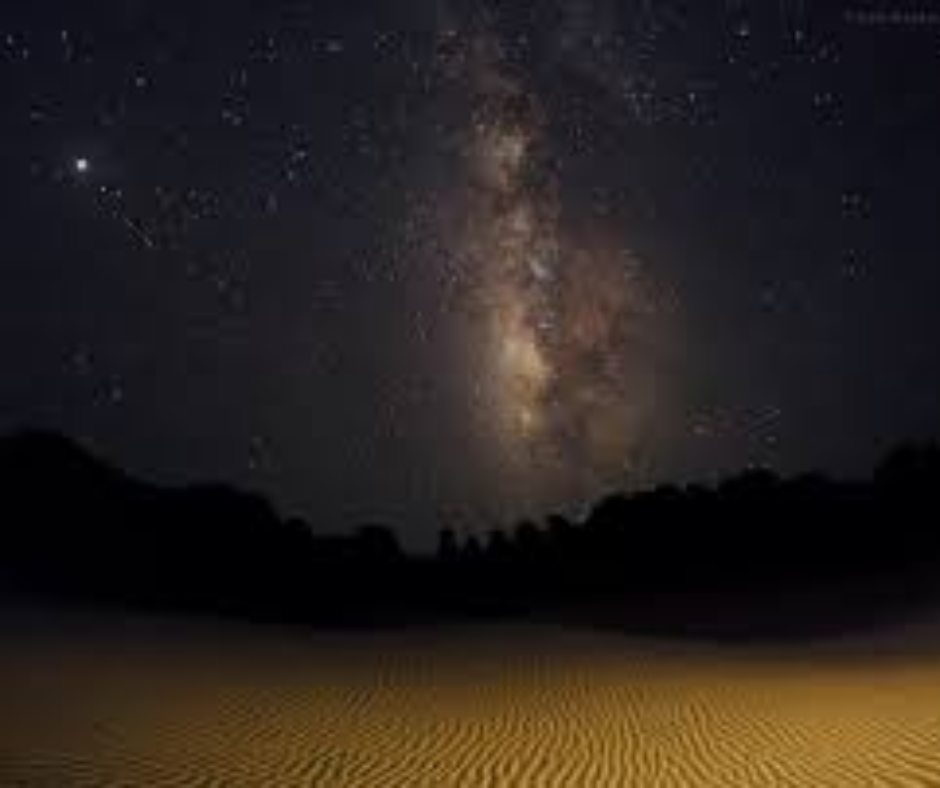
Then lie back on the rugs. A few hours' drive from Djanet there is almost no artificial light, and on a moonless night the Milky Way runs from one horizon to the other. If the stars matter to you, plan your dates around the new moon.
Sunsets and Spanish Heritage in Oran
Oran, Algeria's second city, is the home of raï (UNESCO listed it in 2022), and Spain held it for most of the period from 1509 to 1792. It feels more relaxed than Algiers, with a long seafront promenade and beaches to the west. It is also a highlight of our northern Algeria itinerary, which continues west to Tlemcen.
Visiting the Historic Fort de Santa Cruz
Fort Santa Cruz, built by the Spanish between 1577 and 1604, sits high on Mount Murdjajo above the city, with the Santa Cruz chapel (added in the 19th century) just below it. Take a taxi up the mountain road. The city's cable car on Murdjajo has spent long spells out of service, so don't plan around it.
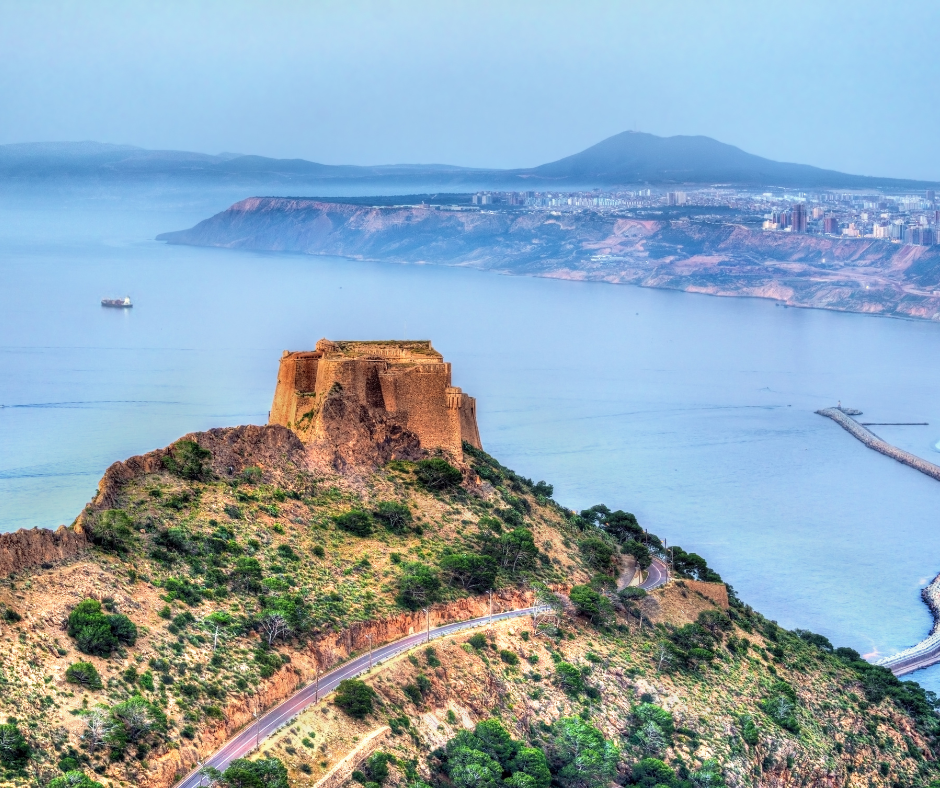
Come up late in the afternoon to watch the sun go down over the city rooftops and the port below.
Strolling Along the Waterfront Corniche
In the city, the Front de Mer is a long promenade on the cliff edge above the port, and in the evening it fills with families and couples. For dinner by the water, head west along the coast road toward Aïn El Turck, where seafood restaurants line the beaches.
Outside high summer, bring a light jacket for the sea breeze after dark.
Tlemcen: Andalusian mosques and the Lalla Setti plateau
Tlemcen, in the far northwest, is the quietest of Algeria's historic cities and the most romantic for a slow day. Its Great Mosque was founded in 1082 under the Almoravids, the mosque at the shrine of Sidi Boumediene dates from the 1330s, and on the western edge of town the 38 m minaret of Mansourah stands over a siege city built around 1300.
In the late afternoon, go up to the Lalla Setti plateau above the city for the park and the view over the rooftops. The Renaissance Tlemcen hotel stands on the plateau, a taxi ride from the old town. Tlemcen pairs well with Oran.
Bridges and traditional dining in Constantine
Constantine, the City of Bridges, is built on a rock plateau cut through by the gorge of the Rhumel river. As Cirta, it was the capital of the Numidian king Massinissa in the 2nd century BC.
Crossing Constantine's suspension bridges
Several bridges cross the gorge. The Sidi M'Cid suspension bridge, high above the river, has the best view down the cliffs, especially at dusk from the Monument aux Morts across the gorge.
The city's cable car, which reopened in April 2025, also crosses the gorge and gives you a different angle on the cliffs.

Traditional dinners in Constantine
Look for small family-run restaurants in the old town and order chakhchoukha, a dish of eastern Algeria: torn pieces of thin semolina flatbread soaked in a spiced tomato and lamb sauce.
Don't expect wine with dinner: restaurants in Constantine rarely serve alcohol. Finish at a pastry shop instead, with jawzia, the walnut-and-honey nougat the city is known for.
Taghit: dunes at the edge of the Grand Erg
If Djanet is too far or too expensive, Taghit is the Sahara at a smaller scale. This Béchar wilaya oasis on the Oued Zousfana has a mud-brick ksar and a palm grove, with the Grand Erg Occidental's dunes climbing straight up behind the town. Climb them at sunset; nearby there are Neolithic rock engravings, and the date festival is held in late October.
For a proper bed we'd look at the Bladi Palace hotel first, or spend a night in a fixed camp by the dunes. As everywhere in the south, go between October and April.
Romantic places to stay
| Where | Place | Why couples like it |
|---|---|---|
| Algiers | Sofitel Algiers Hamma Garden | Next to the Jardin d'Essai, with views over the garden and the bay; about USD 150 to 260 a night in 2026 listings |
| Algiers | A restored dar in or near the Casbah | Courtyards, painted tiles and a roof terrace over the bay; only a handful take guests |
| Oran | Royal Hotel Oran (MGallery) | A renovated 1920 building in central Oran |
| Tlemcen | Renaissance Tlemcen | On the Lalla Setti plateau, with views over the city |
| Constantine | Constantine Marriott | The city's top-end hotel |
| Taghit | Bladi Palace, or a fixed camp by the dunes | Dunes on the doorstep |
| Djanet | A private camp set up by your agency | Just the two of you, the crew and the stars |
Rates change a lot with the season, so compare a few weeks before you travel. Ask for a sea or garden view when you book, and say it's your honeymoon if it is.
Logistics for an unrushed itinerary
Algeria is Africa's largest country, and the Sahara is a flight from the coast, not a drive, so plan fewer stops than you think. If you want a ready-made route to adapt, our 10-day Algeria itinerary links Algiers, Constantine and the Sahara. It moves fast, so drop a stop or two if you'd rather travel slowly.
Choosing your transportation: flights, trains and drivers
For the long jumps, from the coast to the Sahara, fly. Domestic routes are covered by Air Algérie and Domestic Airlines, its subsidiary that used to be Tassili Airlines. Book early in the Sahara season, and carry your passports: you need them to board.
Up north, the main train lines are comfortable, and the Coradia express gets you from Algiers to Oran in about 4.5 to 5 hours. For day trips such as Tipaza, a private driver arranged through your hotel or agency saves you the city traffic and the search for parking.
Budgeting for two (autumn 2026)
| Per couple | Dinars | € paying by card | € with cash changed informally |
|---|---|---|---|
| Simple hotel or guesthouse room, per night (Algiers costs more) | 4,000 to 7,000 | 27 to 47 | 15 to 25 |
| Dinner at a traditional sit-down restaurant | 4,000 to 8,000 | 27 to 53 | 15 to 29 |
| Lunch at a popular restaurant or canteen | 1,200 to 2,400 | 8 to 16 | 4 to 9 |
| Museum or site entry | 400 to 600 | 3 to 4 | about 2 |
| Tip for a half-day city guide | 1,000 | 7 | 4 |
| Tip for the Sahara crew, per day | 3,000 to 4,000 | 20 to 27 | 11 to 15 |
The euro columns use about 150 DZD to the euro for cards and ATMs and about 275 for cash changed on the informal market (autumn 2026). That market isn't strictly legal under the exchange-control rules, yet it operates in the open and most visitors use it: your guide or host can sort out the exchange with someone they know, and you count the notes.
If you declared more than EUR 1,000 on arrival, change part of it at a bank as well, since customs may ask for the receipts when you leave. The Sahara part (flights, 4x4, crew and camp) depends on dates and group size, so we quote it per trip.
Two sample routes for couples
| Day | 7 days: city and Sahara | 10 days: the north |
|---|---|---|
| 1 to 3 | Algiers: the Casbah, Notre-Dame d'Afrique, a day trip to Tipaza | Algiers and a day trip to Tipaza |
| 4 | Fly to Djanet | Fly to Constantine |
| 5 to 6 | Private camp in the Tassili or the Tadrart | Constantine: bridges, Ahmed Bey's palace, dinner in the old town |
| 7 | Fly back to Algiers | Fly to Oran (via Algiers if there's no direct flight) |
| 8 to 10 | Oran and Santa Cruz at sunset, then Tlemcen and the Lalla Setti plateau |
Packing for coast and desert
Pack a light sweater for evenings by the sea, even in May or October, and for the Sahara a thermal layer, a fleece, a hat and a wide scarf against sun and sand.
Our guide on what to wear in Algeria goes region by region, from city clothes to desert gear.
Honeymoon in Algeria: practical notes
- Bring a copy of your marriage certificate, with your names as they appear on your passports, even if you're both foreign.
- Say it's your honeymoon when you book: hotels may give you a room with a view, and a desert agency can set your tent apart and plan a private dinner.
- Pick October to November or March to April for warm days on the coast and cool nights in the Sahara.
- Check the Ramadan dates (around 8 February to 9 March in 2027), when most restaurants close by day.
- Keep at least one slow day: distances are long, and domestic flights run late.
Ramadan dates and keepsakes
Ramadan is expected to begin around 8 February 2027. For that month most restaurants stay closed in daytime, and you'll wait until sunset to eat in public.
Choosing local keepsakes
Algerian crafts are regional, so buy where things are made: pottery and silver jewelry in Kabylie, wool rugs in Ghardaïa and the M'Zab, copperware in Constantine, and Tuareg silver jewelry in Djanet.
Anything that looks old can be confiscated when you leave unless you can show where it came from, so keep receipts. And never pick up flints, arrowheads or pottery shards in the Tassili: taking antiquities out of Algeria can lead to prison.
Common questions
Is Algeria good for a honeymoon?
Yes, if you prefer history, desert and quiet to beach resorts, and can live with a visa arranged in advance, low-key public affection and wine mostly limited to hotels.
What are the most romantic places in Algeria?
A private camp near Djanet under a moonless sky, the dunes of Taghit at sunset, the view from Santa Cruz above Oran, the bay from a Casbah roof terrace in Algiers, and the Lalla Setti plateau above Tlemcen. Tipaza's ruins by the sea are the best day trip from Algiers.
How much does a couples trip to Algeria cost?
Less than you might think, if you pay cash: dinner for two at a traditional restaurant runs about 4,000 to 8,000 DZD and a simple room 4,000 to 7,000 DZD a night (autumn 2026). Upscale Algiers hotels run about USD 150 to 260. The Sahara trip is the big cost.
Can unmarried foreign couples share a hotel room in Algeria?
Usually yes, if you're both on foreign passports, though practice varies and some hotels ask unmarried couples to take two rooms. With an Algerian or dual-national partner, expect to show a marriage certificate or family booklet.
For a trip that mixes the coast and the Sahara, we'd go in October and November or in March and April, when both are comfortable. With a week, pick Algiers and Tipaza plus either Djanet or Oran and Constantine, rather than all five. When you are ready, share your plans with us and we will build the trip around the two of you.


