
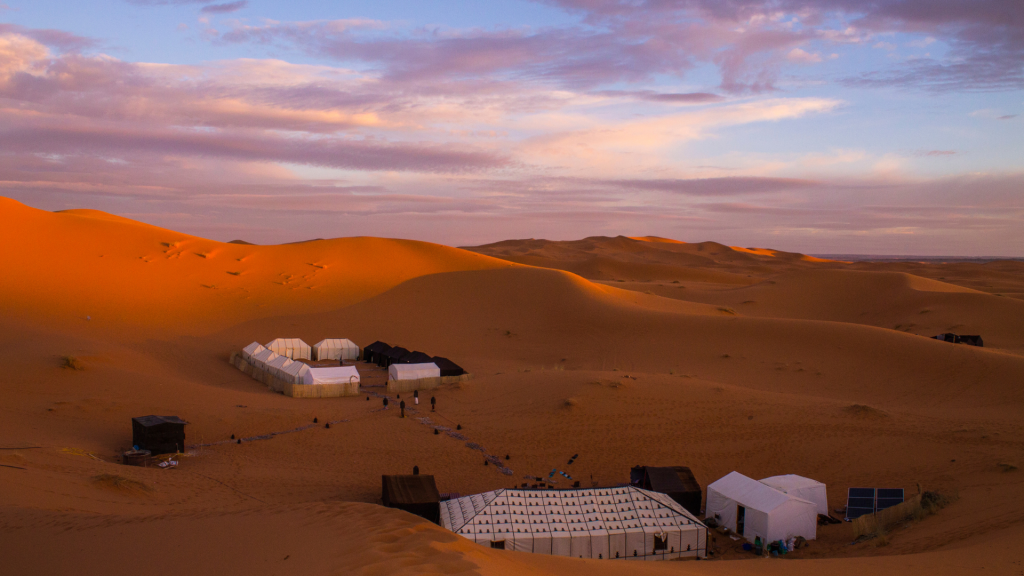

Camping in the Algerian Sahara means joining an organized trip with a licensed Algerian agency, most often out of Djanet, between late October and early April. The agency's Tuareg crew drives, cooks and pitches camp. Your job is the visa, a sleeping bag for nights that can drop close to freezing, and travel insurance that covers your route.
We organize desert trips in Algeria with local guides, cooks and drivers, so this is the same advice we give our own travelers before they fly south (checked October 2026).
Where to camp in the Algerian Sahara
Algeria has more of the Sahara than any other country: over four-fifths of its 2.38 million km² is desert. Most camping trips go to the far southeast around Djanet, for the Tassili n'Ajjer plateau and the red dunes of the Tadrart Rouge, or to the Hoggar mountains around Tamanrasset.
Both are a long way from anywhere, which is much of their appeal: rock art, sandstone towers and dunes with very few other travelers around. Our Algerian Sahara travel guide compares these southern regions with Timimoun and the Grand Erg Occidental.
For a longer walking trip with a Tuareg crew, see our Tuareg Desert Trek in Algeria: Nomad Life.
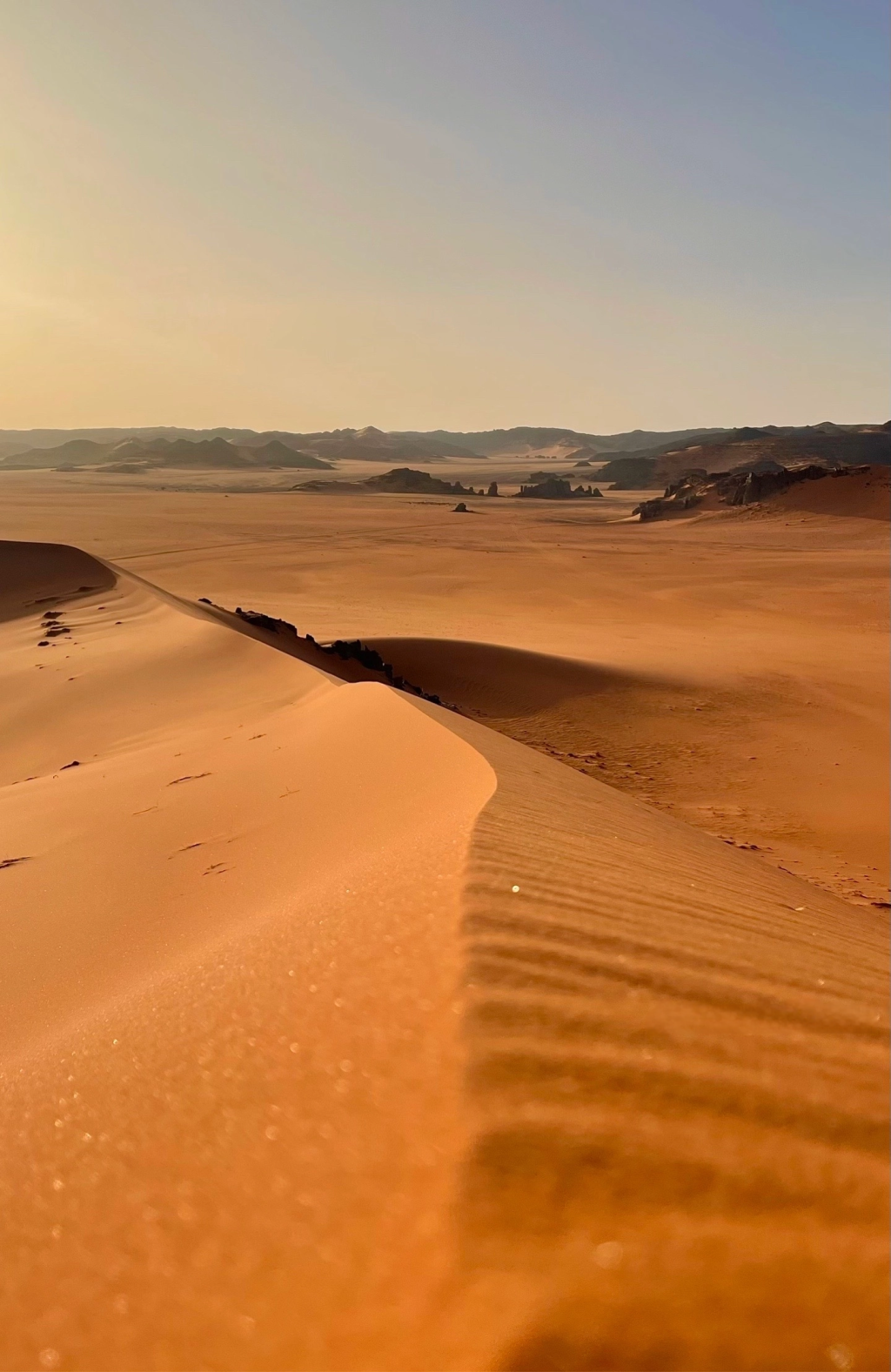
UNESCO inscribed the Tassili n'Ajjer in 1982. Its eroded sandstone forms what UNESCO calls "forests of rock", and the park holds more than 15,000 rock paintings and engravings: giraffes, elephants, cattle and people, drawn when the Sahara was much wetter. The oldest work is usually put at around 10,000 BC, though the dating is still debated. On a Tassili or Tadrart trip the rock-art shelters are part of the daily walks, and you often camp a short drive or walk from them.
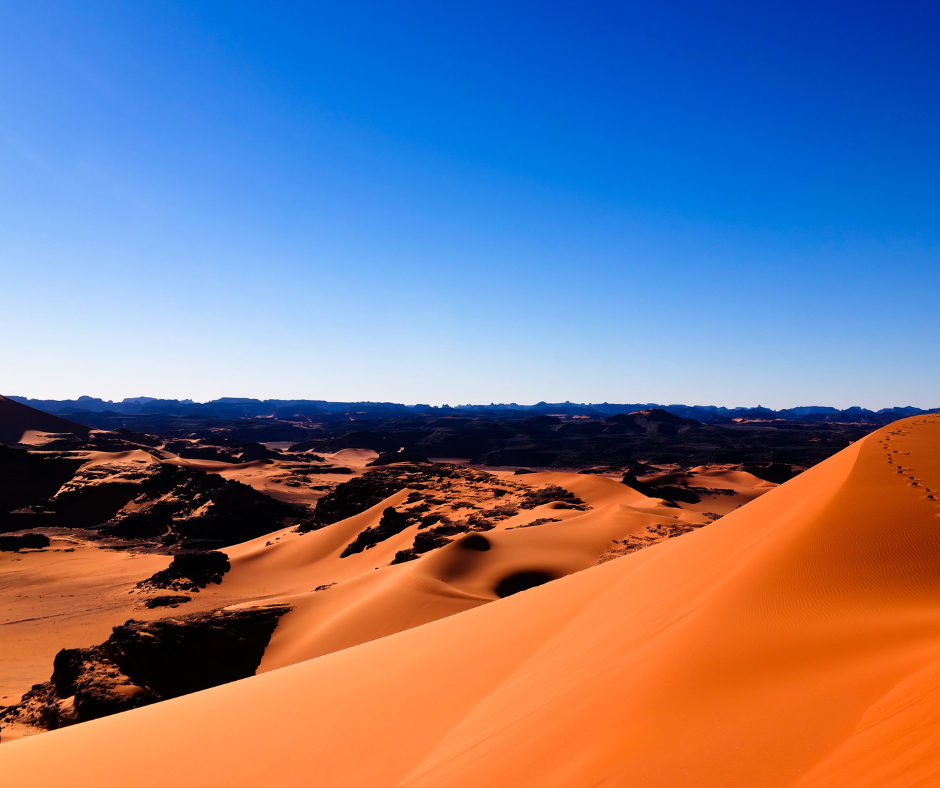
You can't camp here on your own. Visits to the Tassili n'Ajjer go through an approved Algerian travel agency with an official guide, and in practice the authorities expect every foreign visitor in the deep south to travel this way. Some routes also come with a police or gendarmerie escort, assigned by the authorities and arranged by your agency, and that is standard here. It does make the camping easier: the agency's team pitches the tents, cooks, and drives the 4x4s across ground with few marked tracks.
Djanet, Taghit or the coast: rules and seasons
| Where you camp | Who sets it up, and the rules | When to go |
|---|---|---|
| The Tassili n’Ajjer and Tadrart, from Djanet | A licensed Algerian agency and its Tuareg crew, who bring the tents and food; no independent desert camping | Late October to early April; average lows of 3 to 5°C in Djanet in December and January, colder in open desert |
| The Hoggar, from Tamanrasset | The same set-up: agency, crew and a mobile camp | Late October to early April |
| The dunes of Taghit and Timimoun | A fixed camp, or a one-night bivouac arranged by a local guide or guesthouse | October to April |
| The north: coast and forests | No camping within 500 m of a forest outside designated sites, and forests closed from 1 May to 30 October in 2026; ask the commune before pitching on a beach | Summer on the coast, spring in the mountains |
Wherever you go, pack a sleeping bag rated 0°C or lower for midwinter, layers and a headlamp. You need a consulate visa, or the Sahara visa on arrival if an agency books your trip.
Visas, flights and the best season for camping in Algeria
Sort the visa first. Most Western travelers need a visa from an Algerian consulate before they fly.
The exception, since 2023, is a visa on arrival for organized tours that take in the southern wilayas, Djanet and Tamanrasset among them. It works through the agency: it submits your request on the Tourism Ministry platform, a QR-code authorization lets you board, and the fee (commonly reported at about EUR 110, varying by nationality) is paid when you land.
It covers the trip, up to 30 days, and you can land in Algiers as long as the itinerary goes south. It only works for agency-organized tours, not independent travel.
Most travelers fly Algiers to Djanet with Air Algérie, about 2 hours 15 minutes nonstop. In the Saharan season Air Algérie has also flown direct from Paris CDG to Djanet; check the current schedule.
The trip starts at the airport. Most camping trips here are mobile, with a new spot most nights as you move across the Tassili n'Ajjer or southeast into the Tadrart Rouge. Treks up onto the Tassili plateau are on foot, with donkeys usually carrying the bags, because vehicles can't get up there.

We'd plan a camping trip between late October and early April. In Djanet (1,035 m up), average highs run from about 32°C in October down to 20°C in January and back up to 33°C in April, so the start and end of the season are hot by midday.
Nights matter more for packing: average lows in December and January are 3 to 5°C, frost has been recorded in town, and open desert and the plateau run colder than that. November and March are the easy middle, with highs in the mid-20s and lows around 10°C.
Desert camps: mobile or fixed
Sahara camping in Algeria comes in two forms: a mobile camp that moves with you across the desert, or a fixed camp you return to each night. The table sums up the difference.
| Camp type | Where | Where you sleep | Showers | Season |
|---|---|---|---|---|
| Mobile camp with a Tuareg crew | Tassili n’Ajjer and Tadrart Rouge from Djanet; the Hoggar from Tamanrasset | Tents with foam mattresses, or a mat under the stars | None on most trips | Late October to early April |
| Fixed camp in the dunes | Taghit, by the Grand Erg Occidental | Fixed tents, some with real beds | Ask the camp | October to April |
| Dune bivouac for a night | Around Taghit and Timimoun, arranged by a local guide or guesthouse | Blankets and mats around the fire | None | October to April |
Choosing Your Camping Style in the Dunes
Camping in the Algerian Sahara is supported, not self-sufficient. Most travelers use a mobile camp run by a Tuareg crew. This is not quite glamping in the traditional sense, but it is far more comfortable than a backpacking trip where you carry everything yourself.
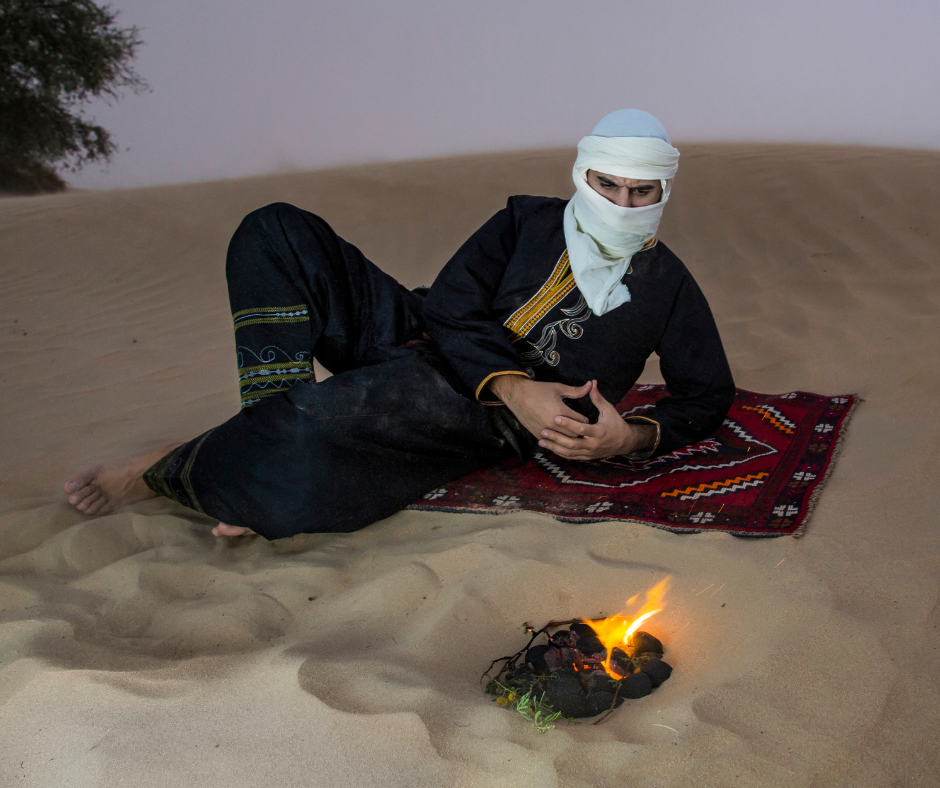
A typical setup is tents with foam mattresses and blankets, a kitchen the crew sets up on the sand, and carpets laid out around the fire for meals. After dinner the fire is where everyone sits, since it's the only heat in camp. Wood is scarce in the Tassili and the Tadrart, so expect a small fire rather than a bonfire, and leave living trees alone.
If you'd rather skip the tent, ask your guides about sleeping out on a mat. The air is dry and there's no light pollution, so many people find this the best night of the trip. From December to February bring a sleeping bag with a comfort rating of 0°C or lower; in October, November, March and April a bag rated around 5°C is usually enough.
What to Pack for the Algerian Desert
Dress for sun by day and cold at night. Loose, long, breathable clothes work best. Cotton and linen are comfortable in the dry heat, and light synthetic hiking shirts work too and dry faster if you sweat on the walks.
For daytime, pack long-sleeved shirts, light trousers, a wide-brimmed hat or a cheche (the long Tuareg-style head scarf), and sunglasses with category 3 or 4 lenses (category 4 is too dark for driving). Covering up keeps the sun off better than sunscreen alone. Glare off pale sand and rock tires your eyes quickly.
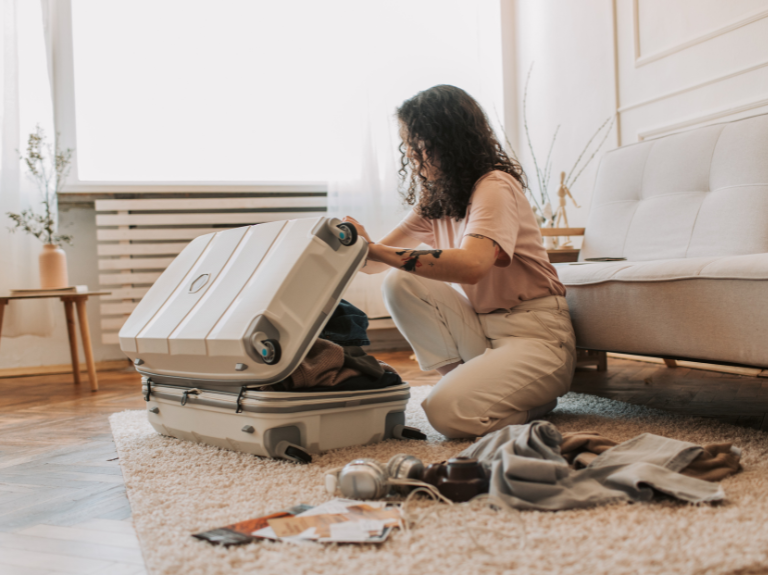
Temperatures fall fast after sunset because the dry air and clear sky hold little heat. You'll want a fleece or light down jacket for the evenings and thermal base layers to sleep in. Wear closed shoes around camp for the rocks. Scorpions are mainly a summer problem (Algerian studies find most stings between July and September, at night), and horned vipers are far less active in the cool months, but shake out your shoes in the morning and don't lift stones with bare hands.
The full clothing list is in our What to Wear in Algeria.
Cultural etiquette and Tuareg customs
Your guides and crew will most likely be Tuareg: Kel Ajjer around Djanet, Kel Ahaggar around Tamanrasset. The "Blue People" nickname comes from the indigo-dyed veils and robes, which can leave a blue tint on the skin. It's the men who traditionally wear the veil (the tagelmust), not the women.
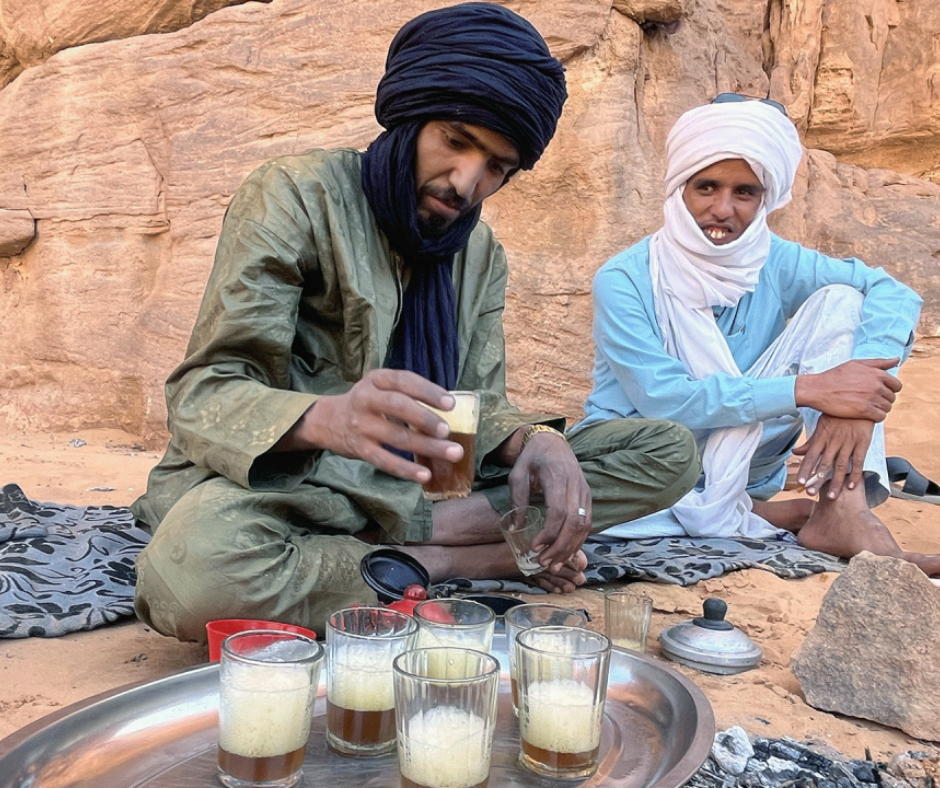
Tea is the center of Tuareg hospitality. If you're offered tea, expect three glasses, and take all three: that's the polite thing. People say the first glass is bitter like life, the second sweet like love and the last gentle like death. The round takes time, and that's the point: it's when people sit, talk and pass on news.
Ask before photographing people or their camps. Many say yes, but asking first matters. Don't photograph checkpoints, police or escorts.
Leave the rock art alone: don't touch it or wet it to bring out the colors, and don't pick up flints or potsherds, which can be treated as antiquities smuggling when you leave. Hold off on politics and very personal questions until you know people better.
Desert trips in the deep south: guides, insurance and signal
The Tadrart Rouge and the Tassili are why people make the long trip to Djanet: red dunes against black rock, painted shelters you reach on foot, and Tuareg crews from the area who read the ground better than any map. Travelers on our desert trips often tell us the south felt calmer and more welcoming than they had expected from what they read before coming. We stick to routes our crews have run for years, with licensed Algerian agencies and local Tuareg guides, and we haven't had a single incident on our trips.
Read your government's current travel advice for the exact route you're booking, the Tadrart included, and make sure your insurer will cover it. Then leave the navigation to the crew: out here, knowing the wells and passes matters as much as the paperwork.
Even with a guide, carry your own basics: a headlamp with spare batteries, a first-aid kit with rehydration salts, antiseptic and your own medication, and a refillable bottle. The crew carries the water in jerrycans, so a bottle with a built-in filter is a sensible backup. On walking days plan on 3 to 4 liters each; the US National Park Service's desert rule of thumb is about a liter per hour of hiking in the heat.
Mobile signal fades soon after you leave Djanet and is absent across most of the Tassili n'Ajjer; the FCDO calls coverage in remote southern areas patchy or unavailable. Mobilis has the best southern network if you buy a local SIM. Ask your agency what it carries for emergencies.
Don't pack your own satellite messenger, GPS unit or drone: bringing drones, binoculars, telescopes and some photography equipment into Algeria without authorization is illegal, as the FCDO points out, and customs can confiscate them. For charging, bring a high-capacity power bank; some 4x4s have a 12V socket, but don't count on it.
Wild camping rules in the north
Wild camping isn't allowed the way it is in much of Europe. The 2023 forest law (law 23-21) bans camping outside designated sites, barbecues and cooking fires within 500 m of a forest, with penalties of two to six months in prison and fines. On top of that, the authorities closed all forests to the public from 1 May to 30 October in 2026, the forest-fire season.
Mountain areas have their own rules. The wali of Bouira banned camping at Tikjda, in the Djurdjura, over the winter of 2024 to 2025 because of snow and cold, so check with the local tourism office before you go. Beaches are managed by the communes under the 2003 beach law, amended in 2025, and we would not pitch a tent on one without asking the commune or the local gendarmerie first.
In the deep south, the question doesn’t arise: foreigners travel with an approved agency, and the agency’s crew chooses and sets up each camp.
Camping in northern Algeria: coast and mountains
Camping in the north is mostly an Algerian summer habit, on the coast. Jijel has 121 km of coastline, rocky coves to the west and long sandy beaches to the east, and Béjaïa has more than 44 beaches, with popular camping spots between Cap Carbon and Cap Sigli. Mostaganem and Chlef also have long coasts with dunes and coves. In summer some communes open family campsites near the beaches, often in schools or youth centers.
These are set up for Algerian families, change from year to year and are rarely listed online, so a foreign visitor is better off with a guesthouse near the beach and a day in a national park. Tikjda and Chréa are the mountain bases people know, but forests shut over the summer and snow comes in winter, which leaves spring for a night out, with a local guide who knows what the rules are that year.
Managing Your Gear in the Sand
Sand gets into everything. Keep your camera in a dry bag when you are not shooting, change lenses inside a tent or vehicle, put electronics away if the wind picks up, and clean lenses with a bulb blower, not a cloth.
For night photography you need a sturdy tripod and a camera with manual settings; the central Sahara has some of the darkest skies anywhere. Use your headlamp's red-light mode when you adjust settings, so you keep your night vision and don't dazzle the rest of the camp.
Dining in the Dunes
Camp food is simple and filling: couscous, stews, and chorba, a traditional soup. The dish to look out for is taguella, the Tuareg bread. The dough is unleavened and baked straight in the hot sand and embers under the fire.
Once it's done, the crew brushes and knocks off the sandy crust, breaks the bread into pieces and soaks them in a meat or vegetable sauce. It's heavy food, which is what you want after a day of walking.
If you're vegetarian or have allergies, tell your agency well before you travel. Crews will work around it, but once the trip has left Djanet there is nowhere to buy substitutes.
What Sahara camping asks of you
Camping in the Algerian Sahara means no signal for days, no showers on most mobile trips, long drives on rough tracks, and midwinter nights a few degrees above freezing. For the right traveler, that is exactly the appeal. It doesn't suit anyone who needs a fixed itinerary: routes change with the weather and with instructions from the authorities. For a first trip, we'd pick the Tassili n'Ajjer and the Tadrart from Djanet in November or March.
Wild camping, cold nights and beach camping
Is wild camping allowed in Algeria?
Mostly no. Outside designated sites, the forest law bans camping within 500 m of a forest, and in 2026 forests were closed to the public from 1 May to 30 October.
Can you camp alone in the Algerian Sahara?
No. Foreign visitors in the deep south are expected to go with an approved Algerian agency, and you only get the Sahara visa on arrival by booking that way. It can still be a private trip: the agency supplies a guide, a cook and a driver for just you or your group.
How cold do desert nights get?
Colder than most people expect. Djanet averages 3 to 5°C at night in December and January, frost has been recorded in town, and the open desert and the Tassili plateau are colder still; in November and March, lows are around 10°C.
Can you camp on Algerian beaches?
Not freely. Beaches are run by the communes, and overnight tents are not part of the normal beach set-up, so ask the commune or the local gendarmerie first. In summer some coastal communes open family campsites near the beaches, but they are aimed at Algerian families and change every year.
Are there glamping options in Algeria?
A few: the fixed camps in the dunes at Taghit have tents with real beds. Don't expect true luxury camps, which are rare.
Choose your dates first, then book with an approved agency early enough for it to file the visa-on-arrival request before you fly.
If you have more questions to ask about your upcoming trip to Algeria, all you have to do is reach out to the WildyNess Team.
To put the desert in context, our Algeria Travel Guide: Safety, Visa Requirements & What To Do covers the rest of the country, and Things to Do in Algeria: Casbah, Roman Ruins and the Sahara lists the highlights.


