


A homestay in Algeria usually means a room in a family house or in a small guesthouse run by the owner's family, and the best regions for one are in the Sahara: Timimoun, Taghit and the M'Zab Valley. Few of these places are on booking sites, so most stays are arranged through a local agency, a guide or a friend of a friend.
Below: what daily life with a family looks like, the paperwork your host has to deal with, the regions we'd pick, and what you'll eat. If a homestay is not for you, our Algeria travel guide lists other places to stay, from family guesthouses to city hotels.
Daily life in an Algerian homestay
Trading a hotel for a family home
You give up a hotel's privacy and fixed hours and take on a family's routine. You eat what the family eats, when they eat it, and most of your waking hours are spent with them, in the kitchen, the courtyard or the salon.
Hospitality is taken seriously, especially in the south and in the villages: guests get the best seat, the first glass of tea and more food than they can finish. The trade-off is privacy. Expect questions about your family and your country, visits from relatives, and little time alone.
There is paperwork too. Under Law 08-11 of 2008, anyone who hosts a foreigner, private individuals included, must declare the guest to the police or gendarmerie within 24 hours, so your host will ask for your passport details. Guesthouses and hotels record passports at check-in in the same way.
Hosts who skip the declaration put themselves at risk, so don't ask them to. Unmarried couples on foreign passports are rarely asked for a marriage certificate, a check that mostly affects Algerian couples, but a conservative family may still give you separate rooms.
French is widely spoken in the cities, less so in desert villages, where a few words of Arabic (or Tamazight in Kabylie) help a lot. Your hosts will want to know about your life at home, and they'll usually take you along on their errands and family visits.
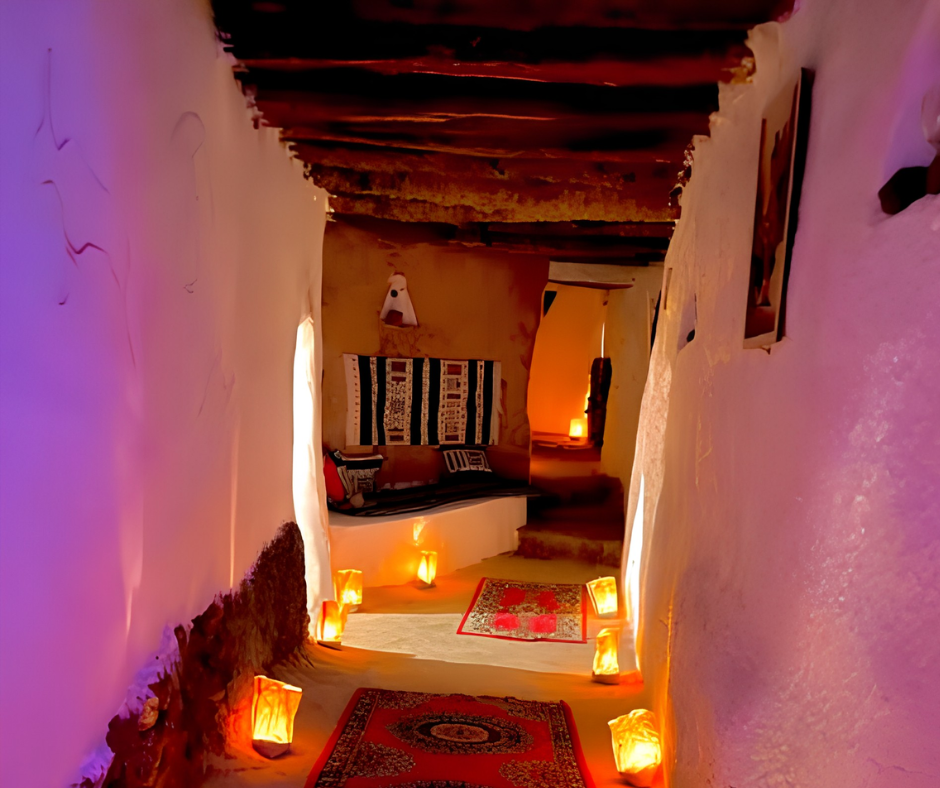
Be flexible. There are no set meal times and no reception desk, and the household runs on its own clock. In the south you may sleep on thick mattresses laid on the floor under woven blankets, and the toilet may well be a squat one. Bring a headlamp for the night.
The daily household routine
Days follow the sun and the prayer times. Many households are up before dawn for the first call to prayer, and even if you sleep through it, breakfast comes early.
Mornings are busy: someone fetches fresh bread from the bakery and the first coffee goes on. By midday, especially in the desert, everything slows down.
In the south, and in the hot months everywhere, families nap after lunch to sit out the worst of the heat. The streets go quiet and people retreat to the coolest rooms in the house. Many shops close for a few hours in the afternoon, so do your errands in the morning. The house wakes up again as the sun goes down.
Evenings are the social part of the day. Children play in the courtyard, neighbors drop in without calling first, and dinner preparation starts. Offer to help with small jobs such as setting the table or carrying the shopping; your host may say no, but the offer counts. Follow your host's lead on shoes (many households take them off before the living room), accept the tea or coffee you're offered, and bring a small gift such as pastries or dates.
The inner courtyard
Traditional Algerian houses face inward, around a courtyard. Most Algerians now live in apartments or modern concrete houses, so you'll find this layout mainly in the old medinas, such as the Casbah of Algiers, and in the M'Zab and the desert ksour.
From the street you see high, blank walls and a heavy wooden door. In the M'Zab the entrance passage bends, so passers-by can't see in; the Mozabite word for that passage, taskift, is also the name of a guesthouse in Beni Isguen. Past it, the house opens onto a private courtyard.
The layout keeps the house cool and family life out of sight. In city houses the courtyard is often tiled, with potted plants and low seating around the edge. In the M'Zab it is usually covered, with an opening in the roof for light and air.
The courtyard is family space: the women of the house spend much of the day there, and it's where tea is poured. Visitors are often received first in the salon, the formal sitting room, so let your hosts show you where to sit. Being asked to join them in the courtyard means you're being treated as one of the household.
The best regions for a homestay in Algeria
We'd pick the three Saharan regions below for a first homestay, from October to April, when days are warm and nights cold. In summer, desert afternoons regularly go above 40 °C. In the north, the Kabyle villages of the Djurdjura, about 100 km east of Algiers, are the other good option. Tamazight has been an official language since 2016, and a greeting in Kabyle goes a long way: "azul" is hello and "tanemmirt" is thank you. Village stays there work best through a local contact who knows the families.
In the far south, a stay with Tuareg hosts around Djanet usually means a camp or a small guesthouse arranged by an approved agency, which the authorities require for foreigners in the deep south; that is how we run our trips there. As with any trip that far south, the official travel advice for your route is worth reading before you commit, and your insurance needs to cover the journey.
Traditional adobe houses in Timimoun
Timimoun is the main oasis town of the Gourara, built in red-ochre mud. The fortified villages around it are called ksour (singular ksar). The region also has its own traditions: the Ahellil chant (on UNESCO's intangible heritage list since 2008) and the S'boue pilgrimage, held in the week after Mawlid, which in 2027 falls around 21 to 22 August, in the heat.
The houses are built for the climate. Thick earth walls soak up the daytime heat and release it slowly overnight, when desert nights from December to February can drop close to freezing. Windows are small to keep out the sun and blowing sand.
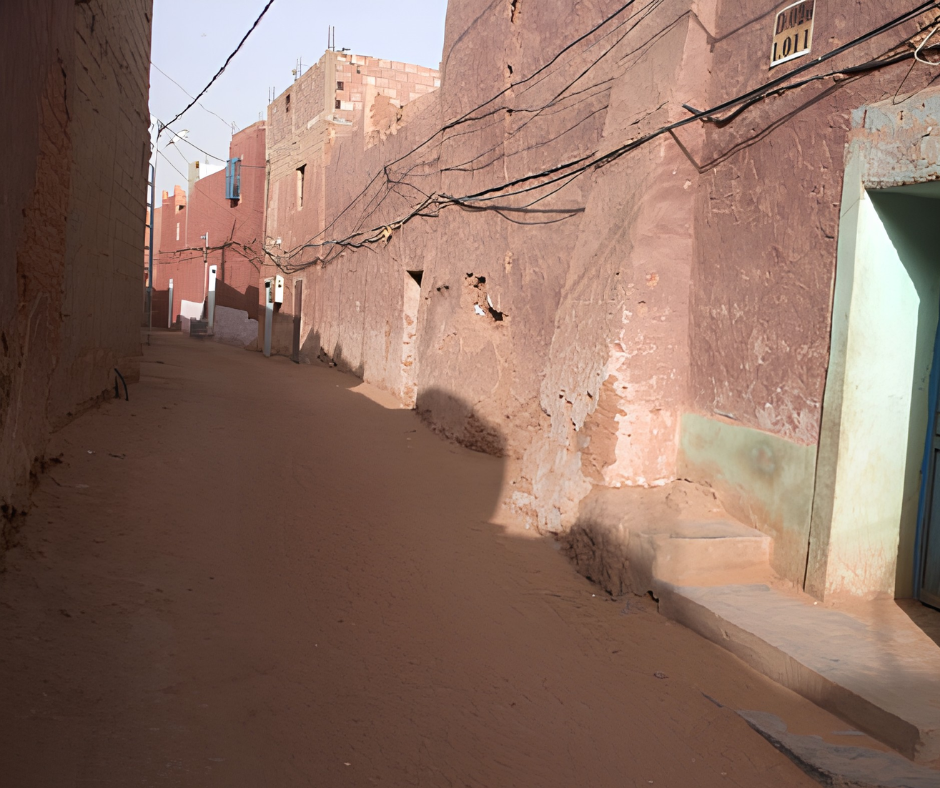
Expect curved archways, carved wooden doors and ceilings of palm trunks. The downside is comfort: rooms can be dim and cold in winter, and hot water depends on the house, so ask before you book.
The palm groves start at the edge of town, and early morning, when the low sun lights the red walls, is the best time to walk in them. Some retreats even use houses like these for courtyard yoga at sunrise; see how an Algeria yoga retreat usually works.
Palm Grove Guesthouses in Taghit
The dunes of the Grand Erg Occidental rise right behind Taghit, a small oasis on the Oued Zousfana in Béchar wilaya. For a slower pace in the Sahara, stay in a family-run guesthouse by the palm grove.
From there you have the dunes on one side and the date palms on the other, with the old mud-built ksar of Taghit a short walk away. Neolithic rock engravings, such as those at Barrebi, are close by, and the town holds a date festival in late October.
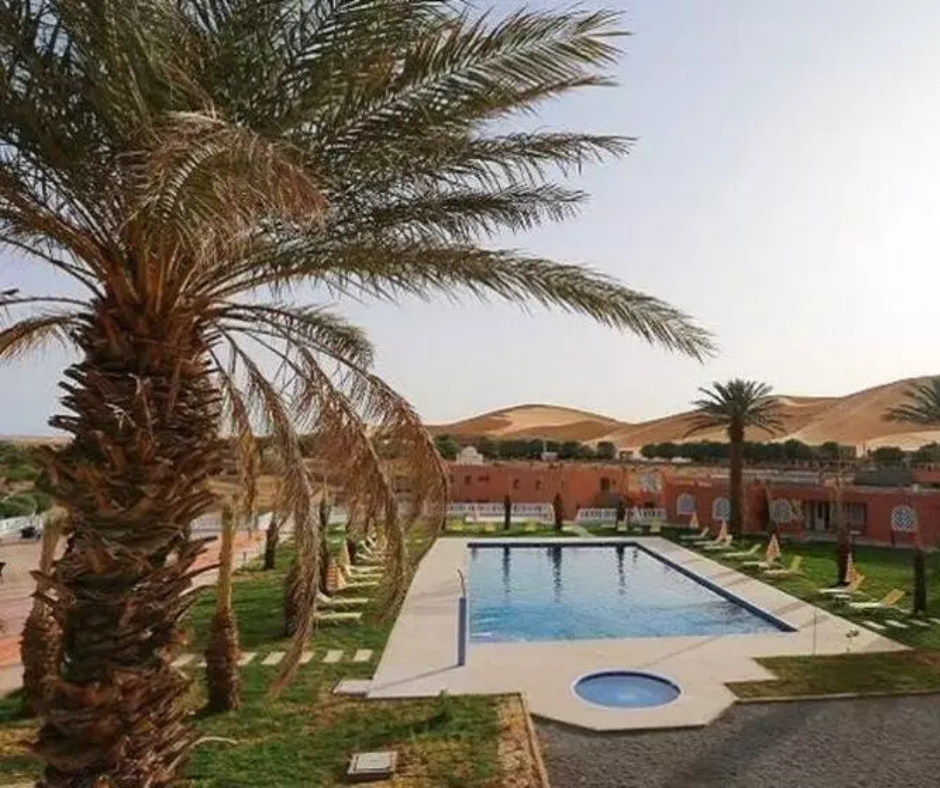
Rooms are simple: clean, quiet, with heavy blankets for the cold nights. Don't expect much more. Wi-Fi can be weak, and dinner is whatever the family cooks.
Get up early. Before breakfast the air is cool and the first sun lights the dunes above the town. If you travel with a camera, that early light is worth planning around, as our tips for an Algeria photography tour explain.
Staying in the M'Zab Valley
Five fortified towns (ksour) make up the M'Zab Valley around Ghardaïa: El Atteuf, Bounoura, Melika, Ghardaïa and Beni Isguen, all founded by the Ibadi Mozabites between about 1012 and 1350. It has been on the UNESCO World Heritage list since 1982. The Mozabite community is conservative and close-knit, and its rules on dress, photography and visitors are stricter than anywhere else you're likely to stay.
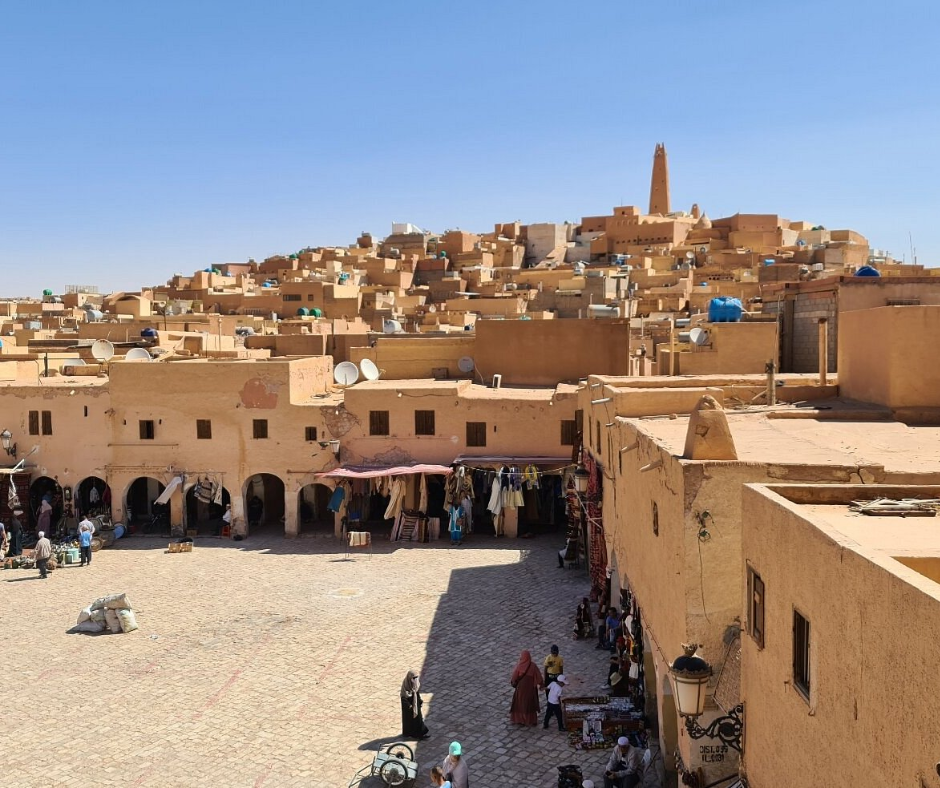
Each town is built around a hilltop mosque, with houses packed together along narrow, shaded lanes. Below the towns lie the palm groves, where families traditionally spent the summer, and that is where you'll sleep: Beni Isguen closes at sunset and non-residents can't spend the night inside. There are guesthouses in the Beni Isguen palm grove that offer exactly this, and we can set one up for you.
A Mozabite host can explain what you won't work out alone: how flood water from the wadi is shared between the gardens, and why privacy matters so much here. The rules are easy to follow. Cover your shoulders and legs, don't smoke in the old towns, and don't photograph people, especially women. Beni Isguen itself admits visitors only with a guide taken on at the main gate, which is one reason many people fold the stay into one of the small-group tours in Algeria.
Homestays in the north
The north has fewer homestays, but they exist. In Kabylie, village stays in the Djurdjura are arranged through a local guide who knows the families; expect stone houses, olive groves and cold winter nights. In Algiers, a few small hotels in restored houses, such as the Afric Hotel-Casbah, give you the courtyard layout of an old Casbah home with hotel services. Elsewhere in the north, most travelers stay in hotels and meet families through a guide.
Where to stay with a family: regions compared
| Region | Type of stay | Good for | How to book |
|---|---|---|---|
| Timimoun | Earth houses and small guesthouses in and around the ksar | Architecture, foggaras, the sebkha | Agency or local guide |
| Taghit | Family guesthouses by the palm grove | Dunes and a first desert stay | Agency, guide or direct by phone |
| M'Zab Valley | Palm-grove guesthouses in Beni Isguen | Mozabite culture and architecture | Direct or through an agency |
| Djanet | Tuareg camps and small guesthouses | Tassili and Tadrart treks | Approved agency only |
| Kabylie | Village family houses | Hiking, Kabyle language and crafts | Local guide or contact |
What should you sort out before a homestay?
| To sort out | What it involves |
|---|---|
| Budget | Around 4,000 to 7,000 DZD a night for a room (autumn 2026), in cash |
| Booking | Mostly through a local agency, guide or contact; few places are on booking sites |
| Paperwork | Your host has 24 hours to declare you to the police or gendarmerie, so have your passport ready |
| Timing | In the Sahara, October to April; in the north, spring or autumn |
| Packing | A small gift, slippers, a headlamp, and something warm for nights in the desert |
How much does a homestay in Algeria cost?
A room in a family guesthouse costs what a budget hotel does: about 4,000 to 7,000 DZD a night in autumn 2026. Paid with cash changed informally (about 275 DZD to the euro), that comes to EUR 15 to 25; at the official rate (about 150) it is EUR 27 to 47. Ask whether dinner and breakfast are included; in the desert they usually are, and in towns they may be extra.
Pay in cash, in dinars, at the end of your stay, unless your agency has already paid. You don't tip a family host, but a gift is welcome: pastries, dates, something from your home country or a toy for the children. If a guesthouse has staff, 100 to 200 DZD a night for housekeeping is a kind gesture.
How to book a homestay
- Pick the region first. The south has the most family stays, and from October to April it has the best weather.
- Go through someone local. Most homestays aren't online. An agency, a guide or a friend in the region will know which families take guests and can vouch for them; we arrange family stays as part of our trips.
- If you book online, check the host's languages, whether meals are included, whether there is hot water and a private or shared bathroom, and how heating works in winter.
- Send your passport details. Your host needs them to declare you to the police or gendarmerie within 24 hours, as the law requires.
- Confirm the price in writing, in dinars, and bring the cash.
Staying with a family in Ramadan or at Eid
Ramadan, expected to begin around 8 February 2027, is best seen from inside a family home, and it is also the hardest time to be a guest. Your hosts fast from dawn to sunset; you don't have to, but eat and drink discreetly during the day, never in the street. At sunset the family breaks the fast together over dates, milk and chorba, and being invited to that iftar is the high point of the day. Nights run late and mornings are slow.
Eid al-Fitr, at the end of Ramadan (around 9 or 10 March 2027), is three days of visits, new clothes and trays of pastries. At Eid al-Adha (around 16 or 17 May 2027), families who can afford it sacrifice a sheep at home on the first morning. It is a family feast and very welcoming, but not for everyone: if you'd rather not watch, say so and your hosts will understand.
Homestay etiquette checklist
- Bring a small gift and accept the tea or coffee you're offered.
- Follow your host's lead on shoes; bring slippers.
- Dress modestly in the house and the village: shoulders and knees covered.
- Eat with your right hand, from the part of the dish in front of you.
- Ask before photographing anyone, especially women, and never inside the house without permission.
- Offer to help with small jobs, and don't be offended if the answer is no.
- Keep alcohol out of the house.
- Give your passport details on arrival so your host can declare you.
What you'll eat in an Algerian home
Meals follow the family. Breakfast is light: kesra, the semolina flatbread, or msemen with honey or olive oil, and coffee with hot milk, the everyday drink in the north.
In the south, mint tea comes at every stop, poured from high to raise a foam, and Tuareg hosts traditionally serve three rounds, so stay for all three. Friday lunch is couscous day in many families, and in Ramadan and on winter evenings you'll get chorba frik. Shared dishes go on a low table and everyone eats from the part in front of them, with the right hand or the spoon you're given; tell the cook how good it is.
Cost, couples, gifts and who can host you
Will a homestay cost more than a hotel? No, about the same as a budget one. Out in the desert, dinner and breakfast are usually thrown in; settle up in cash at the end, and leave a small gift rather than a tip.
Is a family actually allowed to host me? Yes. Private individuals can host foreigners, as long as they declare the guest to the police or gendarmerie within 24 hours. Families in the Sahara oases and in Kabylie are used to it, and most stays are arranged through a local agency or guide who knows the hosts. Bring your passport.
We're not married. Will that be a problem? Usually not, if you are both foreigners: hotels and guesthouses rarely ask foreign couples for a marriage certificate, a check that mostly applies to Algerian couples. A conservative family host may still give you separate rooms, so ask when you book and follow their lead. Keep public affection to holding hands.
What do I bring as a thank-you? Something to share: pastries or chocolates, good dates, coffee or tea, or a small specialty from home, plus toys or school supplies if there are children. Skip alcohol, and anything so expensive it embarrasses your hosts.
A homestay suits travelers who can live without much privacy and on a family's timetable. We match travelers with host families, so if you'd like a family stay built into your trip, let us know where and when you are traveling.


