
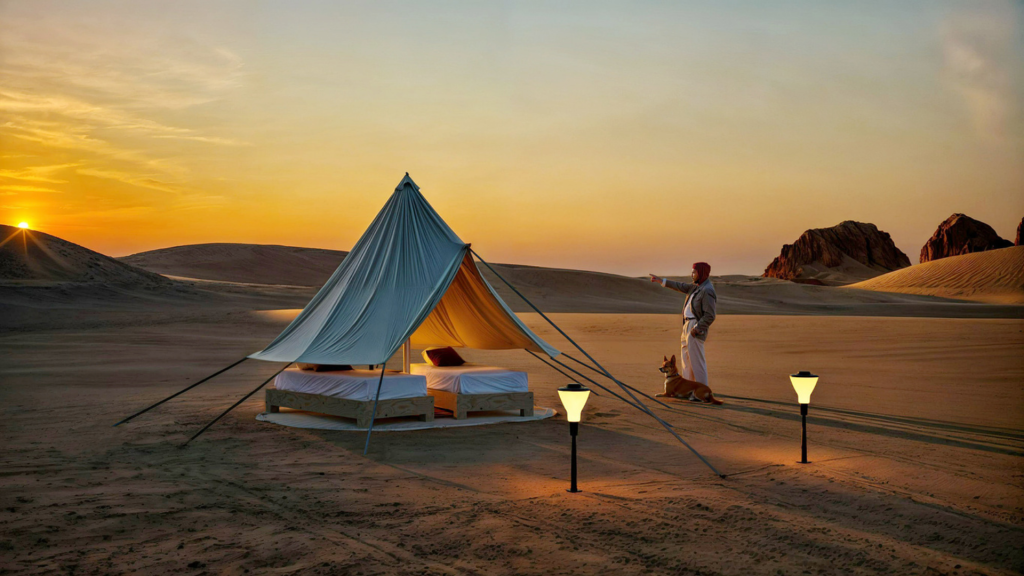

Glamping in Algeria means a real bed, thick blankets and a hot dinner in the Sahara, in a tent or a hut, with a 4x4 crew doing the hard work. The places to do it are Djanet (for the Tassili n'Ajjer and the Tadrart), Taghit and Timimoun, and the season runs from October to April, with November and March the months we'd aim for.
Expect comfort, not lavishness: the country has only a handful of true "deluxe" camps, and most good desert stays are simple fixed camps or well-run mobile bivouacs. In 2026 a fixed camp costs about EUR 15 to 35 a night, and a bivouac trip about EUR 85 to 140 per person per day.
Bathrooms and power are the two things that differ most: fixed camps usually have electricity and sometimes private bathrooms, while on a bivouac you share a toilet tent, wash with a bucket shower and charge your phone from the car. Below we cover what the tents are really like, which region suits you, how to get there, what to pack and what to ask an operator before you pay. The rest of the trip, from visas to the north of the country, is covered in our wider Algeria guide.
What Algeria Glamping Actually Means
The Sahara is the world's largest hot desert (only Antarctica, a cold desert, is bigger), and it covers more than four-fifths of Algeria. Glamping here gets you into that space without the hardships of expedition camping.
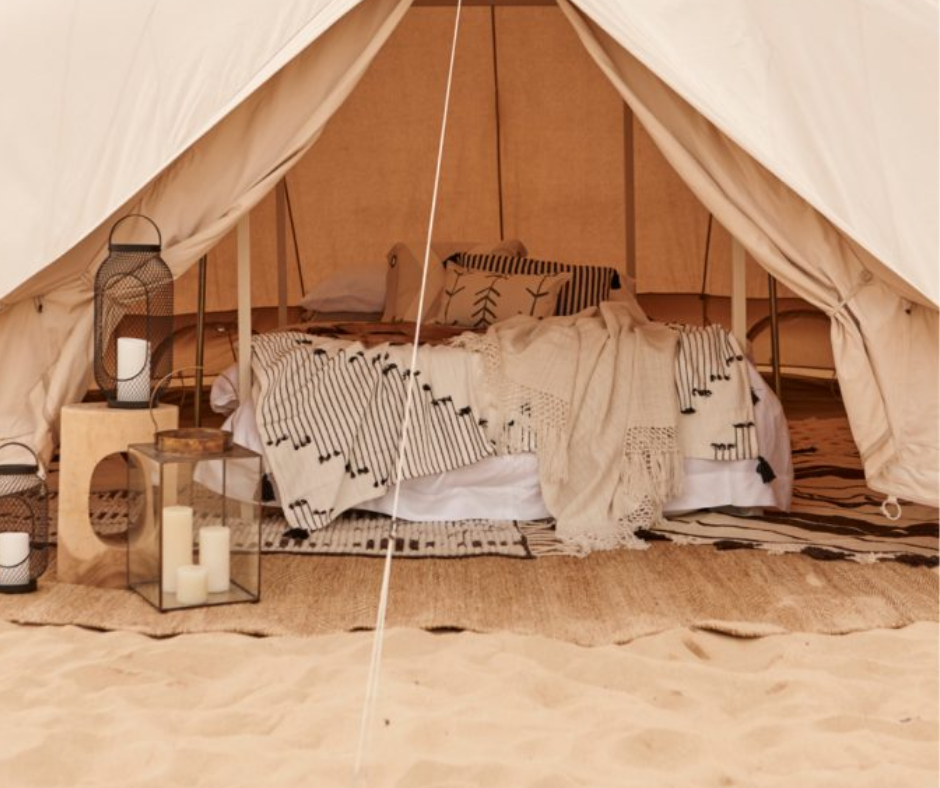
Comfort is measured in space, quiet and good service, not hotel fittings: a canvas tent with a proper bed, a cook who makes dinner on site, and a guide who knows the ground. Algerian camps are fewer and less polished than the big luxury camps around Merzouga in Morocco, and the dunes are far emptier.
The main reason to glamp in Algeria is location. The tent goes up inside the Tassili n'Ajjer or right where the Grand Erg Occidental begins, so the sand starts at your doorstep instead of an hour's drive from a town hotel.
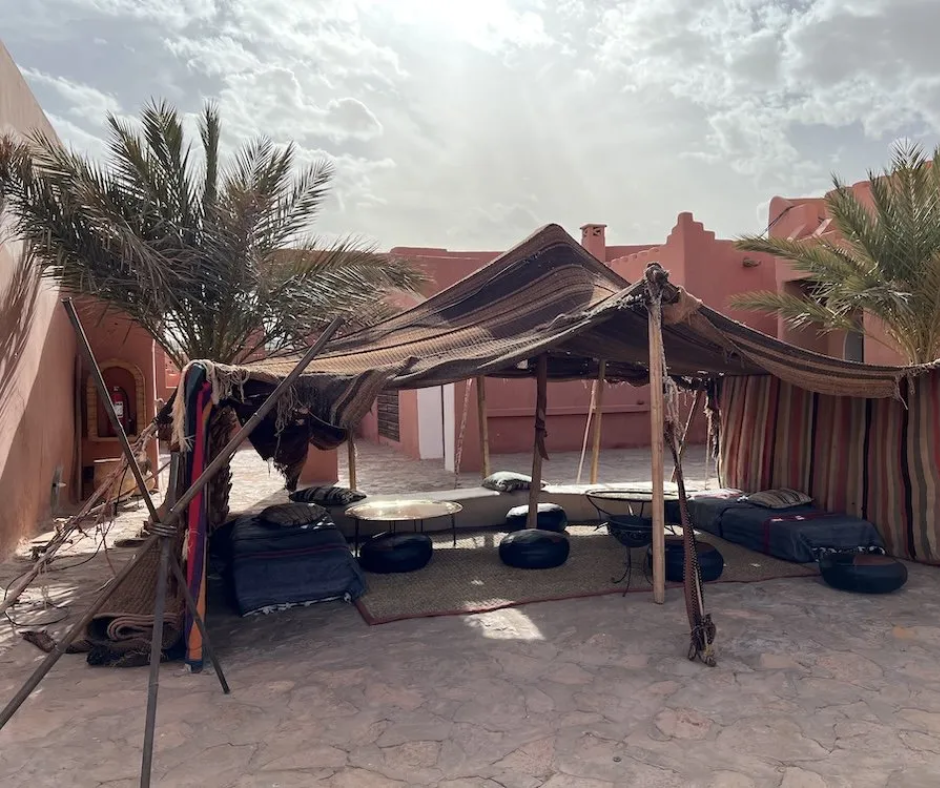
The options fall into two types. Fixed camps sit on the edge of a town, with huts (in Djanet often zeribas, built from palm fronds in the nomad style) or permanent tents, a dining tent, shared or private bathrooms and usually electricity. Taghit and Djanet both have several.
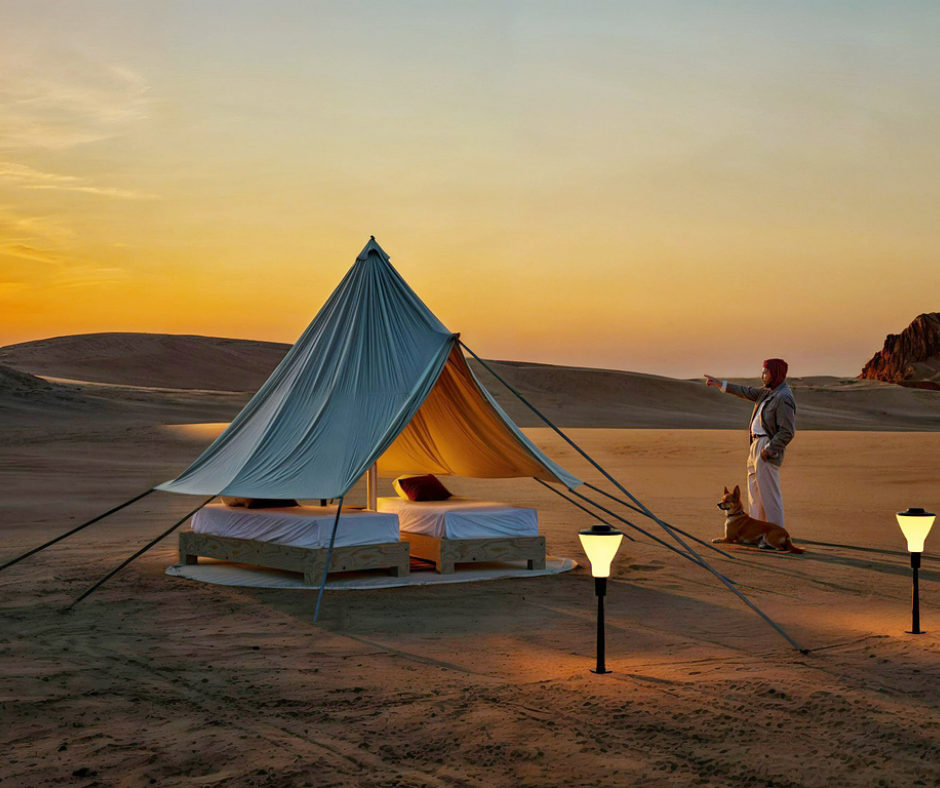
Mobile bivouacs travel with you: the crew drives ahead in the 4x4s, pitches camp somewhere new each evening and cooks dinner, and that is the only way to sleep deep in the Tassili or the Tadrart Rouge. Since late 2024 a few agencies in Djanet have also run seasonal "deluxe" tented camps among the Tikoubaouine rocks, with two-person tents, hotel-style bedding, solar power and separate toilet and shower tents.
Algeria desert camps compared
| Option | Where | Sleeping | Bathroom | Power | Best for |
|---|---|---|---|---|---|
| Fixed camp | Djanet, Taghit, Timimoun | Zeriba huts or permanent tents with real beds | Shared or private | Usually | Two or three nights with day trips |
| Mobile bivouac | Tassili, Tadrart, Hoggar | Tents pitched in a new spot each night, mattresses and blankets | Toilet tent; bucket shower on better trips | Car socket only | Rock art and the deep desert |
| Seasonal deluxe camp | Near Djanet | Two-person tents with hotel-style bedding | Separate toilet and shower tents | Solar | Comfort inside the Tassili |
| Desert hotel | Taghit (for example Bladi Palace), Timimoun | Hotel rooms | Private | Mains | En-suite comfort every night |
Camps change from season to season, so ask your agency which one you'll stay in and for recent photos of the tents and washrooms.
Top Regions for a Luxury Desert Stay
Where you go matters more than which camp you pick. Djanet is about rock towers and rock art, Taghit about tall dunes, Timimoun about red mud architecture and oasis gardens. Our full Sahara travel guide goes into each region in more depth, permits and seasons included.
Djanet and the Tassili n'Ajjer
Djanet is the oasis town in Algeria's far southeast where Tassili n'Ajjer trips begin. The plateau is famous for its "forests of rock", wind-cut sandstone towers standing in orange sand. UNESCO listed it in 1982, and the camps and bivouacs around Djanet mostly sit inside the park or just outside its edge. Our Tassili n'Ajjer guide covers the rock art and the trekking routes.
You spend the days walking between painted shelters. The plateau holds more than 15,000 paintings and engravings by UNESCO's count, and the main styles run from around 10,000 BC to the first centuries AD.
Nights are spent under the cliffs or out on the dunes of the Erg Admer. Black rock against orange sand is the signature view of this corner of the Sahara. Leave flints and potsherds where they lie, as taking antiquities out of Algeria can mean prison.
Taghit and the Great Western Erg
If you picture the Sahara as rolling sand dunes, go to Taghit. Algerians often call it the pearl of the Saoura: a palm oasis on the Oued Zousfana, about 95 km by road from Béchar, where the Grand Erg Occidental begins. The dunes rise straight up on the far side of the palm grove from the old town.
Most places to stay are a short walk from the sand, so you can climb a dune for sunrise before breakfast. The old ksar, a mud-brick village under the rocky hills on the other side of the valley, is worth an hour, and there are Neolithic rock engravings nearby at sites such as Barrebi. Comfort in Taghit means fixed places: options include the Bladi Palace hotel and the fixed camps looking onto the big dune.
Timimoun and the Red Oasis
Timimoun, in the Gourara region, is called the Red Oasis for the ochre-red mud walls of its buildings. A stay here is less about dunes and more about oasis life, including the foggaras, underground channels that still carry water to the palm gardens.
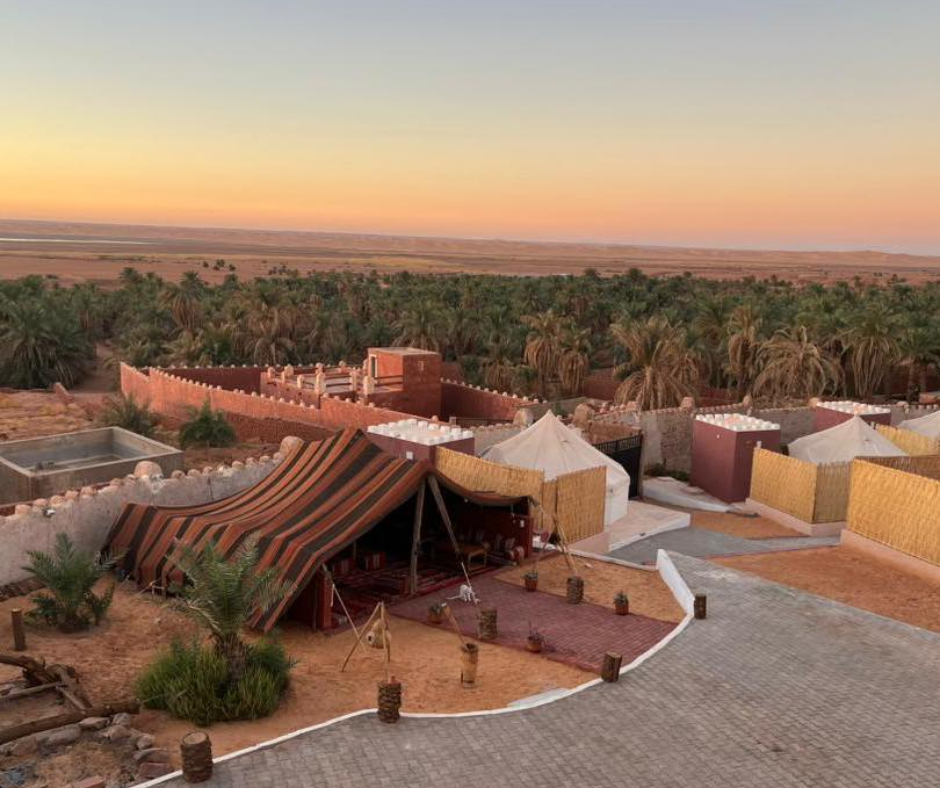
Camps around Timimoun usually sit near the sebkha, the large salt flat below the town, or in the palm groves. Pick it if Saharan architecture and village life interest you more than sleeping out in the dunes. More on the old ksar and the salt lake sunsets is in our guide to visiting Timimoun.
What to Expect Inside Your Desert Tent
Setups vary a lot between operators, so ask for photos of the actual tent. In a good camp you get heavy canvas walls that keep the wind out, a real mattress on a raised frame, clean linen and several thick wool blankets. You'll need them: on clear winter nights the temperature can drop close to freezing.
Meals and tea happen in a large communal tent or hut, with rugs on the floor and low tables. Fixed camps and hotels, especially in Taghit, can offer private bathrooms.
Mobile bivouacs share a toilet tent and, on better-equipped trips, a shower tent where the crew heats water for a bucket shower. On basic trips it is a basin and wet wipes, so ask before you book. If you are happy with fewer comforts, our notes on classic desert camping in Algeria cover the traditional bivouac.
Practical Logistics for Your Algeria Trip
Algeria takes more preparation than Morocco or Tunisia: a visa arranged in advance, domestic flights that change schedule, and an approved agency for any trip into the deep south. In return, the camps and rock-art sites are nearly empty compared with Morocco's desert.
What sets a Djanet camp apart is the setting and the people who run it: Tuareg crews who grew up around the Tassili, sandstone towers outside the tent and no other camp in sight. Guests often tell us the south felt more welcoming and relaxed than they had expected from what they read at home, and we only use camps and routes we have used for years.
A licensed Algerian agency runs every deep-south trip for foreign visitors, and where the authorities put a police or gendarmerie escort on a route, the agency sorts that out too. When you book, look up the current official travel advice for the area you're heading to and make sure your insurance covers a desert trip there.
The Sahara visa on arrival
A visa from an Algerian consulate, arranged before you fly, is the norm for most Western travelers. Glamping trips can use an easier route, the Sahara visa on arrival, which covers 24 southern wilayas, including Djanet, Béchar (for Taghit) and Timimoun. The catch is that an approved Algerian agency has to book your tour and file the request; the fee is paid when you land, commonly about EUR 110 in 2026.
Both routes, with the documents each one needs, are explained in Algeria Visa: Requirements and Visa on Arrival.
Flights to Djanet, Timimoun and Béchar
From Algiers, Air Algérie serves Djanet, Timimoun and Béchar (the airport for Taghit), and in the Saharan season it has also run direct flights from Paris CDG to Djanet. Southern schedules change at short notice and seats go fast in the high season, so book domestic flights early and keep a buffer night in Algiers at the start or end of the trip. Then comes the road: about 30 km from the airstrip into Djanet, and about 95 km of road from Béchar to Taghit.
Your camp or agency will normally meet you at the airport with a 4x4. If you are traveling overland instead, the M'Zab Valley makes a natural stop on the way south.
What to Pack for a Sahara Camp
Pack in layers. The midday sun is strong even in winter, and the nights are cold.
For the day, wear light, long sleeves and long pants against the sun and blowing sand, a wide-brimmed hat and good sunglasses. A cheche, the long Tuareg headscarf, keeps dust out of your nose and mouth in a sandstorm; buy one locally and your guide will show you how to wrap it.
For the evenings, bring a thermal base layer and a light down jacket, even in October and April. Wear broken-in boots on the rocky Tassili trails, and pack a large power bank, as camp solar power is limited.
Activities Beyond the Campfire
The camp is a base; the days are spent out. Follow your hosts' lead: Tuareg crews around Djanet, local Saharan guides around Taghit and Timimoun.
Camel Trekking and 4x4 Exploration
The 4x4s cover the long distances between sites, but a camel sets a slower, quieter pace. A two-hour camel ride at sunset is the easiest way to hear how silent the Sahara is, and it is simple to arrange in Taghit and Djanet.
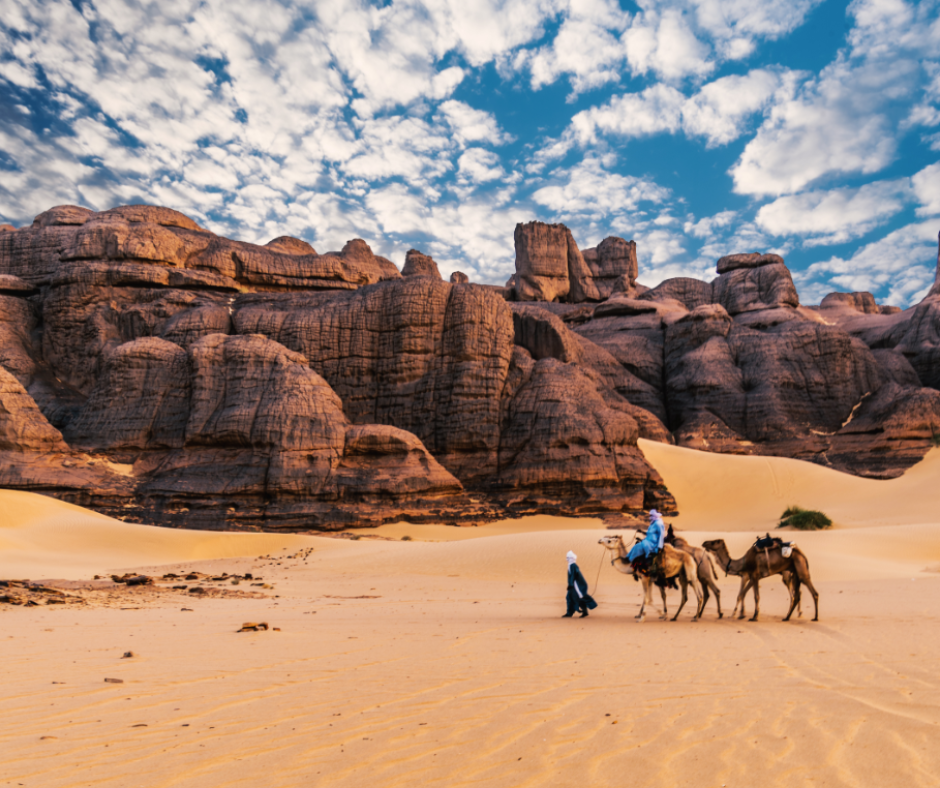
On longer trips the 4x4s reach remote canyons and gueltas, rock pools that hold water long after the rains. The Essendilène canyon near Djanet is the classic example.
Tuareg Tea and Desert Bread
Tea is at the center of Saharan hospitality. The Tuareg way is three small glasses brewed from the same leaves, so the first is the strongest and most bitter and the later ones lighter and sweeter; a common saying matches them to life, love and death. Expect a round after meals and at most stops. It is the easiest time to talk with your guides.
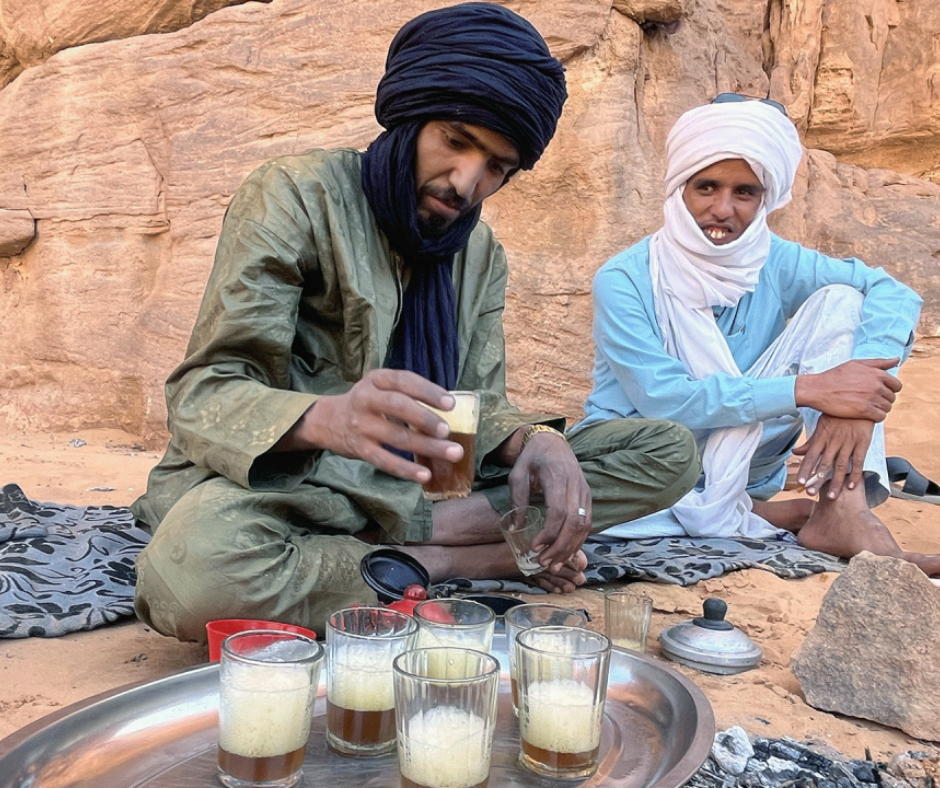
Around Djanet you may also see taguella made: a flat Tuareg bread baked under the sand and embers of the fire, then broken into a sauce. Ask the crew if they will make it.
Stargazing in the Deep Desert
Away from the towns the Sahara sky is very dark, and on a moonless night the Milky Way is a clear band overhead. Plan around the moon: a full moon washes out most of the stars, so check the lunar calendar before you fix your dates. A few operators bring a telescope, but the naked eye is plenty.
Download a star map app that works offline before you leave, as most camps have no phone signal.
Choosing the Best Time to Visit
The season runs from October to April. October, November, March and April have warm days for walking.
December and January are colder, with nights close to freezing, but the long, dry nights are good for stars. From May to September the heat (average highs of 36 to 38°C in Djanet, with peaks above 40°C) makes walking dangerous and turns any tent into an oven, and few camps operate. For a first trip we'd pick November or March.
How much does glamping in Algeria cost?
Prices depend on how far into the desert you sleep. A fixed camp near Taghit or Djanet is the cheapest way to wake up in the sand, while a mobile bivouac pays for the 4x4, driver, guide and cook every day. These are typical 2026 ranges.
| Item | What we see people pay (2026) |
|---|---|
| Simple fixed camp, per night | About EUR 15 to 35 |
| Mobile bivouac trip with 4x4, guide and cook, per person per day | About EUR 85 to 140 (two to four travelers) |
| Visa on arrival | Commonly about EUR 110 |
| Crew tips, per traveler per day | 1,500 to 2,000 DZD, about EUR 5.50 to 7.30 informal or EUR 10 to 13 official |
Tips are pooled and given at the end of the trip. Exchange rates are autumn 2026: about 275 DZD to the euro with cash changed informally, about 150 at the official rate.
How many nights should you stay?
In Taghit, two nights is the minimum: one for sunset from the big dune, one for sunrise, and a morning in the old ksar. Give Timimoun two or three nights for the ksar, the foggaras and the salt flat. Around Djanet, plan on five to seven nights. The Tadrart Rouge is most of a day's drive each way, and the painted sites on the Tassili plateau take three or four days on foot.
Choosing a Glamping Operator
Ask exactly what the price includes. A good package covers airport transfers, all meals, drinking water, park fees and a local guide, plus the paperwork for the visa on arrival if you use it. Ask what is not included, such as tips, drinks or an extra night in Algiers, and bring cash for it, as the south runs almost entirely on cash. Ask how the camp handles power and waste too: the better ones use solar and carry their rubbish out.
Toilets, power, cold nights and the Morocco question
Is it real glamping, or camping with a nicer name?
Real beds, dining tents and better washrooms, yes, at fixed camps near Djanet and Taghit and at a few seasonal deluxe camps near Djanet, though there are fewer of them and they're simpler than Morocco's luxury camps.
Will there be a shower?
At fixed camps and desert hotels, yes, sometimes private. On a mobile bivouac it depends on the crew: better-equipped trips heat water for a bucket shower, basic ones give you a basin and wet wipes, so ask before you book.
Can I charge my phone and get online?
Charging, usually. Fixed camps run on the grid or solar panels, and on mobile trips you charge from the car's 12V socket while driving. Getting online is another matter: there's no wifi in the dunes and usually no phone signal either, so download maps, music and a star map app before you leave town.
How cold are the nights in December?
Close to freezing on clear nights in December and January, even after a warm day. October, November, March and April nights are cool rather than cold. A good camp gives you several thick blankets, but bring a thermal layer, a down jacket and a warm hat.
I loved Merzouga. Why come to Algeria instead?
For the emptiness. Merzouga has far more camps, more polish and easier access; Algeria has fewer, simpler ones, but you sleep among Tassili rock art or under the Taghit dunes with almost no one else around, at the price of a visa, a domestic flight and an approved agency.
Glamping gets you the deep desert and a good night's sleep. The plumbing stays basic, extras are paid in cash, and an agency runs the logistics. If you want en-suite comfort every night, base yourself in a Taghit hotel and spend the days in the dunes. Either way, we can arrange it: the camp, local guides, cooks and drivers, the airport pickup and, through a licensed partner agency, the visa on arrival.
For a ready-made itinerary, see A 6-Day Escape into the Tadrart Rouge.
Or From Casbahs to Canyons: A Journey Through East & South‑East Algeria.


